


























Views
Downloads
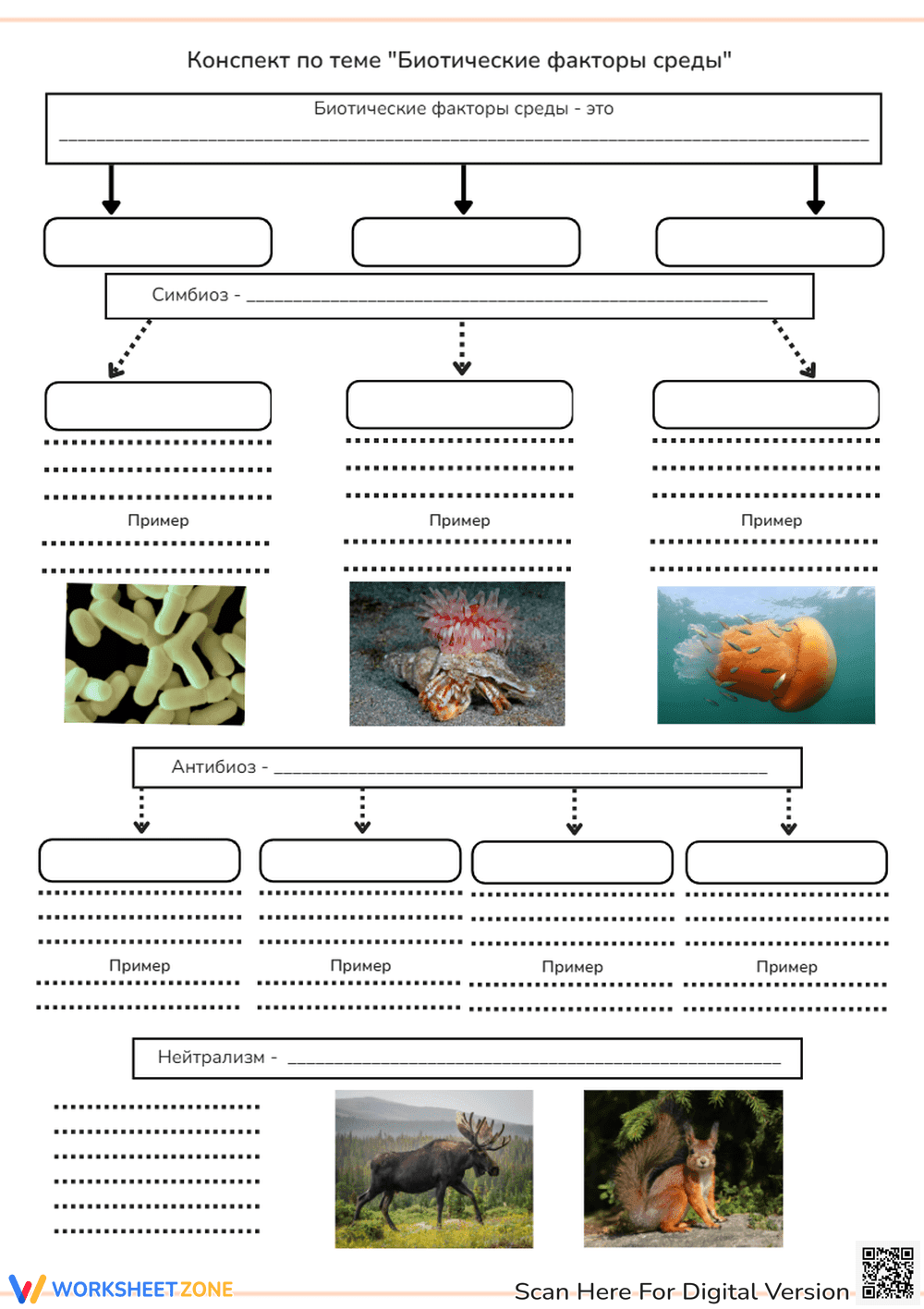

Grade 11 Biotic Factors — Printable No-Prep Worksheet
Paste this activity's link or code into your existing LMS (Google Classroom, Canvas, Teams, Schoology, Moodle, etc.).
Students can open and work on the activity right away, with no student login required.
You'll still be able to track student progress and results from your teacher account.
This Grade 11 biology worksheet helps students map out complex ecological relationships by categorizing biotic factors. Using a structured graphic organizer, learners define key interactions like symbiosis, antibiosis, and neutralism, while providing real-world examples for each. This visual approach clarifies how organisms interact within an ecosystem.
At a Glance
- Grade: 11 · Subject: Biology
- Standard:
HS-LS2-6— Evaluate complex interactions in ecosystems- Skill Focus: Categorizing ecological relationships
- Format: 1 page · 12 problems · PDF
- Best For: Independent practice or review
- Time: 15–20 minutes
Inside this single-page resource, educators will find a comprehensive concept map designed to organize student thinking about environmental factors. The layout features 12 distinct fill-in-the-blank sections where students define overarching terms and break them down into specific sub-categories. Visual cues, including images of bacteria and marine life, prompt students to connect abstract concepts with concrete examples. The structured format ensures students capture definitions and examples in one document.
This resource is designed for immediate classroom implementation:
- Print (1 minute): Generate copies of the single-page PDF for the entire class without worrying about complex formatting or multi-page stapling.
- Distribute (1 minute): Hand out the graphic organizer as students enter the room for an immediate bell-ringer or transition activity.
- Review (3 minutes): Quickly project the document on a smartboard to guide students through the expected definitions and examples.
Total teacher preparation requires under two minutes, making this an ideal, reliable option for emergency sub plans or rapid lesson adjustments.
This activity aligns with HS-LS2-6: Evaluate the claims, evidence, and reasoning that the complex interactions in ecosystems maintain relatively consistent numbers and types of organisms in stable conditions. By categorizing symbiotic and antagonistic relationships, students build the foundational vocabulary necessary to analyze these complex ecosystem dynamics. Both standard codes can be copied directly into lesson plans, IEP goals, or district curriculum mapping tools.
Deploy this graphic organizer during direct instruction as a guided note-taking tool. As the teacher introduces species interactions, students fill in the corresponding branches, ensuring active engagement. Alternatively, use it as a formative assessment after a lecture. Teachers can observe whether students correctly differentiate between mutualism and parasitism within the symbiosis branch. Expected completion time ranges from 15 to 20 minutes.
This worksheet is primarily designed for high school biology students mastering ecology units. The visual structure provides excellent scaffolding for visual learners and English Language Learners who benefit from organizing vocabulary spatially rather than in linear paragraphs. It pairs perfectly with an introductory slide deck on community ecology or a textbook chapter detailing predator-prey and symbiotic relationships.
Understanding ecological relationships requires structured vocabulary acquisition and conceptual mapping. This resource targets HS-LS2-6, helping students evaluate complex interactions in ecosystems by categorizing biotic factors into clear, logical frameworks. According to Fisher & Frey (2014), utilizing graphic organizers during vocabulary instruction significantly improves student retention of domain-specific terminology by visually representing the hierarchical relationships between concepts. By requiring students to define terms like antibiosis and neutralism while simultaneously providing concrete biological examples, this worksheet bridges the gap between abstract ecological theory and observable natural phenomena. The structured format reduces cognitive load, allowing learners to focus on the nuances of species interactions rather than formatting their notes. This targeted practice ensures students build the robust ecological schema necessary for advanced biological analysis and environmental science applications.


