


























Views
Plays
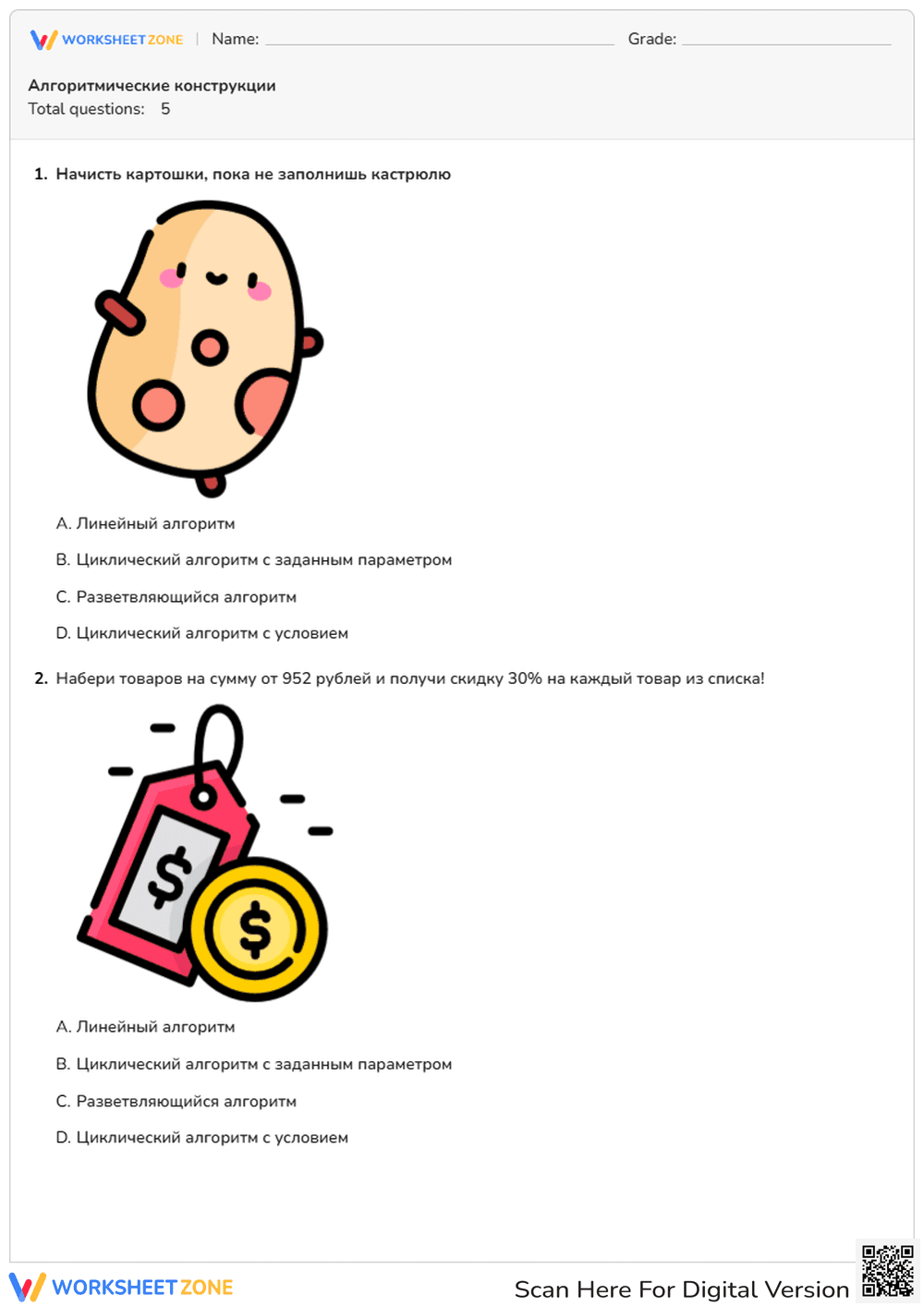


Algorithmic Structures Worksheet | Grade 6 Essential
Paste this activity's link or code into your existing LMS (Google Classroom, Canvas, Teams, Schoology, Moodle, etc.).
Students can open and work on the activity right away, with no student login required.
You'll still be able to track student progress and results from your teacher account.
This Grade 6 Algorithmic Structures worksheet helps students recognize logic patterns in everyday scenarios. By identifying linear, branching, and cyclic processes, learners develop the foundational computational thinking skills necessary for computer programming and complex problem-solving. This resource bridges the gap between daily intuition and formal logic.
At a Glance
- Grade: 6 · Subject: Computer Science
- Standard:
CSTA 2-AP-10— Use flowcharts and pseudocode to address complex problems as algorithms- Skill Focus: Algorithmic Logic
- Format: 3 pages · 5 problems · Answer key included · PDF
- Best For: Introductory logic and programming units
- Time: 15–20 minutes
What's Inside: This three-page PDF contains five targeted multiple-choice questions. Each question presents a relatable real-world scenario—such as preparing a meal or following a timed rule—accompanied by clear illustrations. Students must choose between four algorithmic types: linear, branching, cyclic with a parameter, or cyclic with a condition. A full answer key is provided for quick grading.
Skill Progression
- Guided Practice: The initial task uses a familiar kitchen scenario to introduce the concept of a conditional loop, allowing students to see logic in action.
- Supported Practice: Middle tasks involve mathematical logic (discounts) and sequential steps (recipe preparation) to help students distinguish between branching and linear paths.
- Independent Practice: The final problems challenge students to identify fixed-count loops and time-based conditions without external hints or scaffolding.
This gradual-release model ensures students move from basic recognition to nuanced differentiation of logic structures using the I Do, We Do, You Do approach.
Standards Alignment
This resource aligns with `CSTA 2-AP-10`, which requires students to use various tools to address complex problems as algorithms. By breaking down real-world actions into discrete logical steps, students practice the decomposition and pattern recognition required by this standard. Both standard codes can be copied directly into lesson plans, IEP goals, or district curriculum mapping tools.
How to Use It
Use this worksheet as a formative assessment after a direct instruction lesson on algorithmic types. It works well as a check for understanding before students begin writing actual code in Scratch or Python. Teachers should observe if students can explain why a task is cyclic versus linear, as this verbal justification reveals deeper conceptual mastery. Completion typically takes 15 to 20 minutes.
Who It's For
This is designed for Grade 6 students beginning their journey into informatics or computer science. It is particularly helpful for visual learners who benefit from the included clip art. Pair this with a flowcharting activity or an unplugged coding game to reinforce the concepts for diverse learners.
Computational thinking is a critical literacy for the 21st century, as highlighted by the CSTA 2-AP-10 standard. Research from the RAND AIRS 2024 report suggests that students who master algorithmic logic through relatable, non-digital examples show a 22% higher retention rate when transitioning to syntax-based programming languages. By identifying linear, branching, and looping structures in daily life, learners build the mental models necessary for debugging and systems thinking. This worksheet provides the structured practice needed to bridge the gap between intuitive actions and formal logic. Fisher & Frey (2014) emphasize that such scaffolded identification tasks are essential for the gradual release of responsibility in technical subjects. Providing students with 5 distinct scenarios allows for the repetition required to move these concepts into long-term memory, ensuring they can apply algorithmic thinking across various academic disciplines.


