


























Views
Downloads

Science Valentine Puns | Grade 6-12 Printable Essential
Paste this activity's link or code into your existing LMS (Google Classroom, Canvas, Teams, Schoology, Moodle, etc.).
Students can open and work on the activity right away, with no student login required.
You'll still be able to track student progress and results from your teacher account.
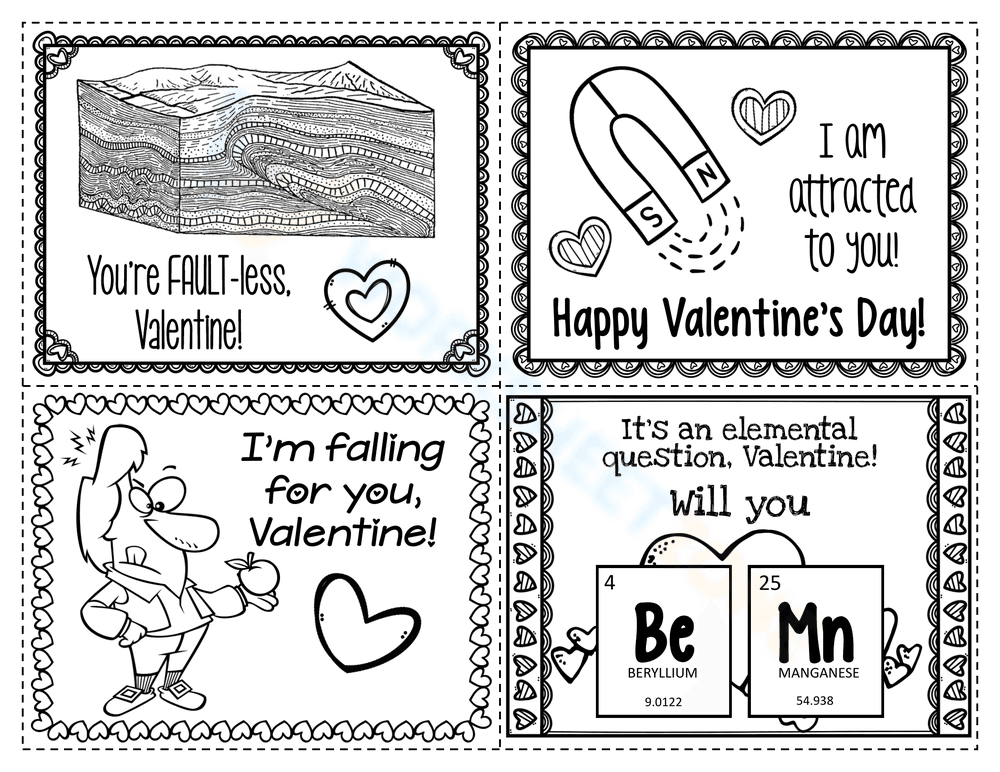
This Grade 6-12 science Valentine's Day worksheet provides students with four unique, pun-filled cards that reinforce core scientific vocabulary through humor and visual cues. By connecting complex concepts like fault lines and magnetic attraction to seasonal themes, students demonstrate their understanding of domain-specific terminology in a creative, low-stress format that encourages engagement with STEM topics.
At a Glance
- Grade: 6-12 · Subject: Science
- Standard:
MS-PS2-3— Ask questions about data to determine the factors that affect magnetic force strength- Skill Focus: Science Vocabulary & Puns
- Format: 1 page · 4 problems · Answer key included · PDF
- Best For: Seasonal Science Bell Ringer
- Time: 10–15 minutes
The resource consists of a single printable page containing four distinct Valentine's Day cards. Each card features a hand-drawn illustration and a science-themed pun covering Earth Science (faults), Physics (magnetism and gravity), and Chemistry (periodic table elements Beryllium and Manganese). The black-and-white design allows for student customization and coloring, while the clear dashed lines facilitate easy cutting and distribution for classroom exchange.
The zero-prep workflow for this resource is designed for maximum efficiency during busy seasonal transitions. First, print the single-page PDF in under 30 seconds. Second, distribute the sheet to students or have them cut the four individual cards along the dashed lines in about 1 minute. Third, allow students to color the illustrations and identify the scientific concept behind each pun, such as magnetism or plate tectonics. Total teacher preparation time is under 2 minutes, making this an ideal sub plan addition.
This resource aligns with MS-PS2-3, which requires students to understand the nature of magnetic forces and interactions. Additionally, it supports Earth Science standards regarding tectonic plate boundaries and Chemistry standards involving the interpretation of the Periodic Table of Elements. Both standard codes can be copied directly into lesson plans, IEP goals, or district curriculum mapping tools to ensure compliance with state and national frameworks.
Use these cards as a formative assessment exit ticket where students must explain the scientific principle behind one of the puns before leaving class. Alternatively, assign them as a creative extension after a unit on forces or plate tectonics. Completion typically takes 10 to 15 minutes, providing a perfect buffer during shortened holiday schedules or as a reward for finishing a lab early.
This worksheet is designed for middle and high school science students who have been introduced to basic concepts in physics, chemistry, and geology. It is particularly effective for English Language Learners (ELLs) as it uses visual puns to bridge the gap between technical vocabulary and everyday language. Pair this with a periodic table anchor chart or a tectonic plate map for additional instructional support.
According to Fisher & Frey (2014), the use of non-linguistic representations and wordplay in secondary science classrooms significantly enhances vocabulary retention and conceptual retrieval. This worksheet leverages the MS-PS2-3 standard by requiring students to recognize the underlying physical principles of magnetism and plate tectonics within a humorous context. Research from the RAND AIRS 2024 report suggests that integrating seasonal, low-stakes activities into rigorous STEM curricula helps mitigate student burnout while reinforcing domain-specific terminology. By connecting abstract concepts like fault lines and periodic table symbols to social-emotional exchanges, educators provide a cognitive bridge that aids in long-term memory consolidation. This resource serves as a formative tool for assessing student familiarity with core scientific metaphors, ensuring that learners can distinguish between literal and figurative applications of technical language across multiple disciplines including chemistry, physics, and earth science.


