




























Views
Downloads

Relationship Vision Worksheet | Essential Social Skills

Paste this activity's link or code into your existing LMS (Google Classroom, Canvas, Teams, Schoology, Moodle, etc.).
Students can open and work on the activity right away, with no student login required.
You'll still be able to track student progress and results from your teacher account.
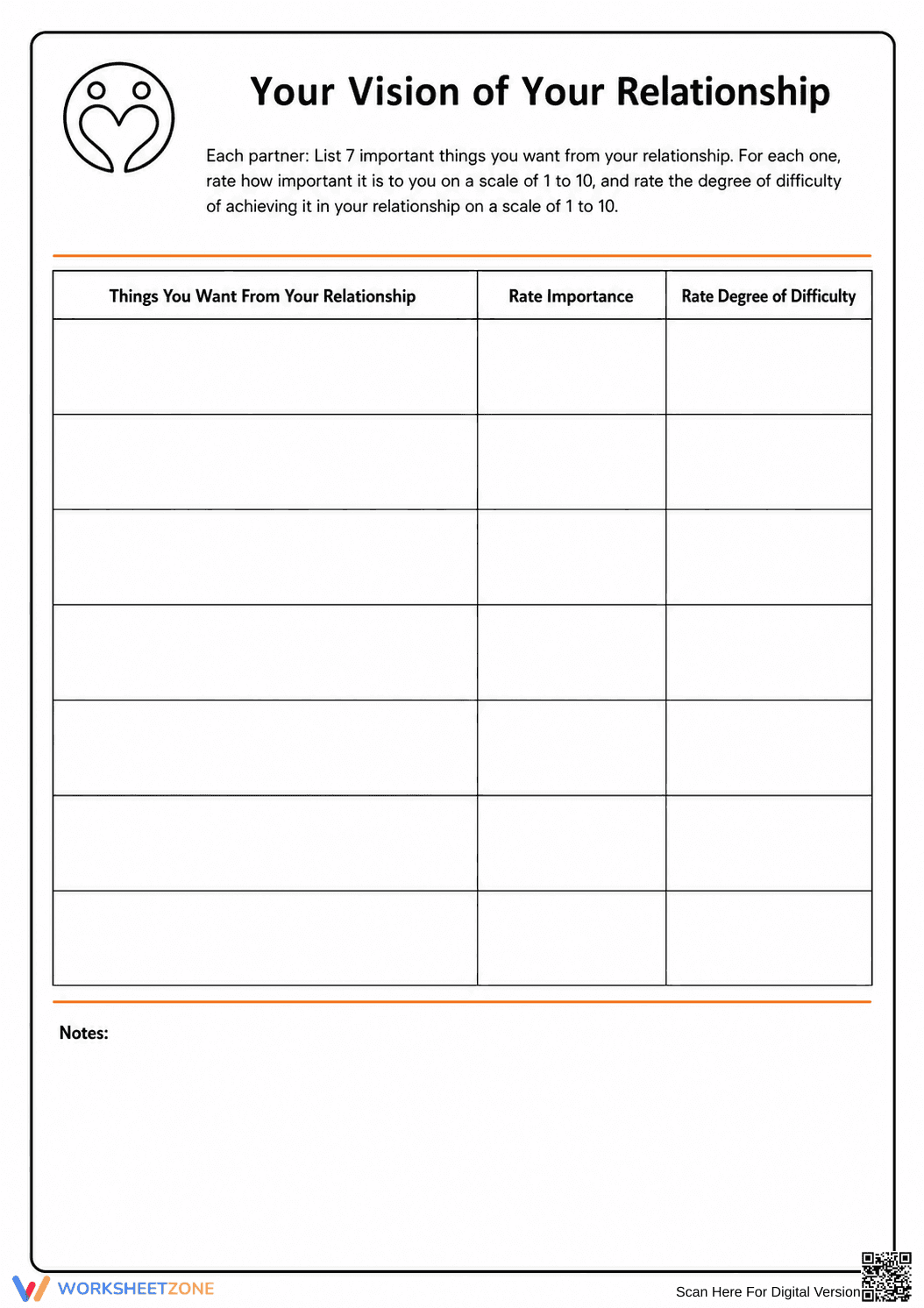
This relationship vision worksheet empowers adults and Grade 12 students to articulate personal expectations and desires within a partnership. By identifying specific needs and quantifying their importance, users develop the self-awareness necessary for healthy interpersonal communication. It serves as a structured tool for fostering transparency and mutual understanding in long-term commitments.
At a Glance
- Grade: 12 · Subject: Social Skills
- Standard:
CCSS.ELA-LITERACY.SL.11-12.1— Initiate and participate effectively in a range of collaborative discussions- Skill Focus: Relationship Communication
- Format: 1 page · 14 tasks · Self-reflection · PDF
- Best For: Adult social skills and counseling
- Time: 15–20 minutes
The resource features a clean, single-page layout centered on a 7-row analysis table. Each row prompts the user to list a specific relationship desire, followed by two numerical rating scales (1-10) for importance and perceived difficulty. A dedicated notes section at the footer allows for summarizing insights or recording action steps after a partner discussion.
The workflow is designed for immediate implementation in counseling or classroom settings. First, print the single-page PDF (30 seconds). Second, distribute to individuals or couples for independent reflection (10-15 minutes). Third, facilitate a review or partner exchange to compare ratings and identify alignment gaps (5 minutes). Total teacher preparation time is under 2 minutes, making it an ideal sub plan or supplemental activity.
This worksheet aligns with `CCSS.ELA-LITERACY.SL.11-12.1`, which requires students to initiate and participate effectively in collaborative discussions, building on others' ideas and expressing their own clearly and persuasively. It supports social-emotional learning by providing a framework for civil, evidence-based dialogue regarding personal values. Both standard codes can be copied directly into lesson plans, IEP goals, or district curriculum mapping tools.
Use this as a formative assessment during a unit on interpersonal communication or as a reflection activity for adult learners. Instructors should observe how students prioritize their needs versus the perceived difficulty of achieving them. Completion typically takes 15 to 20 minutes, making it an ideal warm-up for deeper group discussions on conflict resolution and partnership dynamics.
This is designed for Grade 12 students, college-aged adults, and individuals in relationship counseling. It is particularly effective for learners who benefit from structured writing frames to organize complex emotions. Pair this with a communication styles anchor chart or a reading passage on active listening for a comprehensive social skills lesson.
According to research by Fisher & Frey (2014), structured scaffolds like this relationship vision worksheet are vital for helping learners transition from internal reflection to external collaborative dialogue. By utilizing the CCSS.ELA-LITERACY.SL.11-12.1 framework, the tool ensures that students are not just listing preferences but are preparing for the high-level interpersonal negotiation required in adult life. The 14-task structure provides enough data points for meaningful analysis without overwhelming the user. This approach aligns with the RAND AIRS 2024 findings that emphasize the importance of self-regulation and social awareness in post-secondary success. Educators can use this printable to bridge the gap between abstract social concepts and concrete, actionable communication strategies. It remains a staple for practitioners focusing on adult social skills and behavioral health interventions.


