


























Views
Downloads

Printable Confidence Drawing Worksheet | Grade 1
Paste this activity's link or code into your existing LMS (Google Classroom, Canvas, Teams, Schoology, Moodle, etc.).
Students can open and work on the activity right away, with no student login required.
You'll still be able to track student progress and results from your teacher account.
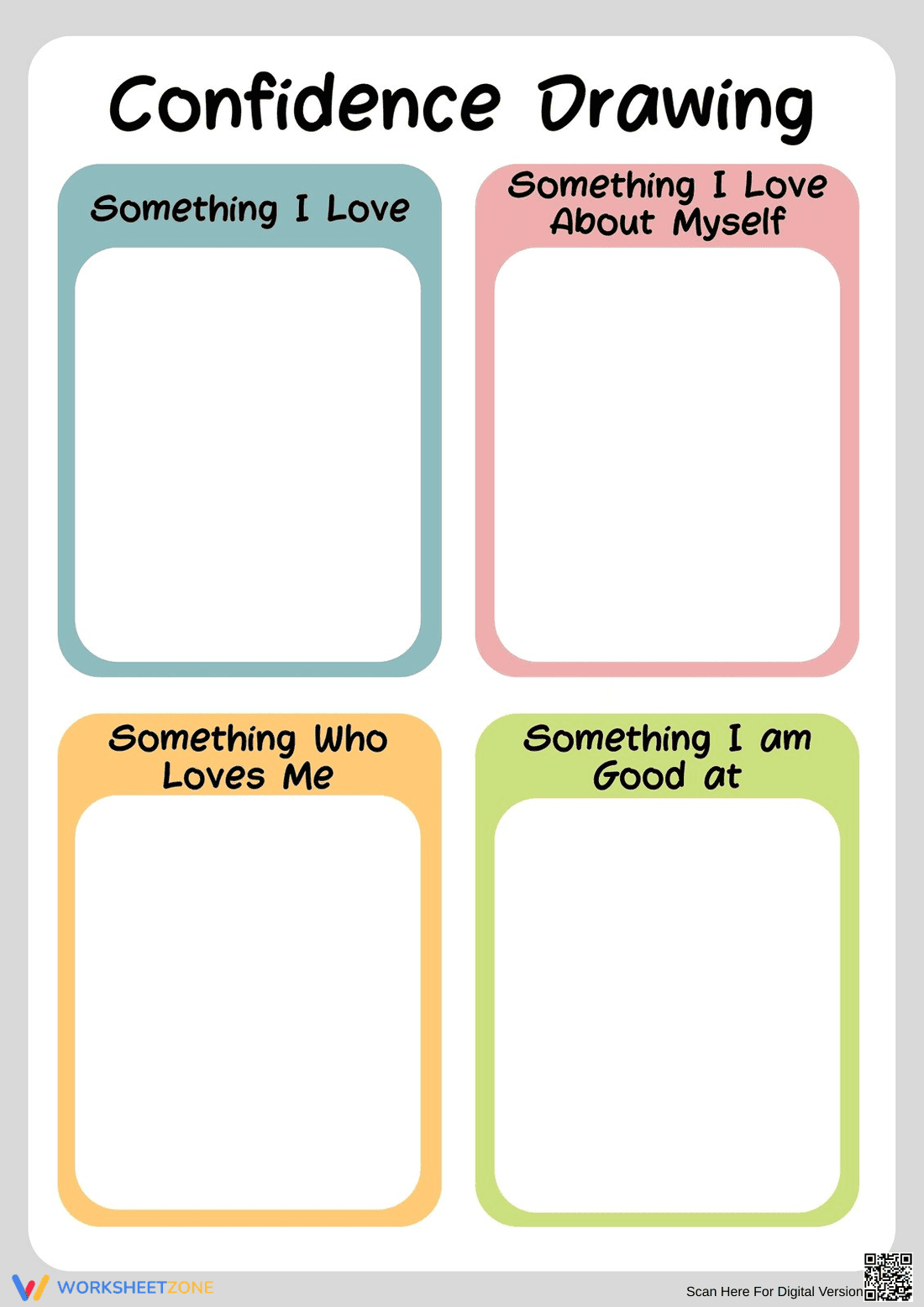
This Grade 1 social-emotional learning worksheet helps students build self-awareness and self-esteem through guided visual expression. By completing four specific drawing prompts about their personal strengths and support systems, young learners develop confidence while practicing fine motor skills. The activity provides a safe space for personal reflection.
At a Glance
- Grade: 1 · Subject: SEL
- Standard:
CCSS.ELA-LITERACY.SL.1.5— Add drawings or visual displays to descriptions to clarify thoughts and feelings.- Skill Focus: Self-awareness and confidence
- Format: 1 printable page · 4 drawing tasks · No answer key needed · PDF
- Best For: Morning work or SEL blocks
- Time: 15–20 minutes
This single-page printable features four distinct, color-coded drawing boxes designed to prompt positive self-reflection. Students illustrate "Something I Love," "Something I Love About Myself," "Someone Who Loves Me," and "Something I am Good at." The open-ended format allows children to express themselves creatively without the pressure of right or wrong answers, making it ideal for early elementary classrooms focusing on emotional development.
This resource is designed for immediate classroom implementation with a zero-prep workflow.
- Print (1 minute): Simply download the PDF and print a class set.
- Distribute (1 minute): Hand out the sheets along with crayons, markers, or colored pencils. No additional teacher setup or complex instruction is required.
- Review (3 minutes): Allow students to share one of their drawings with a partner or the class to reinforce positive self-talk.
Total teacher preparation time is under two minutes, making this an excellent, reliable option for emergency sub plans or unexpected schedule changes.
This activity aligns with CCSS.ELA-LITERACY.SL.1.5: "Add drawings or other visual displays to descriptions when appropriate to clarify ideas, thoughts, and feelings." It also supports core CASEL competencies related to self-awareness by encouraging students to identify their personal traits and support networks. Both standard codes can be copied directly into lesson plans, IEP goals, or district curriculum mapping tools.
Teachers can utilize this worksheet during morning meetings to set a positive tone, or as a calming transition activity after recess. It works well before direct instruction on community building. As students draw, teachers can conduct formative assessments by observing which prompts children complete quickly versus those they struggle with, offering insights into self-esteem levels. Expected completion time is 15 to 20 minutes.
This resource is designed for first-grade students, though it is highly adaptable for kindergarten and second-grade classrooms. It serves as an excellent differentiation tool for English Language Learners who may find visual expression more accessible than written responses. Pair this worksheet naturally with a read-aloud book about self-confidence or a classroom anchor chart.
Integrating visual arts into social-emotional learning provides critical pathways for young students to articulate complex internal states. According to a recent EdReports 2024 analysis on early childhood development, structured drawing prompts significantly increase a child's ability to identify personal strengths and emotional support systems. This worksheet directly addresses CCSS.ELA-LITERACY.SL.1.5 by requiring students to add drawings to descriptions to clarify thoughts and feelings. By engaging in this targeted self-awareness activity, learners build the foundational confidence necessary for academic risk-taking and peer collaboration. The four distinct prompts guide children through a systematic reflection process, moving from external interests to internal validation. Utilizing such evidence-based, reflective practices in the primary grades establishes a resilient classroom culture where students feel valued and understood. When children visually map their support networks and personal talents, they develop a stronger, more resilient self-concept that carries over into all areas of their educational journey.


