


























Views
Downloads
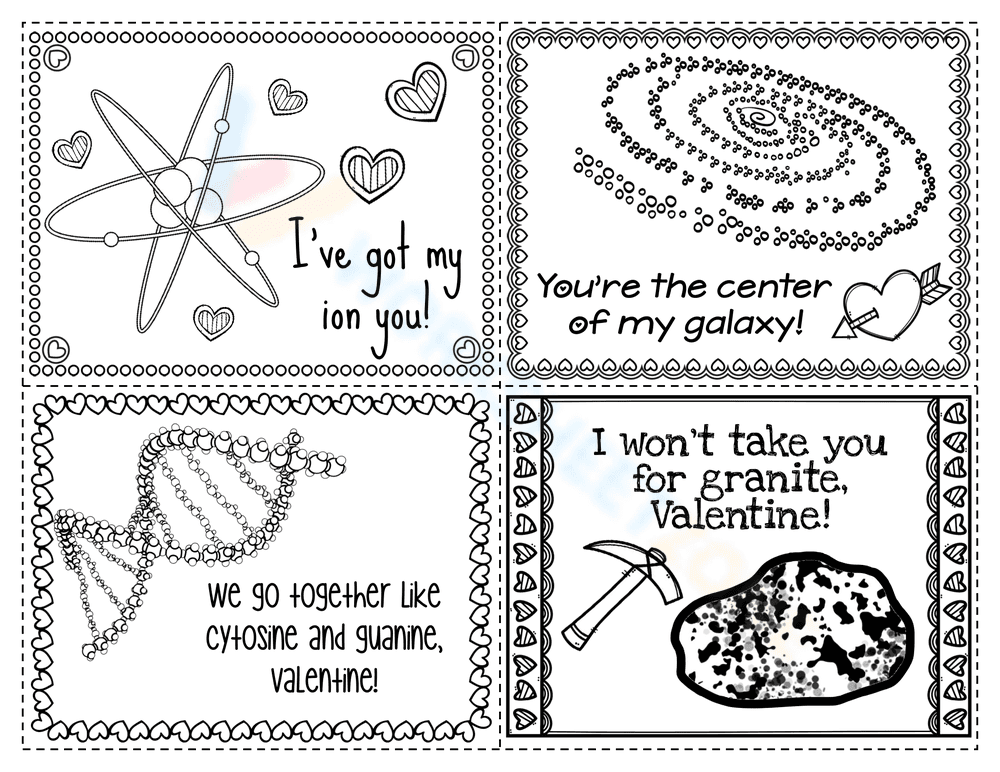

Science Valentine Puns Printable | Grade 6-12 Essential
Paste this activity's link or code into your existing LMS (Google Classroom, Canvas, Teams, Schoology, Moodle, etc.).
Students can open and work on the activity right away, with no student login required.
You'll still be able to track student progress and results from your teacher account.
This Grade 6-12 science Valentine puns worksheet provides a creative way for students to engage with complex scientific vocabulary through humor. By connecting core concepts in chemistry, biology, and geology to seasonal wordplay, students reinforce their understanding of terminology while participating in a lighthearted classroom tradition. It is an ideal resource for secondary science teachers.
At a Glance
- Grade: 6-12 · Subject: Science
- Standard:
MS-PS1-1— Develop models to describe the atomic composition of simple molecules and structures- Skill Focus: Science vocabulary and wordplay
- Format: 1 page · 4 cards · Answer key included · PDF
- Best For: Seasonal science warm-ups and early finishers
- Time: 10–15 minutes
The resource contains one high-quality page featuring four distinct Valentine’s Day cards. Each card highlights a different scientific discipline: chemistry (ions), astronomy (galaxies), biology (DNA base pairs), and geology (igneous rocks). The clean, black-and-white design allows for student customization and coloring, making it a versatile addition to any middle or high school science curriculum. No additional materials are required beyond standard coloring supplies.
This resource follows a zero-prep workflow designed for busy educators. First, print the single-page PDF for your entire class, which takes approximately 30 seconds. Second, provide students with scissors to cut along the dashed lines, a task requiring about 1 minute. Finally, distribute the cards for students to personalize and exchange. The total teacher preparation time is under 2 minutes, making this an excellent option for sub plans or last-minute holiday activities.
The primary alignment for this activity is `MS-PS1-1`, as students must recognize the concept of ions and atomic structure to understand the wordplay. Additionally, it supports `L.6.5`, which focuses on understanding figurative language, word relationships, and nuances in word meanings. Both standard codes can be copied directly into lesson plans, IEP goals, or district curriculum mapping tools.
Use this worksheet as a bell-ringer activity on February 14th to immediately engage students as they enter the room. Alternatively, set up a "Science of Love" station where students must explain the scientific principle behind each pun before they can color the card. This provides a quick formative assessment of their ability to recall vocabulary from previous units. Expected completion time is 10 to 15 minutes.
This activity is designed for secondary students in grades 6 through 12 who have been introduced to basic concepts in physical and life sciences. It is particularly effective for English Language Learners who benefit from visual cues and linguistic puns to solidify their grasp of academic vocabulary. Pair this with a short review of the periodic table or a DNA structure anchor chart for maximum impact.
According to Fisher & Frey (2014), the use of non-traditional texts and wordplay in the secondary classroom significantly enhances disciplinary literacy by lowering the affective filter and encouraging students to manipulate complex vocabulary in novel contexts. This printable worksheet leverages this pedagogical approach by utilizing four specific science puns that align with MS-PS1-1 and MS-LS3-1 standards. By identifying the underlying scientific principles behind the 'ion' and 'cytosine' jokes, students demonstrate a deeper conceptual grasp than through rote memorization alone. Research indicates that students who engage with humorous content in STEM subjects report higher levels of interest and better long-term retention of specific terminology. This resource provides a structured yet flexible way to integrate these findings into a standard lesson plan, ensuring that the seasonal activity remains academically rigorous while fostering a positive classroom culture. The standard code MS-PS1-1 can be directly integrated into curriculum maps.


