


























Views
Downloads

Essential Syllabication Worksheet | Grade 8-10 ELA
Paste this activity's link or code into your existing LMS (Google Classroom, Canvas, Teams, Schoology, Moodle, etc.).
Students can open and work on the activity right away, with no student login required.
You'll still be able to track student progress and results from your teacher account.
This Grade 8 English Language Arts worksheet focuses on the critical skill of syllabication, helping students master word construction and pronunciation. By arranging isolated syllables into coherent academic words, learners improve decoding efficiency and morphological awareness. This targeted practice ensures students can confidently approach multisyllabic vocabulary in complex texts, directly supporting reading fluency and spelling accuracy.
At a Glance
- Grade: 8 · Subject: English Language Arts
- Standard:
L.8.4.B— Use word parts as clues to the meaning and pronunciation of words- Skill Focus: Multisyllabic Word Construction
- Format: 1 page · 6 problems · Answer key included · PDF
- Best For: Daily warm-ups and vocabulary intervention
- Time: 10–15 minutes
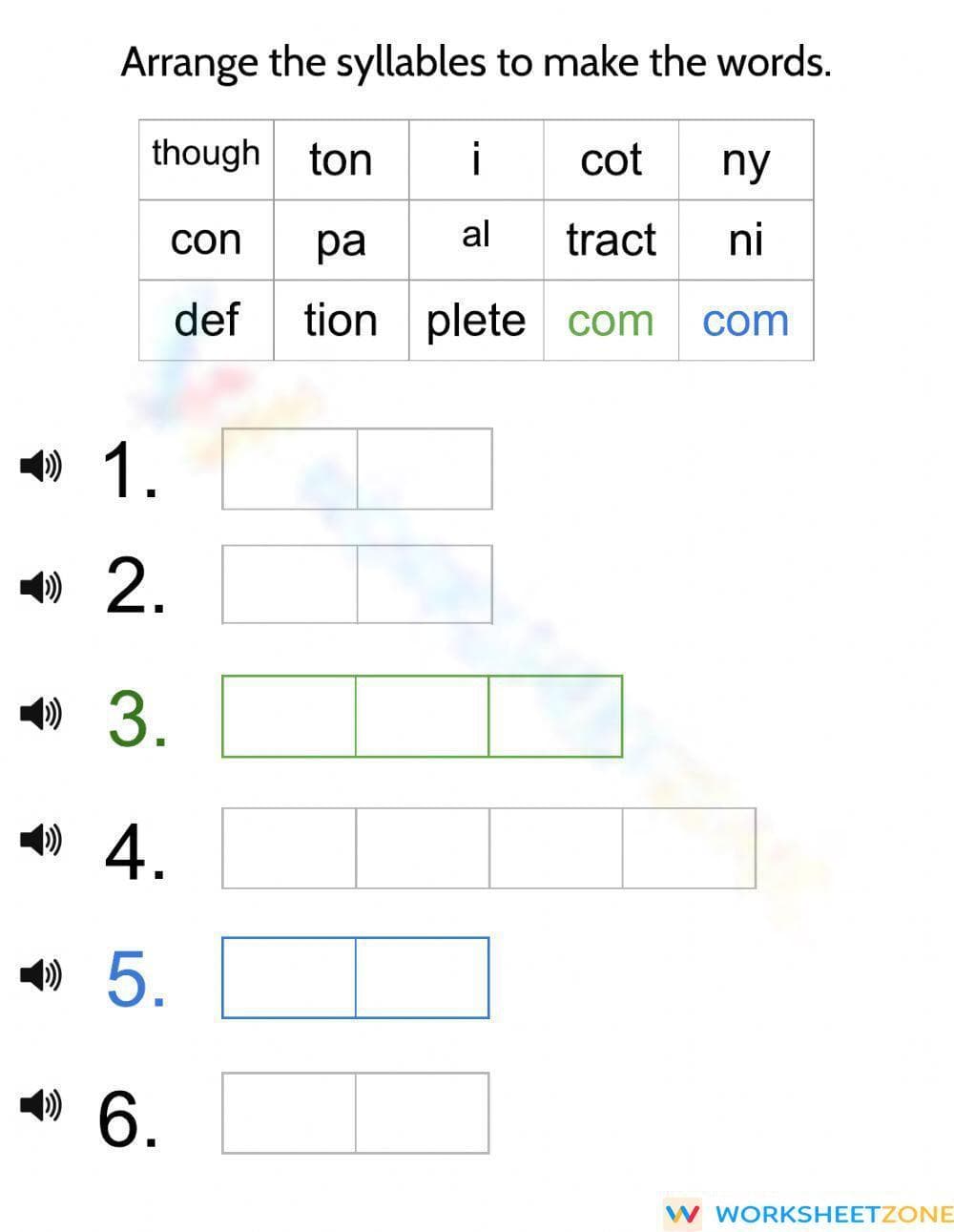
Inside this printable resource, students are presented with a word bank containing fifteen distinct syllables. Below the bank, six numbered tasks feature visual boxes representing the specific syllable counts for each target word, ranging from two to four syllables. The layout includes audio icons to support multi-modal learning, making it an excellent tool for both standard classrooms and English Language Learner (ELL) environments. A comprehensive answer key is provided to facilitate quick grading and immediate student feedback.
The worksheet follows a structured skill progression designed to build student confidence. Guided Practice begins with two-syllable words. In Supported Practice, the complexity increases to three and four-syllable constructions like "definition," requiring higher-level phonological processing. Finally, Independent Practice is achieved as students utilize remaining syllables to complete the set without additional cues, mirroring the gradual release of responsibility model.
This resource is strictly aligned to the `L.8.4.B` standard, which requires students to use common, grade-appropriate roots and affixes as clues to word meaning. By breaking words like "complete" and "contract" into their constituent parts, students gain a functional understanding of how English words are built. Both standard codes can be copied directly into lesson plans, IEP goals, or district curriculum mapping tools to ensure instructional compliance and academic rigor.
For optimal results, use this worksheet as a formative assessment during a vocabulary unit or as a bell-ringer activity to start an ELA block. Teachers should observe students as they cross out syllables in the word bank to track elimination strategies and identifying which phonemic blends cause the most hesitation. This 10-minute activity provides immediate data on student decoding skills, allowing for timely small-group intervention if common errors emerge during the word-building process.
This resource is designed for students in Grades 8, 9, and 10 who require reinforcement in phonics and word structure. It is particularly effective for students with IEPs focusing on reading fluency or ELL students mastering English pronunciation. We recommend pairing this resource with a vocabulary anchor chart or a digital pronunciation guide to provide a comprehensive literacy experience that bridges the gap between spelling and spoken language.
The CCSS.ELA-LITERACY.L.8.4.B standard emphasizes using word parts to determine meaning and improve pronunciation accuracy in secondary education. This syllabication worksheet provides a focused environment for students to decode multisyllabic vocabulary like 'definition' and 'complete,' foundational for reading fluency. Research indicates direct instruction in morphological awareness and syllable structure significantly enhances a student's ability to tackle unfamiliar academic texts. By decomposing words into their constituent phonological units, learners build a bridge between simple recognition and deep linguistic comprehension. This resource acts as a critical scaffolding tool, moving students from guided syllable arrangement to independent vocabulary mastery. Educators can utilize these six targeted tasks to identify specific phonemic gaps, ensuring Grade 8 through 10 learners maintain the requisite decoding speed for high-school level informational texts and literary analysis.


