


























Views
Downloads

Essential Multisyllabic Word Practice | Grade 5-11 Ready
Paste this activity's link or code into your existing LMS (Google Classroom, Canvas, Teams, Schoology, Moodle, etc.).
Students can open and work on the activity right away, with no student login required.
You'll still be able to track student progress and results from your teacher account.
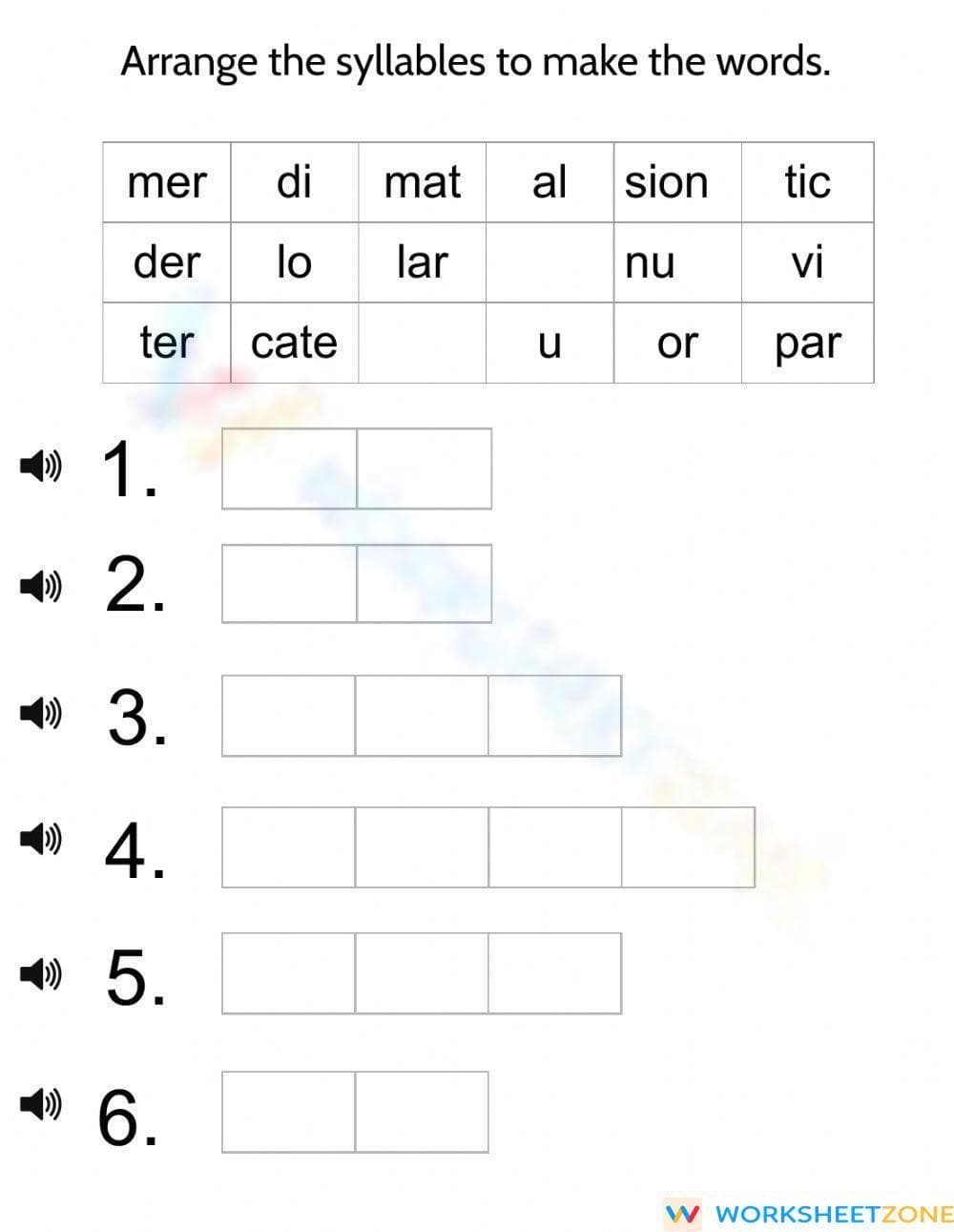
This Grade 5-11 multisyllabic word construction worksheet helps students master complex word structures by arranging syllables into correct sequences. By interacting with suffixes like -sion and -lar, learners strengthen their decoding and pronunciation abilities. This focused practice is designed to improve reading fluency and spelling accuracy for middle and high school students who need reinforcement in phonological awareness and academic vocabulary.
At a Glance
- Grade: 5–11 · Subject: ELA
- Standard:
CCSS.ELA-LITERACY.RF.5.3.A— Use syllabication patterns and morphology to read unfamiliar multisyllabic words accurately- Skill Focus: Multisyllabic Word Construction
- Format: 1 page · 6 problems · Answer key included · PDF
- Best For: Vocabulary reinforcement and phonetic decoding practice
- Time: 10–15 minutes
The PDF contains a single-page interactive layout featuring a bank of 16 specific syllables such as "mer," "sion," and "cate." Students must select and sequence these fragments into six designated word slots, ranging from two to four syllables in length. The worksheet includes clear numbering and structural boxes to guide the assembly of academic words like "particular" and "division," providing a visual framework for linguistic synthesis.
Zero-Prep Workflow
Teachers can implement this resource in under 2 minutes. Step 1: Print the PDF or open the interactive version (30 seconds). Step 2: Distribute to students for independent or small-group work (30 seconds). Step 3: Use the included answer key for rapid grading or student self-check (60 seconds). Its self-contained nature and intuitive design make it an ideal choice for emergency sub plans or quick literacy warm-up activities.
Standards Alignment
This resource is explicitly aligned to CCSS.ELA-LITERACY.RF.5.3.A, which requires students to use combined knowledge of letter-sound correspondences, syllabication patterns, and morphology to read unfamiliar multisyllabic words. By breaking down words into constituent parts, students apply morphological analysis to recognize complex patterns. This standard code can be copied directly into lesson plans, IEP goals, or district curriculum mapping tools.
How to Use It
Assign this worksheet during the "Independent Practice" phase of a vocabulary lesson to solidify understanding of word parts. It is particularly effective as a "Do Now" activity to activate phonological skills before a heavy reading session. Teachers should observe if students struggle with the 4-syllable word to identify specific gaps in complex decoding. Expect completion in 10–15 minutes depending on the instructional context.
Who It's For
Designed for students in Grades 5 through 11, this activity serves as an essential bridge for those struggling with multi-morphemic academic vocabulary. It provides excellent Tier 2 intervention support for English Language Learners and students with dyslexia who benefit from orthographic manipulation. Pair this resource with a Greek and Latin roots anchor chart to further enhance the morphological connection across the curriculum.
According to the RAND AIRS 2024 report, systematic instruction in multisyllabic word decoding is a critical predictor of reading comprehension success in adolescent learners. This worksheet addresses CCSS.ELA-LITERACY.RF.5.3.A by forcing students to mentally manipulate and synthesize phonemes and morphemes into recognizable lexemes. By focusing on high-frequency academic syllables like "sion" and "mat," the activity reduces cognitive load during reading by automating word recognition processes. Research from Fisher & Frey (2014) emphasizes that such word-building tasks are vital for transitioning from simple decoding to advanced academic literacy. This tool provides a structured, low-stakes environment for students to practice the morphological decomposition necessary for mastering Grade 5-11 level texts, ensuring that they can accurately pronounce and understand the structural logic of complex English vocabulary.


