


























Views
Downloads
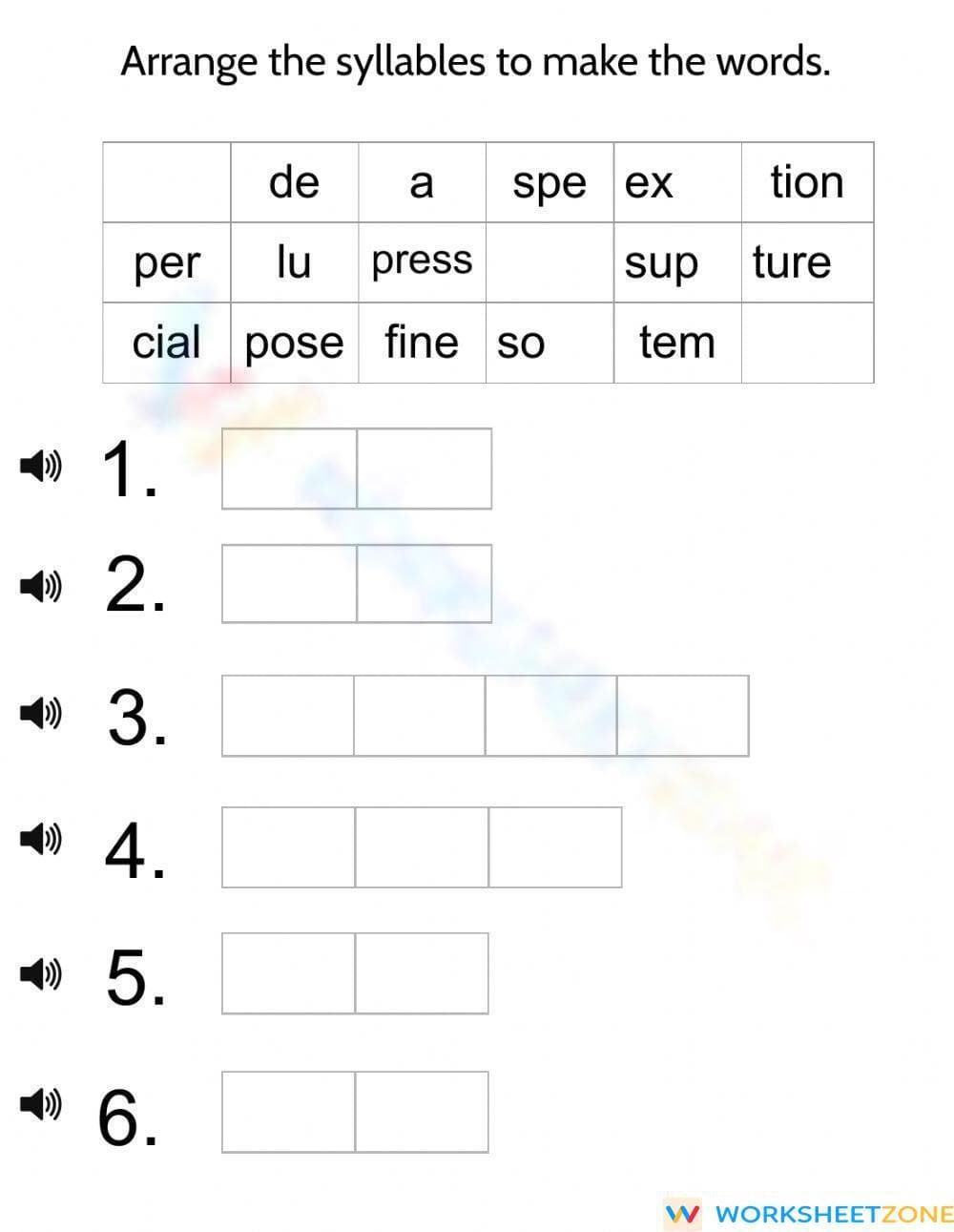

Essential Syllables Worksheet | Grade 5-11 ELA Aligned
Paste this activity's link or code into your existing LMS (Google Classroom, Canvas, Teams, Schoology, Moodle, etc.).
Students can open and work on the activity right away, with no student login required.
You'll still be able to track student progress and results from your teacher account.
Strengthen student vocabulary and decoding skills with this focused syllabication worksheet. Designed for upper elementary and middle school students, this resource requires learners to manipulate component syllables to construct high-frequency academic words. By engaging in the active assembly of words, students internalize spelling patterns and develop a deeper phonological awareness necessary for reading fluency and complex writing tasks.
At a Glance
- Grade: 5–11 · Subject: English Language Arts
- Standard:
CCSS.ELA-LITERACY.L.5.4— Use context clues and word parts to determine word meaning.- Skill Focus: Multisyllabic Word Construction
- Format: 1 page · 6 problems · Answer key included · PDF
- Best For: Vocabulary reinforcement and spelling intervention
- Time: 15–20 minutes
What's Inside
This single-page PDF features a comprehensive syllable bank containing 15 unique word parts, such as "de," "ex," "tion," and "press." Students must select the correct combinations to fill six distinct word frames. The layout includes visual boxes that indicate the number of syllables required for each target word, ranging from two to four syllables. Audio icons next to each task provide a cue for interactive or teacher-led pronunciation support.
Skill Progression
- Guided Practice: Students begin by reviewing the provided syllable bank to identify familiar prefixes and suffixes, establishing a baseline for word recognition.
- Supported Practice: Learners use the provided frames (2-syllable and 4-syllable boxes) to narrow down potential word combinations, reducing the cognitive load of open-ended spelling.
- Independent Practice: Students complete the 6-task set by verifying that each constructed word is phonetically and semantically correct within the English language.
This approach follows the gradual release of responsibility model, moving from identifying parts to independent construction.
Standards Alignment
The primary standard for this resource is `CCSS.ELA-LITERACY.L.5.4`, which focuses on determining the meaning of unknown words using Greek and Latin affixes and roots. By breaking words into syllables, students learn to recognize these meaningful units. This standard code can be copied directly into lesson plans, IEP goals, or district curriculum mapping tools.
How to Use It
This worksheet is ideal as a morning warm-up or a focused exit ticket following a lesson on word parts. During instruction, observe if students start with the final syllable (like "tion") or the initial syllable to gauge their decoding strategy. Most students can complete the entire set in 15 to 20 minutes, making it a perfect low-prep supplemental activity.
Who It's For
This resource is tailored for students in Grades 5 through 11, particularly those needing additional support with multisyllabic decoding or ELL students building academic vocabulary. It pairs naturally with a root word anchor chart or a reading passage containing high-level Tier 2 vocabulary words like "exposition" or "suppress."
According to the research conducted by Fisher & Frey (2014) on the importance of word study, the ability to decompose and recompose multisyllabic words is a critical bridge between basic phonics and advanced reading comprehension. This worksheet applies these principles by forcing students to interact with syllables as discrete, manageable units of meaning and sound. Aligned with CCSS.ELA-LITERACY.L.5.4, the activity targets the specific skill of word construction which is often a prerequisite for successful vocabulary acquisition in secondary education. By providing a finite set of syllables in a grid, the resource reduces the anxiety associated with spelling while still demanding rigorous cognitive processing to find the correct combinations. This systematic approach ensures that students are not just memorizing words, but are learning the structural logic of the English language. Such exercises are essential for preparing learners for the increased lexical demands of college and career readiness standards.


