




























Views
Downloads


Multiple Meaning Words Worksheet | Essential Grade K-1

Paste this activity's link or code into your existing LMS (Google Classroom, Canvas, Teams, Schoology, Moodle, etc.).
Students can open and work on the activity right away, with no student login required.
You'll still be able to track student progress and results from your teacher account.
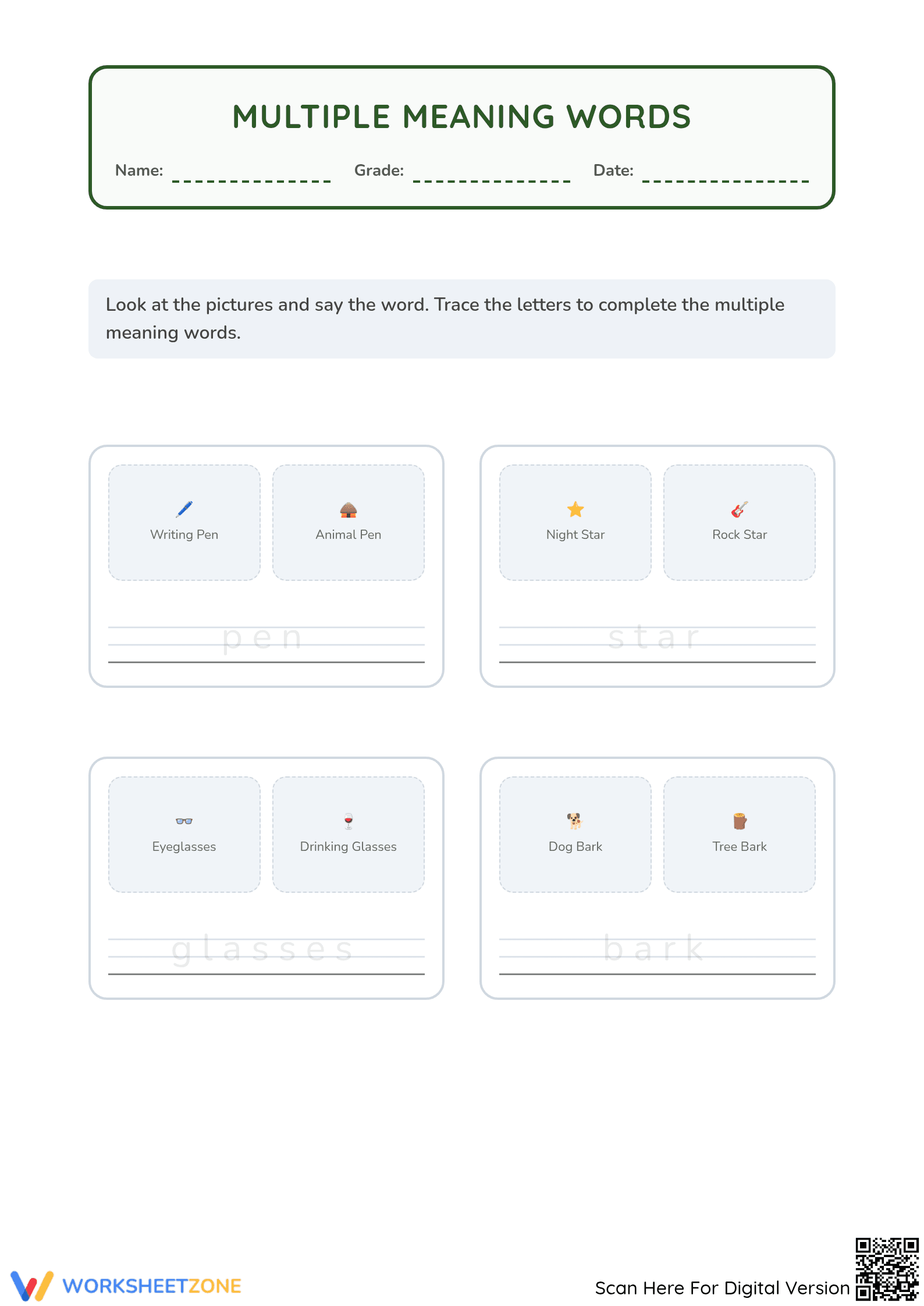
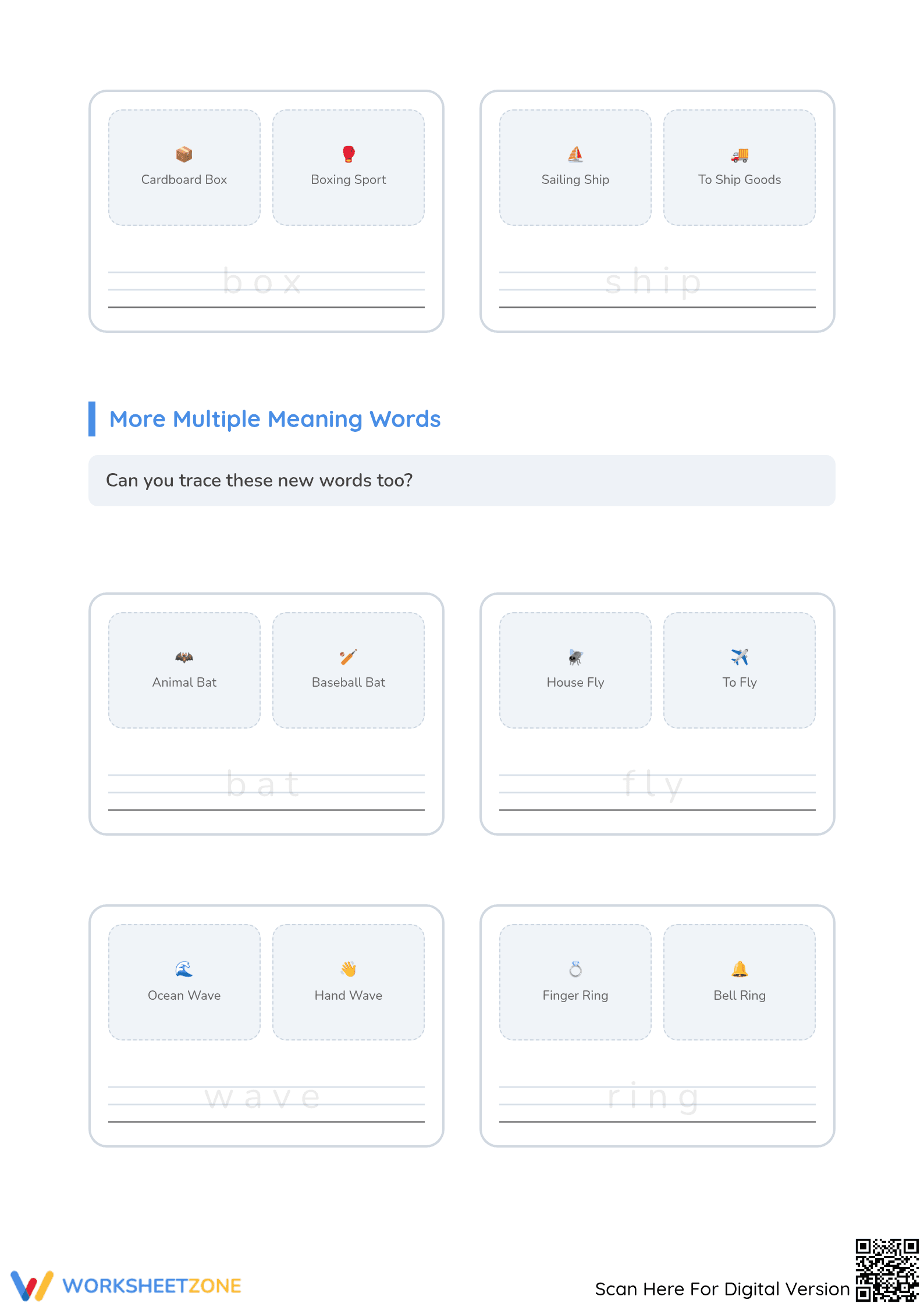
This Grade K-1 multiple meaning words worksheet helps early learners identify and understand homonyms through visual association and handwriting practice. By connecting a single word to two distinct illustrations, students develop a deeper grasp of vocabulary nuances and linguistic flexibility. This resource simplifies complex language concepts into manageable, visual tasks.
At a Glance
- Grade: Kindergarten · Subject: ELA
- Standard:
CCSS.ELA-LITERACY.L.K.4.A— Identify new meanings for familiar words and apply them accurately- Skill Focus: Homonyms and Tracing
- Format: 3 pages · 10 problems · Answer key included · PDF
- Best For: Independent literacy centers and vocabulary building
- Time: 15–20 minutes
What's Inside: The packet contains three pages of structured vocabulary practice. It features 10 unique homonym pairs, including common words like "pen," "star," "bark," and "fly." Each task provides two clear icons representing different meanings of the same word, followed by a dashed-line tracing area to reinforce spelling and fine motor skills. A complete answer key is provided for quick grading.
Zero-Prep Workflow: This resource is designed for immediate classroom implementation. Teachers can print the PDF in less than 30 seconds. Distribution takes approximately 1 minute, as the instructions are self-explanatory for young learners. Reviewing the completed work with the provided answer key takes under 1 minute per student, making it an ideal choice for busy mornings or emergency sub plans.
Standards Alignment: The primary focus is `CCSS.ELA-LITERACY.L.K.4.A`, which requires students to identify new meanings for familiar words. By seeing a "pen" as both a writing tool and an animal enclosure, students meet this rigorous foundational requirement. Both standard codes can be copied directly into lesson plans, IEP goals, or district curriculum mapping tools.
How to Use It: Assign this worksheet during a literacy rotation after a direct instruction lesson on homonyms. It serves as an excellent formative assessment to see if students can verbally explain the difference between the two pictures. Expected completion time is 15 to 20 minutes depending on the student's handwriting speed and fine motor development.
Who It's For: This resource is tailored for Kindergarten and Grade 1 students, as well as English Language Learners (ELLs) who benefit from visual aids to understand word polysemy. It pairs naturally with a classroom anchor chart showing common homonyms or a read-aloud of a picture book focused on wordplay and puns.
According to the RAND AIRS 2024 report on foundational literacy, visual-verbal pairing is a critical component in developing early semantic networks. This worksheet utilizes dual-coding theory by presenting a single lexical label alongside two distinct visual representations, which significantly improves retention in Grade K-1 learners. Research indicates that tracing exercises combined with vocabulary acquisition help bridge the gap between phonemic awareness and orthographic mapping. By focusing on the CCSS.ELA-LITERACY.L.K.4.A standard, this resource ensures that students are not just memorizing words but are understanding the flexible nature of the English language. This approach aligns with evidence-based practices for tiered vocabulary instruction, providing the necessary scaffolding for students to master multiple meaning words. The inclusion of 10 specific tasks allows for sufficient repetition to ensure mastery of the concept before moving to more complex linguistic structures.


