


























Views
Downloads

Multiple Meaning Words Worksheet | Printable Grade K ELA
Paste this activity's link or code into your existing LMS (Google Classroom, Canvas, Teams, Schoology, Moodle, etc.).
Students can open and work on the activity right away, with no student login required.
You'll still be able to track student progress and results from your teacher account.
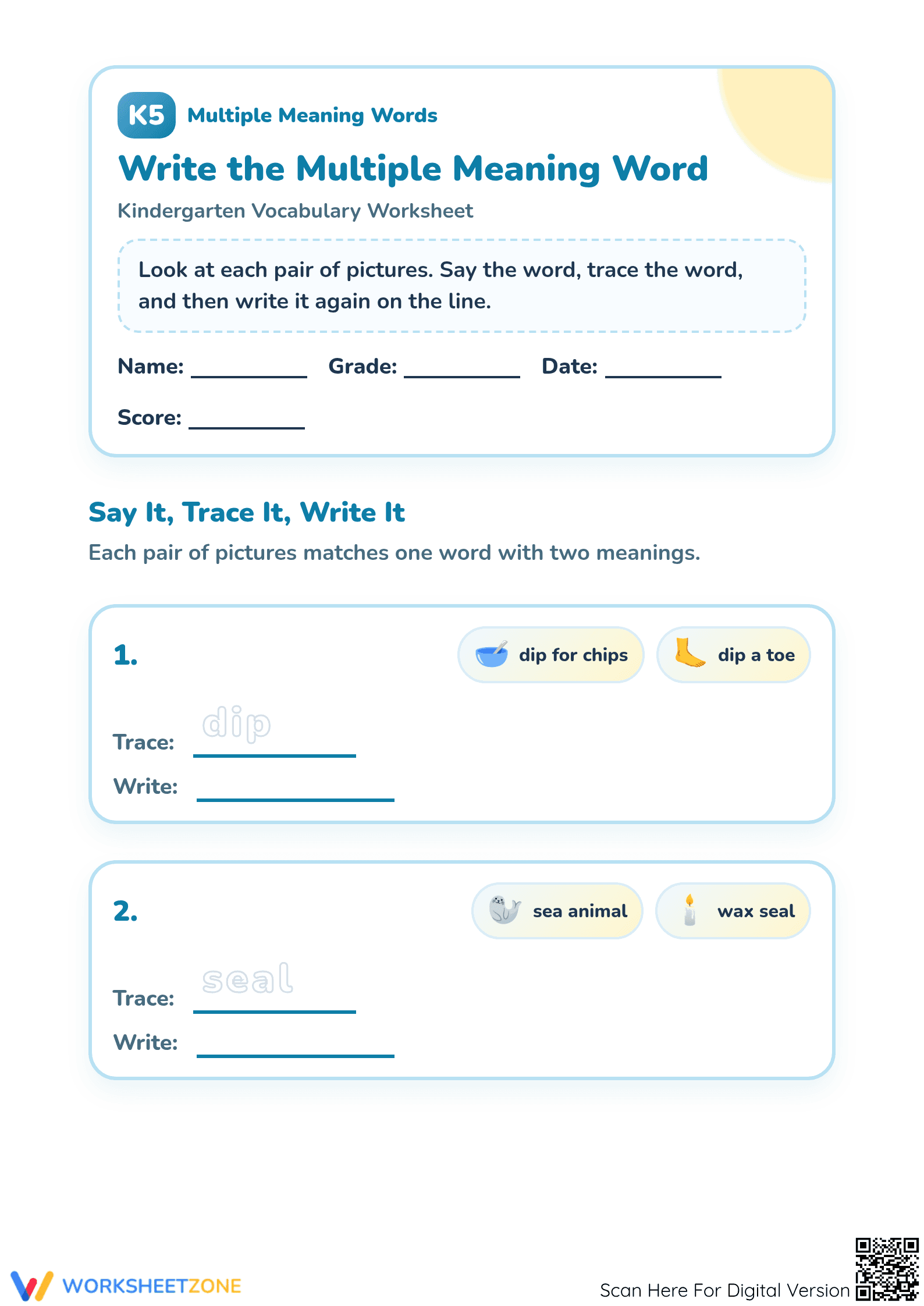
This Kindergarten vocabulary worksheet helps young learners master multiple meaning words through a "Say It, Trace It, Write It" approach. By connecting visual cues to common homonyms like "dip" and "seal," students build semantic flexibility. This resource ensures early readers can distinguish between different word meanings in context through structured practice.
At a Glance
- Grade: Kindergarten · Subject: ELA
- Standard:
L.K.4.A— Identify new meanings for familiar words and apply them accurately with visual support- Skill Focus: Homonyms (Multiple Meaning Words)
- Format: 2 pages · 6 problems · Answer key included · PDF
- Best For: Kindergarten literacy centers and independent student vocabulary development practice
- Time: 15–20 minutes of instructional time
What's Inside
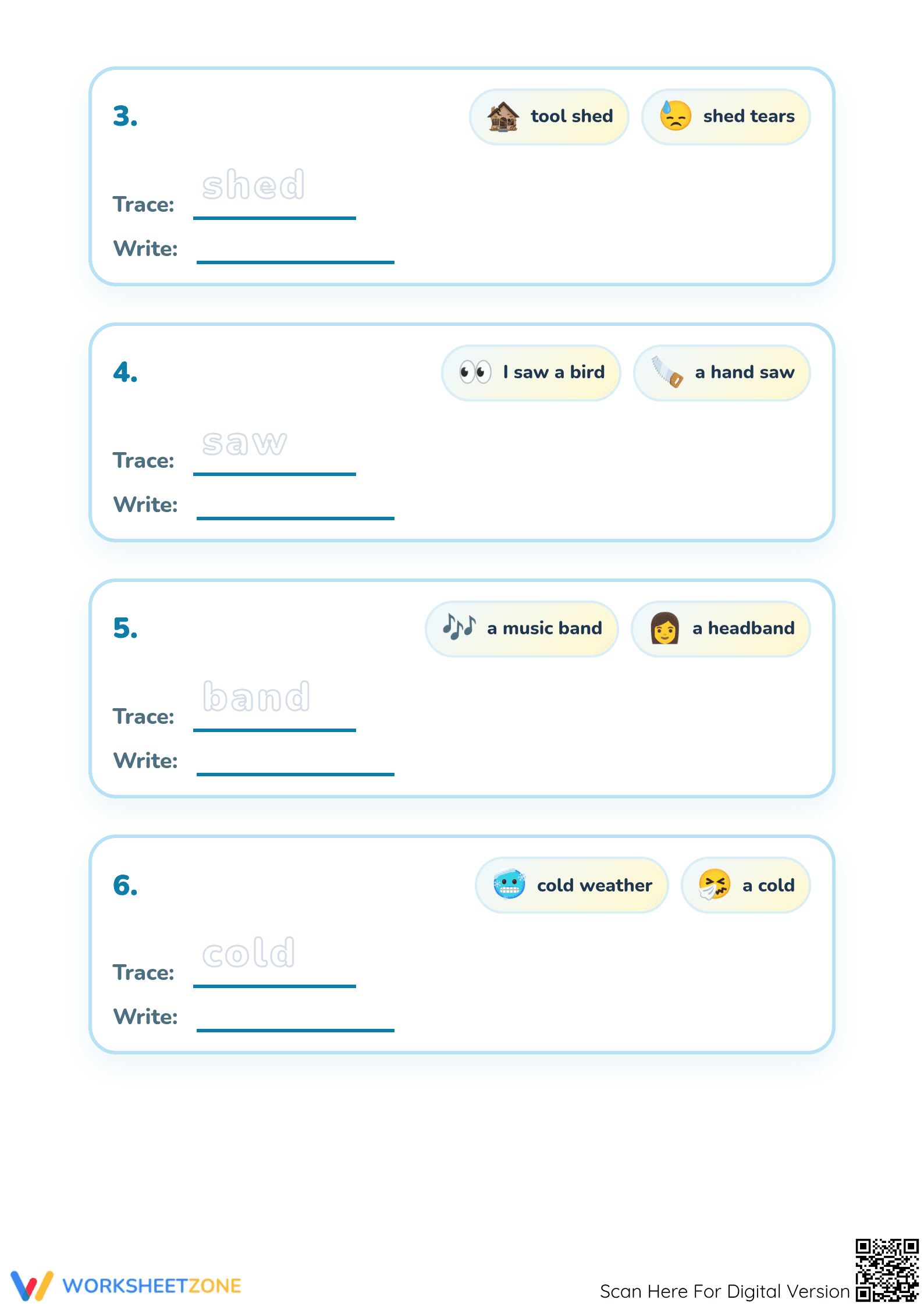
This two-page PDF includes six word pairs for Kindergarten and Grade 1. Each task features two illustrations representing different meanings of the same word (e.g., "tool shed" and "shed tears"). Students interact by tracing the target word on primary lines and then writing it independently, reinforcing spelling and semantic retention.
Skill Progression
- Guided Practice: Students observe paired illustrations that provide visual context for homonyms, reducing cognitive load.
- Supported Practice: Tracing fonts allow students to master letter formations for all six words before independent production.
- Independent Practice: Final blank lines require writing the word from memory, solidifying the phonics and definitions.
This model follows the "I Do, We Do, You Do" framework.
Standards Alignment
The primary focus is `L.K.4.A`, requiring students to identify new meanings for familiar words and apply them accurately. This worksheet also supports RF.K.1.B by reinforcing that spoken words are represented by specific sequences of letters. Both standard codes can be copied directly into lesson plans, IEP goals, or district curriculum mapping tools.
How to Use It
Use this during the independent practice phase of a homonym lesson. After using an anchor chart, distribute these pages. For formative assessment, listen to students "Say It" aloud; if they cannot describe both meanings, they may need oral support. Completion takes 15–20 minutes.
Who It's For
This resource is for Kindergarteners, Grade 1 students, or English Language Learners expanding Tier 2 vocabulary. It is ideal for literacy rotations or homework. Pair this with a homonym-focused picture book to provide a richer narrative context for the featured words like "saw" and "band."
Mastering multiple meaning words is a critical milestone in early literacy, as semantic ambiguity accounts for many reading comprehension difficulties. Research from Fisher & Frey (2014) highlights that vocabulary acquisition is most effective when students engage in multi-modal tasks that combine visual stimuli, verbal rehearsal, and kinesthetic writing. This Grade K worksheet leverages these strategies by requiring students to "Say It, Trace It, and Write It," ensuring standard `L.K.4.A` is met through active engagement. By explicitly teaching homonyms like "seal" and "cold," educators provide students with the decoding flexibility needed to deconstruct complex texts. According to EdReports 2024 benchmarks, high-quality materials must integrate vocabulary practice with phonemic awareness, a core feature of this 6-problem resource. This document serves as a verified tool for building the linguistic depth required for future reading mastery.


