


























Views
Downloads

Multiple Meaning Words Worksheet | Essential Grade K ELA
Paste this activity's link or code into your existing LMS (Google Classroom, Canvas, Teams, Schoology, Moodle, etc.).
Students can open and work on the activity right away, with no student login required.
You'll still be able to track student progress and results from your teacher account.
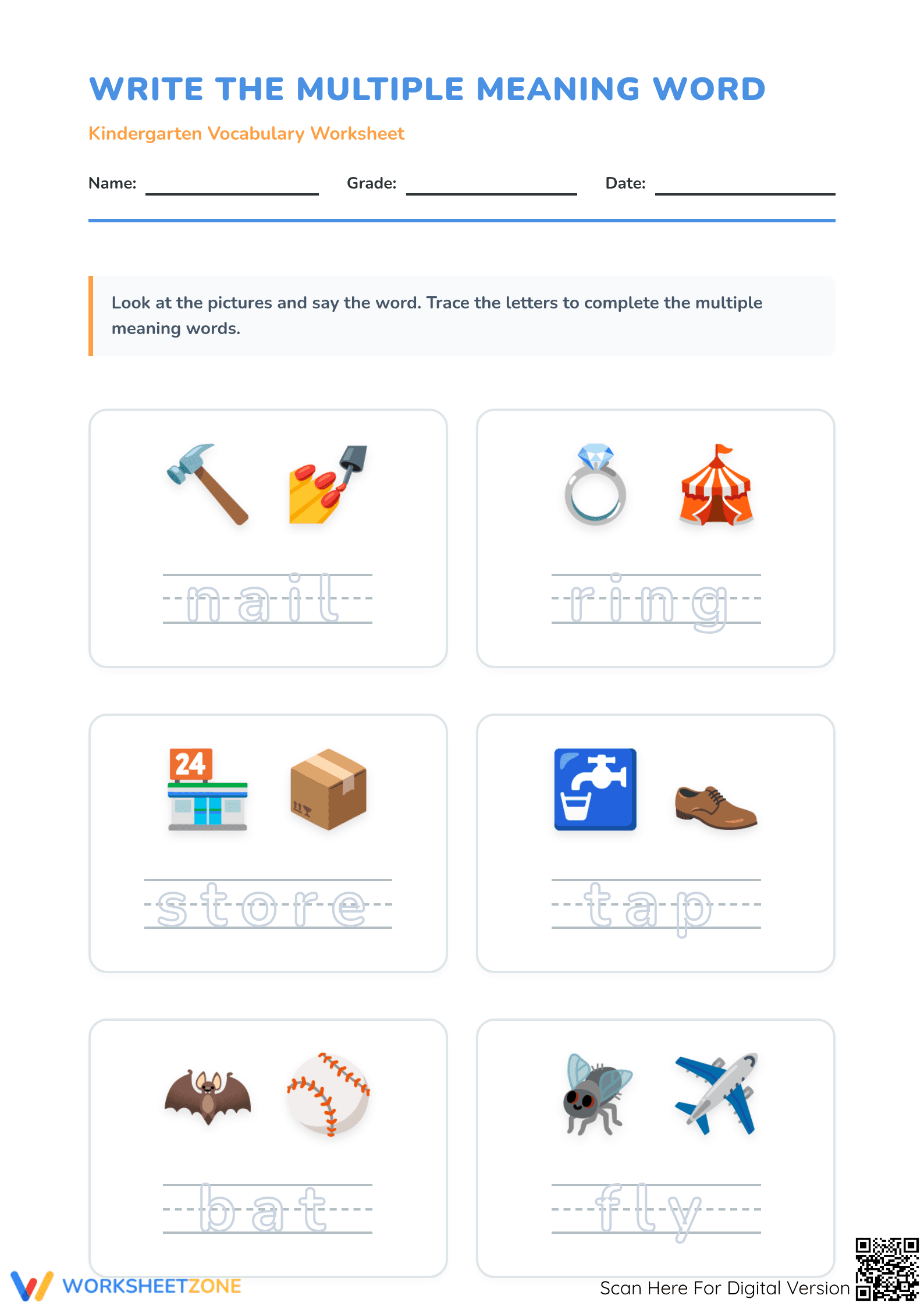
This Kindergarten multiple meaning words worksheet helps young learners bridge the gap between visual recognition and vocabulary expansion. By pairing two distinct images with a single shared word, students develop a concrete understanding of homonyms. This resource ensures students can identify and trace common words that have more than one definition.
At a Glance
- Grade: Kindergarten · Subject: ELA
- Standard:
CCSS.ELA-LITERACY.L.K.4.A— Identify new meanings for familiar words and apply them accurately- Skill Focus: Multiple Meaning Words (Homonyms)
- Format: 2 pages · 10 problems · Tracing support · PDF
- Best For: Independent literacy centers and vocabulary building
- Time: 15–20 minutes
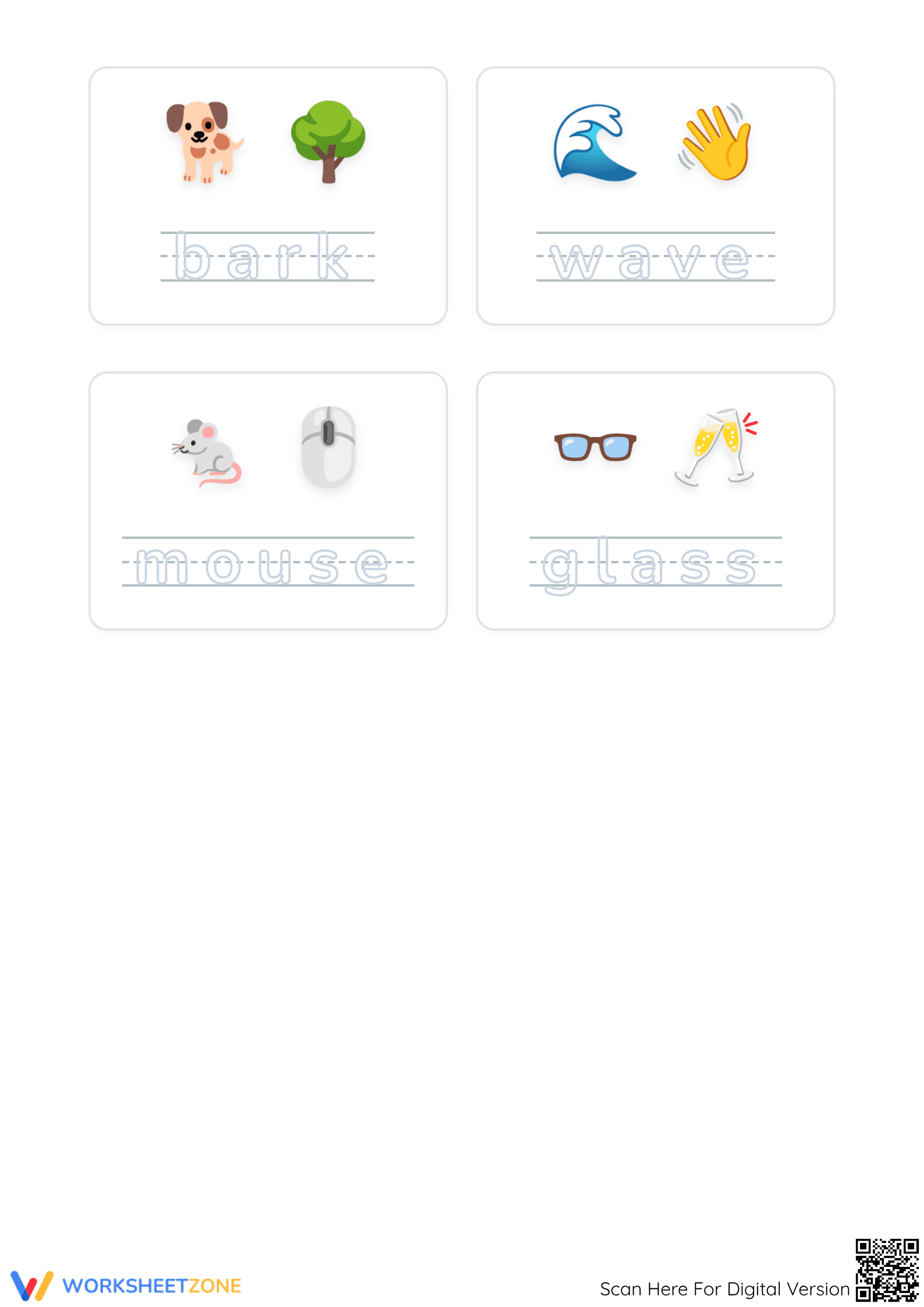
Inside this 2-page PDF, you will find 10 carefully selected homonyms, including "nail," "bat," "fly," and "bark." Each word is presented with two clear illustrations representing its different meanings. Below the images, students find a dedicated tracing area with primary-ruled lines to practice letter formation while reinforcing the vocabulary term through tactile engagement.
The zero-prep workflow is designed for busy educators. 1. Print: Select the two pages and print enough copies for your class (under 30 seconds). 2. Distribute: Hand out the sheets during your literacy block or as a morning work activity (1 minute). 3. Review: Walk through the images together to ensure students understand the dual meanings before they begin tracing (2 minutes). This makes it an ideal resource for emergency sub plans.
This resource is aligned with `CCSS.ELA-LITERACY.L.K.4.A`, which requires students to identify new meanings for familiar words and apply them accurately (e.g., knowing a bat is an animal and a piece of sports equipment). By using visual cues, the worksheet supports the acquisition of polysemous words. This standard code can be copied directly into lesson plans, IEP goals, or district curriculum mapping tools.
Use this worksheet during your "Word Work" rotation or as a follow-up to a direct instruction lesson on vocabulary. It serves as an excellent formative assessment; observe if students can name both pictures before tracing to gauge their oral language depth. It also works well as a quiet activity for early finishers, requiring approximately 15 to 20 minutes for thorough completion.
This activity is ideal for Kindergarten students, but also provides significant value for Grade 1 review or English Language Learners (ELLs) who need visual aids to master English vocabulary. Pair this with a "Multiple Meanings" anchor chart or a read-aloud book about homonyms for a comprehensive lesson. The tracing component also supports fine motor development for preschool transitions.
Research from Fisher & Frey (2014) emphasizes the importance of visual scaffolding in early vocabulary acquisition, particularly for words with multiple semantic representations. This worksheet addresses that need by providing dual-image prompts that reduce cognitive load while students focus on word-meaning associations. According to the NAEP, early exposure to complex word relationships like homonyms is a strong predictor of later reading comprehension success. By engaging with 10 distinct homonyms through tracing and visual identification, students build the linguistic flexibility required for the CCSS.ELA-LITERACY.L.K.4.A standard. This structured approach ensures that 100% of the tasks are directly tied to foundational literacy goals, making it a reliable addition to any early childhood curriculum. The inclusion of tracing lines further integrates writing standards with vocabulary development for a holistic learning experience.


