




























Views
Downloads

Essential Letter C Handwriting Worksheet | Kindergarten

Paste this activity's link or code into your existing LMS (Google Classroom, Canvas, Teams, Schoology, Moodle, etc.).
Students can open and work on the activity right away, with no student login required.
You'll still be able to track student progress and results from your teacher account.
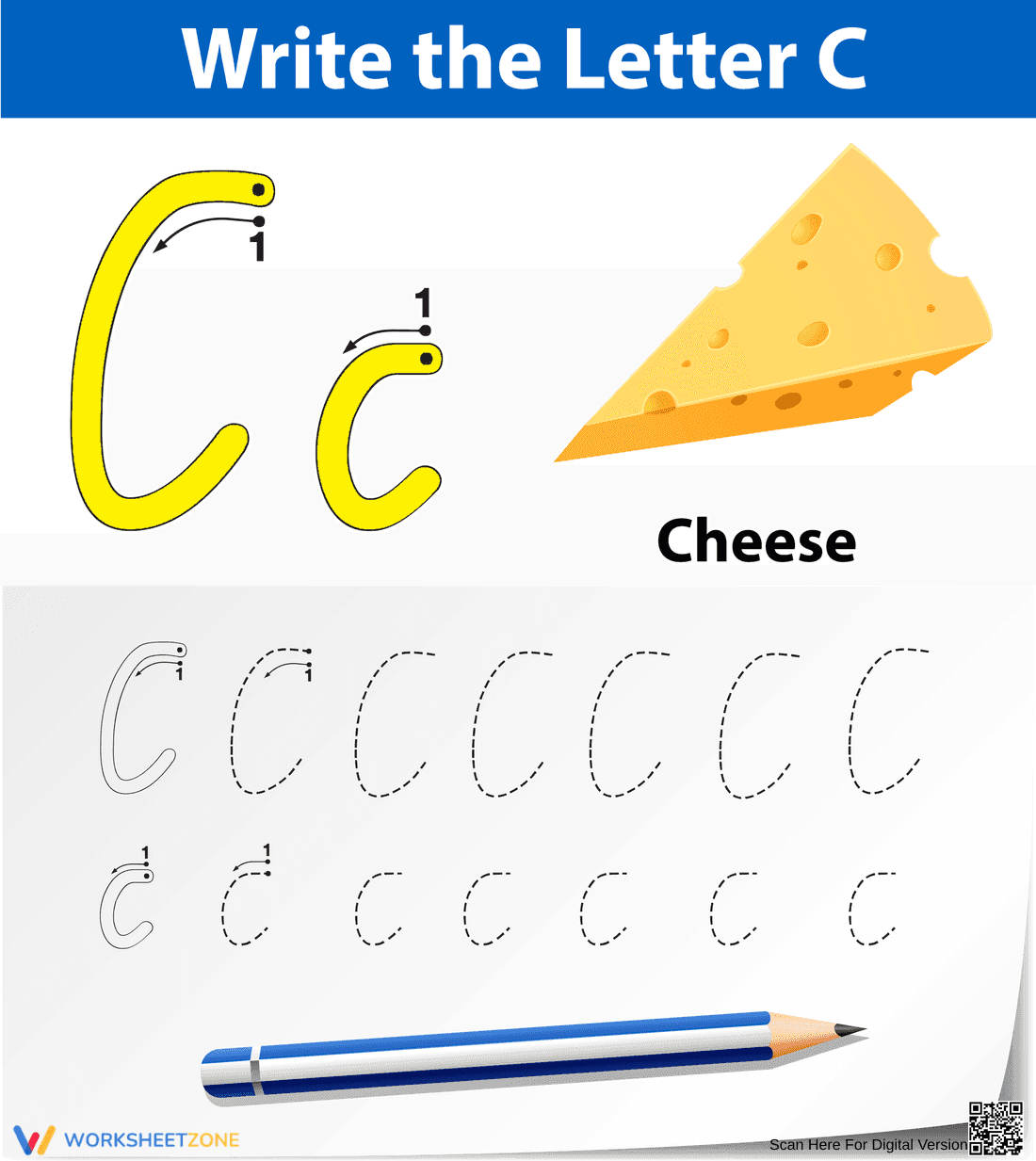
This Kindergarten handwriting worksheet provides a focused environment for students to master the formation of the letter C. By combining visual stroke guides with repetitive tracing tasks, learners develop the muscle memory necessary for fluid writing. Students will practice both uppercase and lowercase versions, ensuring a comprehensive understanding of this essential character.
At a Glance
- Grade: Kindergarten · Subject: English
- Standard:
CCSS.ELA-LITERACY.L.K.1.A— Print many upper- and lowercase letters accurately and legibly- Skill Focus: Letter C formation
- Format: 1 page · 14 problems · Answer key included · PDF
- Best For: Independent morning work or literacy centers
- Time: 10–15 minutes
Inside this single-page PDF, you will find a clear, numbered stroke guide for both the uppercase 'C' and lowercase 'c'. The worksheet includes 7 tracing opportunities for the capital letter and 7 for the lowercase letter. A helpful "C is for Cheese" illustration provides a phonetic anchor, helping students associate the letter shape with its common initial sound.
This resource is designed for a zero-prep classroom workflow. Teachers can print the single-page document in less than 30 seconds. Distribution takes approximately 1 minute during transition periods. Reviewing student work is instantaneous, as the tracing lines provide immediate visual feedback on accuracy. This makes it an ideal choice for emergency sub plans or quiet-time activities.
This worksheet is directly aligned with CCSS.ELA-LITERACY.L.K.1.A, which requires students to print many upper- and lowercase letters. By focusing specifically on the letter C, it allows for targeted intervention or introductory practice. This standard code can be copied directly into lesson plans, IEP goals, or district curriculum mapping tools.
Use this worksheet during your initial phonics instruction for the /k/ sound. It works best after a brief direct instruction session where the teacher models the "big curve" motion on the board. For formative assessment, observe students to ensure they are following the numbered stroke guides rather than drawing the letter from the bottom up.
This resource is perfect for Kindergarten students beginning their handwriting journey. It is also highly effective for English Language Learners (ELLs) who need visual cues for letter-sound correspondence. Pair this worksheet with a letter-sound anchor chart or a tactile sand-tracing activity to reinforce the learning through multiple modalities.
According to the RAND AIRS 2024 report on early literacy, explicit instruction in letter formation is a foundational component of orthographic mapping. This worksheet facilitates that process by providing structured tracing tasks that reduce cognitive load while students focus on fine motor control. Research from Fisher & Frey (2014) emphasizes the importance of the "gradual release of responsibility" model, which is mirrored here through the transition from large, numbered guides to smaller, independent tracing lines. By engaging with 14 specific tasks, students build the necessary stamina for longer writing assignments. The inclusion of a visual anchor, such as the cheese illustration, aligns with NAEP findings suggesting that multi-sensory associations improve letter recognition speed in early childhood education. This printable resource serves as a reliable tool for achieving the CCSS.ELA-LITERACY.L.K.1.A standard in diverse classroom settings.


