


























Views
Plays
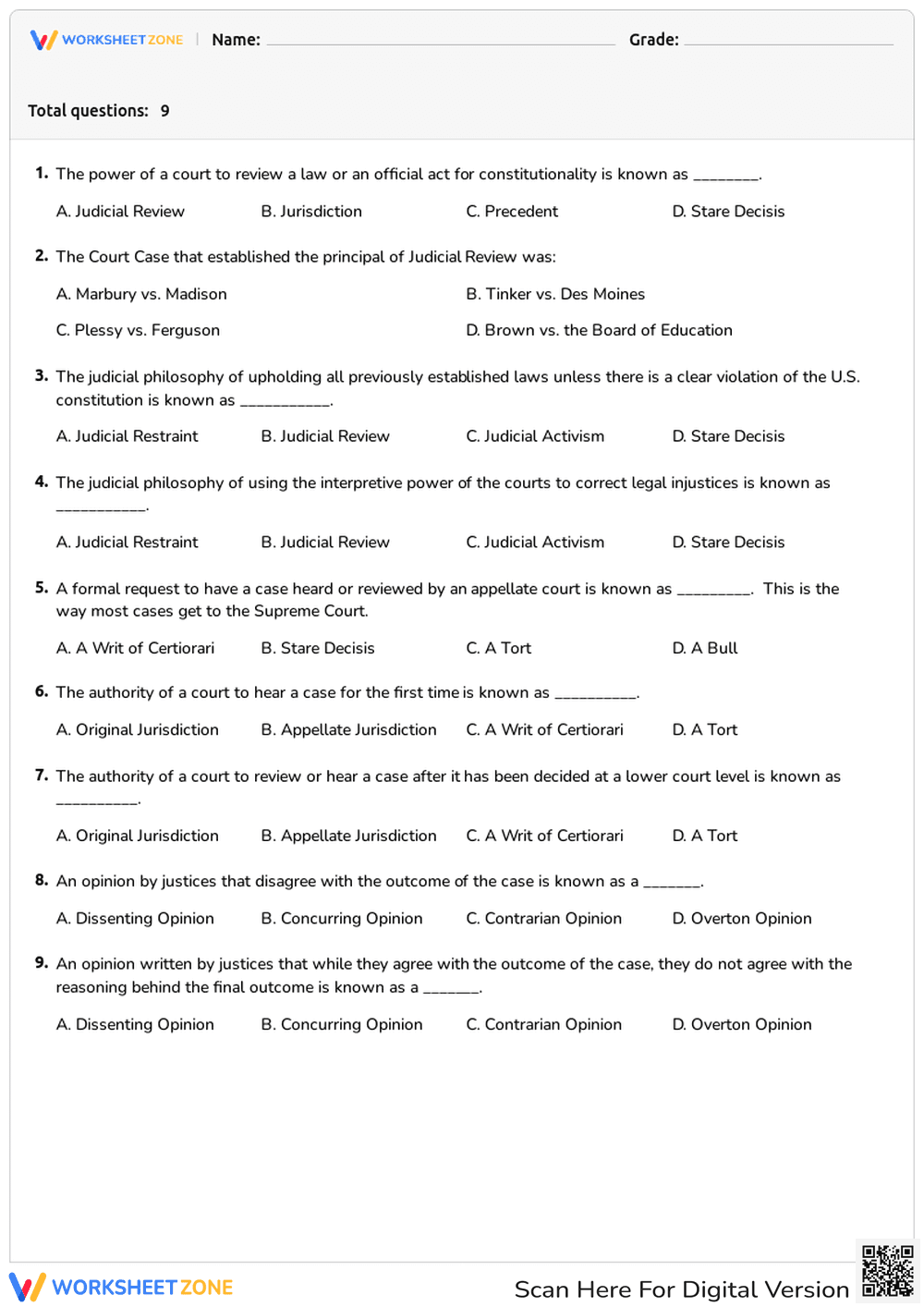

Essential Judicial Branch Review | Grade 11-12 History
Paste this activity's link or code into your existing LMS (Google Classroom, Canvas, Teams, Schoology, Moodle, etc.).
Students can open and work on the activity right away, with no student login required.
You'll still be able to track student progress and results from your teacher account.
This Grade 11-12 Judicial Branch review worksheet provides students with 9 targeted multiple-choice questions to solidify their understanding of the United States court system. By focusing on landmark cases and legal terminology, students achieve clarity on how the judiciary functions within the federal government. It is an efficient tool for assessing prior knowledge or summarizing a unit.
At a Glance
- Grade: 11-12 · Subject: US History / Civics
- Standard:
CCSS.ELA-LITERACY.RH.11-12.4— Determine the meaning of domain-specific words and phrases in history- Skill Focus: Judicial Branch Terminology
- Format: 1 page · 9 problems · Answer key included · PDF
- Best For: Quick formative assessment or unit review
- Time: 10–15 minutes
What's Inside: This single-page PDF features 9 multiple-choice questions designed to mirror the rigor of social studies assessments. The worksheet covers critical concepts including judicial review, Marbury vs. Madison, and the distinctions between original and appellate jurisdiction. Each question is clearly numbered with four options, ensuring a straightforward experience for students and easy grading for instructors.
Zero-Prep Workflow: This resource is designed for immediate use with a total teacher prep time of under 2 minutes. First, print the single-page document (1 minute). Second, distribute the sheets as a bell-ringer or exit ticket (30-seconds). Finally, review the answers using the included key to provide instant feedback (5 minutes). Its concise format makes it an ideal sub plan or a quick check for understanding.
Standards Alignment: The primary standard addressed is `CCSS.ELA-LITERACY.RH.11-12.4`, which requires students to determine the meaning of domain-specific words and phrases related to history and social studies. By identifying terms like "Writ of Certiorari" and "Concurring Opinion," students demonstrate technical literacy. This standard code can be copied directly into lesson plans, IEP goals, or district curriculum mapping tools.
How to Use It: Use this worksheet as a formative assessment after a lecture on the federal court system to gauge retention. Alternatively, assign it as a timed review before a unit exam. Teachers should observe which students struggle with the distinction between judicial activism and restraint to identify needs for deeper instruction. Completion typically takes 10 to 15 minutes.
Who It's For: This resource is tailored for high school students in Grade 11 or 12 enrolled in US History or Civics. It is effective for students preparing for government exams. Pair this worksheet with a primary source reading of Article III of the Constitution or a summary of the Marbury vs. Madison decision for a comprehensive lesson.
According to Fisher & Frey (2014), the use of structured vocabulary reviews in social studies is essential for developing the disciplinary literacy required for college and career readiness. This worksheet addresses the CCSS.ELA-LITERACY.RH.11-12.4 standard by requiring students to accurately identify and apply complex legal terminology such as "Appellate Jurisdiction" and "Dissenting Opinion." Research indicates that frequent, low-stakes retrieval practice—like the 9-question format used here—significantly improves long-term retention of abstract civic concepts compared to passive reading alone. By isolating these terms within the context of the US Judicial Branch, the resource ensures that students can navigate the linguistic demands of higher-level historical texts. This alignment with evidence-based instructional strategies supports mastery of the foundational principles of the American legal system, providing a reliable metric for student progress in secondary social studies curricula.


