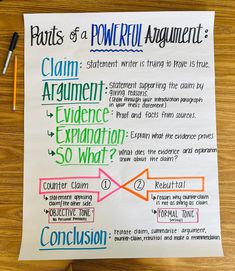
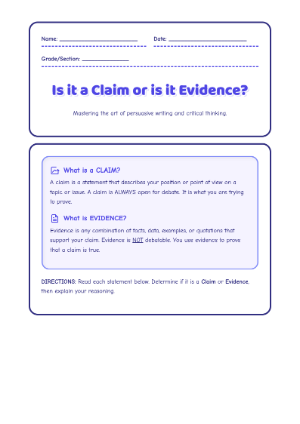
the quality of being believable or trustworthy: credibility. informational literature that includes a writer's opinions and feelings: subjective point of view. informational literature that does not includes a writer's opinions and feelings; factual: objective point of view. A statement that can be proved: fact. numerical data: Statistics. to repeat exactly what someone else has said or written: quote. a specific case used to illustrate or represent a group of people, ideas, conditions, experiences, or the like: example. Appeal that relies on the speaker's credibility: Ethos. Appeal to emotion: pathos. Appeal to logic: Logos. A statement put forth and supported by evidence: Argument. a point of view or general standpoint from which different things are viewed, physically or mentally: Perspective. the writer's position on an issue or problem, usually supported by evidence: claim. a cause, explanation, or justification for an action or event: reason. proof, usually found directly in the text: evidence. an opposing argument to the one a writer is putting forward: counterargument. A counterargument, especially in debate: rebuttal. An original document containing the observations, ideas, and conclusions of an individual. It is a firsthand account presented by someone present or actively participating in the event. Examples include manuscripts, photographs, oral histories, and personal journals: Primary Source. A secondhand account of an event or a retelling of another person's observations written by someone who did not witness or actually participate in the events. Includes sources that combine, synthesize, and or interpret information from primary sources. Examples include encyclopedias, textbooks, and reviews: Secondary Source. prejudice in favor of or against one thing, person, or group compared with another: bias












 Interactive Worksheet Maker
 Quiz Maker
 Word Search Maker
 Crossword Puzzle Maker
 Word Scramble Generator
 Sentence Scramble Generator
 Handwriting Worksheet Generator
 Name Tracing Generator
 Fill In The Blank Generator