


























Views
Plays



Rhetorical Strategies Worksheet | Grade 11-12 Essential
Paste this activity's link or code into your existing LMS (Google Classroom, Canvas, Teams, Schoology, Moodle, etc.).
Students can open and work on the activity right away, with no student login required.
You'll still be able to track student progress and results from your teacher account.
This rhetorical strategies worksheet helps upper-level students master the art of persuasion by identifying Ethos, Pathos, and Logos. Students analyze both visual advertisements and complex text excerpts to determine how authors influence their audience. By the end of these 10 tasks, learners will demonstrate a clear understanding of rhetorical appeals in real-world contexts.
At a Glance
- Grade: 11-12 · Subject: ELA
- Standard:
CCSS.ELA-LITERACY.RI.11-12.6— Analyze how an author uses rhetoric to advance point of view or purpose- Skill Focus: Rhetorical Appeals (Ethos, Pathos, Logos)
- Format: 3 pages · 10 problems · Answer key included · PDF
- Best For: AP Language prep or rhetoric units
- Time: 15–20 minutes
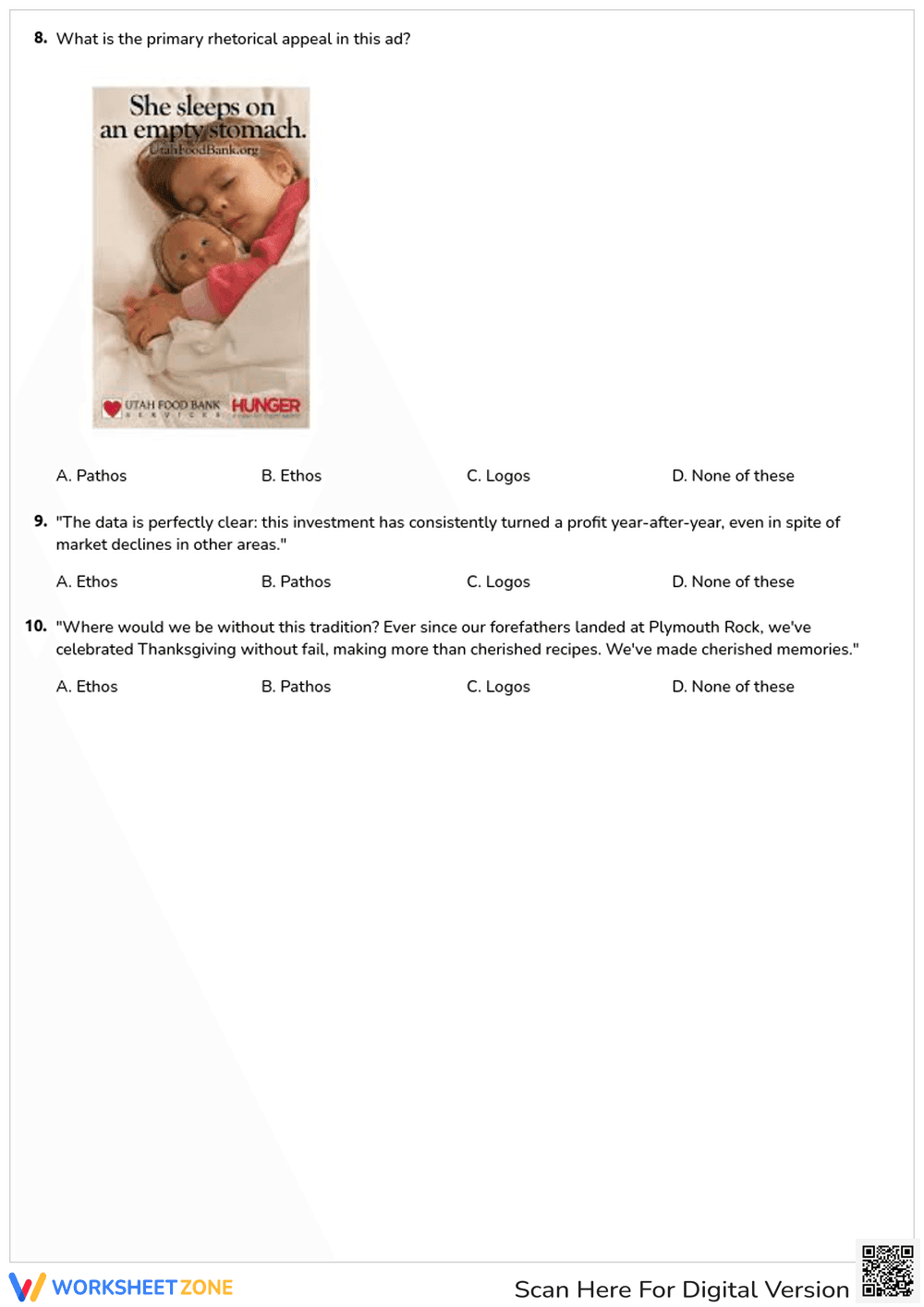
The resource contains 10 multiple-choice questions spread across three pages. It features a mix of conceptual definitions, visual analysis of advertisements (including a food bank ad and a PETA campaign), and textual analysis of legal arguments and traditional narratives. A full answer key is provided for immediate feedback and grading.
Skill Progression
- Guided Practice: The worksheet begins with foundational definitions and simple image-based identification to build confidence in recognizing the Aristotelian triad.
- Supported Practice: Students move to supported practice where they analyze short slogans and medical-themed advertisements to see how credibility and emotion are leveraged.
- Independent Practice: Finally, independent practice requires students to evaluate longer, more nuanced paragraphs, such as a jury summation and a reflection on cultural traditions.
This structure follows a gradual-release model to ensure students move from basic identification to deep rhetorical analysis.
Standards Alignment
This resource is aligned with `CCSS.ELA-LITERACY.RI.11-12.6`, which requires students to determine an author's point of view and analyze the specific rhetorical choices made to advance that purpose. It also supports CCSS.ELA-LITERACY.W.11-12.1 by helping students recognize the tools needed for effective argumentative writing. Both standard codes can be copied directly into lesson plans, IEP goals, or district curriculum mapping tools.
How to Use It
Use this as a formative assessment after an introductory lecture on the Aristotelian triad. It works well as a "bell-ringer" or a quick check for understanding before moving into a deeper analysis of a full speech. Teachers should observe if students struggle more with visual pathos versus textual logos to guide future instruction. Expected completion time is 15 to 20 minutes.
Who It's For
This is designed for Grade 11, Grade 12, and introductory college composition students. It is particularly useful for AP English Language and Composition students who need to sharpen their rhetorical analysis skills. Pair this with a graphic organizer or an anchor chart detailing the definitions of the three appeals for maximum student support.
According to the RAND AIRS 2024 report, explicit instruction in rhetorical strategies significantly improves a student's ability to deconstruct complex informational texts, a core requirement for college and career readiness. This worksheet targets the specific skill of identifying rhetorical appeals, which serves as the foundation for higher-order analysis. By isolating Ethos, Pathos, and Logos within 10 distinct tasks, the resource provides the repetitive exposure necessary for mastery. The inclusion of visual media alongside text reflects modern literacy demands, ensuring students can apply CCSS.ELA-LITERACY.RI.11-12.6 across various platforms. Research from Fisher & Frey (2014) emphasizes that gradual release models, like the one utilized here, help bridge the gap between basic comprehension and critical evaluation. This structured approach ensures that Grade 11 and 12 students develop the analytical stamina required for high-stakes assessments and academic writing, making it a vital component of any secondary ELA curriculum.


