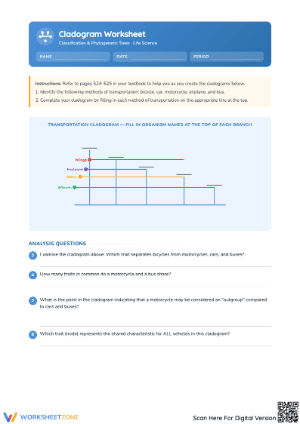
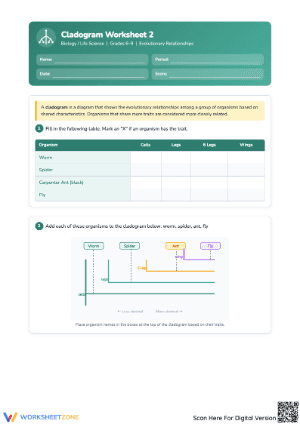
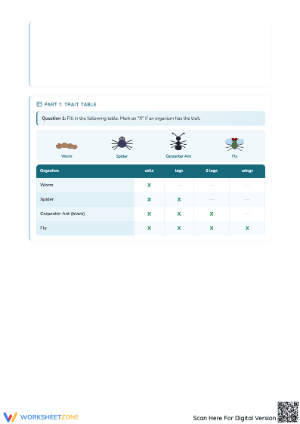
If you teach life science in grades 6-9, you already know that classification and evolution units can feel abstract to students who are used to sorting animals by 'cute' or 'scary' rather than by shared traits. Cladogram worksheets give students a concrete tool for talking about ancestry the way scientists do: through branching diagrams built from evidence, not intuition. Instead of starting with a broad hook about worksheets in general, it helps to start from the classroom problem these tasks solve. Students need repeated, structured practice reading and building tree diagrams before they can reason about common ancestry on a summative assessment.
A cladogram worksheet sequence typically supports three stages of skill-building: vocabulary review, guided reading of a pre-built cladogram, and independent construction from a trait matrix. That progression maps well onto a two-to-three day mini-unit or a set of stations you can rotate through during a longer evolution unit.
Connecting Cladogram Practice to NGSS Expectations
Cladogram worksheets are a direct fit for NGSS MS-LS4-2, which asks students to apply scientific ideas to construct an explanation for anatomical similarities and differences among modern organisms in order to infer evolutionary relationships. At the high school level, HS-LS4-1 extends this by asking students to communicate how common ancestry and biological evolution are supported by multiple lines of evidence. Planning worksheet sequences around these two standards keeps your unit anchored to what students are actually expected to demonstrate.
One planning detail worth flagging for your team: MS-LS4-2 and HS-LS4-1 both foreground evidence-based explanation rather than memorized taxonomy, so a worksheet that only asks students to label branches without justifying groupings misses the standard. Building at least one open-response question into every cladogram worksheet, such as asking students to cite the shared derived trait that defines a branch point, keeps the task aligned to the performance expectation instead of reducing it to vocabulary recall.
A Classroom Sequence: Vocabulary, Reading, Then Construction
Start with vocabulary. Terms like common ancestor, branch point, clade, and shared derived trait need direct instruction before students can read a cladogram accurately. A short worksheet or warm-up that pairs each term with a labeled diagram works well as day one of the sequence.
On day two, move to guided reading. Give students a completed cladogram and ask evidence-based questions: which two organisms share the most recent common ancestor, what trait defines a particular clade, and how the diagram would change if a new organism were added. This step builds comprehension before students are asked to generate their own diagrams.
Day three shifts to construction. Provide a character or trait matrix, similar to the approach used in Carolina Biological's cladogram construction resources, and have students build a cladogram from scratch by grouping organisms according to shared traits. This is the step where misconceptions surface most clearly, so plan time to circulate and check reasoning rather than just final diagrams.
Classroom Implementation
To roll cladogram worksheets into an existing unit, pair them with your broader classification content on archaea, bacteria, protists, fungi, plants, invertebrates, vertebrates, and humans. Introduce cladogram vocabulary right after students have sorted organisms into kingdoms, since that prior sorting activity gives them a concrete reference point for the more abstract branching diagram.
Plan for one class period of guided reading before assigning independent construction as homework or a station task. Students who skip the guided reading step tend to produce cladograms that are structurally correct but poorly justified, since they have not yet practiced articulating why a branch point exists. Building in a short partner-check step, where students explain their finished cladogram to a peer before submitting it, catches many of these reasoning gaps before you grade the assignment.
Frequently Asked Questions
1. What grade level and standard do cladogram worksheets typically target?
Cladogram worksheets are most common in grades 6-9 life science and biology units on classification and evolution. Middle school tasks generally align to NGSS MS-LS4-2, while high school tasks extend into HS-LS4-1 with a stronger emphasis on multiple lines of evidence.
2. How should teachers introduce cladogram vocabulary before assigning practice worksheets?
Start with a short, direct-instruction warm-up that pairs terms like common ancestor, branch point, clade, and shared derived trait with a labeled diagram, so students have a shared vocabulary base before reading or building their own cladograms.
3. What is the difference between a cladogram reading task and a cladogram construction task?
A reading task gives students a completed cladogram and asks evidence-based questions about relationships shown in the diagram. A construction task gives students a trait matrix and asks them to build the cladogram themselves, which is a higher-demand skill better suited to students who have already mastered reading.
4. How can cladogram worksheets be used for formative assessment or review stations?
Short exit tickets asking students to identify the closest related pair, name a defining trait, or correct a mislabeled branch point give a quick read on comprehension. Review stations can pair a printed cladogram with annotation questions for students to complete before a unit test.
5. What common misconceptions should teachers watch for when students interpret cladograms?
Watch for students reading cladograms like a ladder of increasing complexity instead of a branching tree, and for students confusing any shared trait with a shared derived trait that actually defines a clade. Both misconceptions are best addressed during the guided reading stage before independent construction begins.















 Interactive Worksheet Maker
 Quiz Maker
 Word Search Maker
 Crossword Puzzle Maker
 Word Scramble Generator
 Sentence Scramble Generator
 Handwriting Worksheet Generator
 Name Tracing Generator
 Fill In The Blank Generator