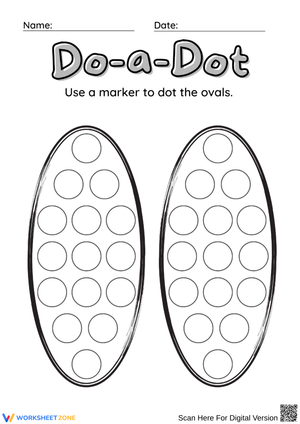
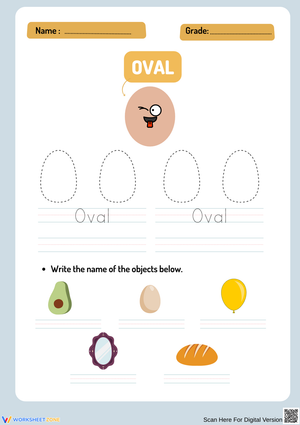
There is a quiet magic that unfolds the moment a young child picks up a crayon and notices a curved line that is not quite a circle. The egg-like silhouette of an oval invites curiosity, and our oval worksheets for preschool turn that curiosity into a guided journey of creative discovery. Each page becomes a small canvas where little learners can wonder, sketch, color, and connect the shape to the everyday world around them, from a smooth river stone to a chicken egg resting in a basket.
Tracing the soft, looping curve of an oval is wonderful practice for tiny fingers. As children glide their pencils along dotted outlines, they strengthen the muscles needed for handwriting, scissor work, and buttoning a coat. These activities also nurture hand-eye coordination, helping children connect what they see with the careful movements of their hands. For more ideas that build pencil control and finger strength, our friends at Worksheetzone share a thoughtful guide on fine motor practice for early learners that pairs beautifully with shape work.
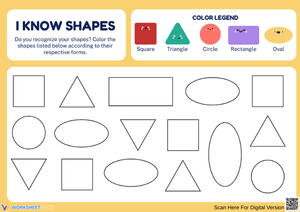
Look closely at the printable pages and you will find layers of imaginative detail waiting to be uncovered. Some sheets ask children to spot ovals hidden among circles, squares, and triangles, while others invite them to color a row of dinosaur eggs, balloons, or watermelon seeds. These hidden patterns reward attentive eyes and gentle focus, turning a simple geometry exercise into a treasure hunt that toddlers and kindergarteners genuinely enjoy returning to again and again.
Older preschoolers and early kindergarten students can stretch their thinking by sorting ovals from other 2D shapes and explaining what makes the oval special. Quiet coloring time also offers a wonderful pause in the day, a moment of mindfulness where students breathe slowly, blend warm and cool colors, and feel proud of a finished page. Teachers and parents can deepen the lesson by exploring the broader family of flat shapes through this companion piece on teaching everyday two-dimensional figures.
So gather your crayons, sharpen a pencil, and let the page become a quiet studio of color and shape. Our oval worksheets for preschool are designed to spark wonder, build confidence, and celebrate every small artistic victory. Print a set tonight and watch your child fall in love with the gentle, unmistakable curve of the oval as they create their very first geometry masterpiece.
Frequently Asked Questions
Question 1: What age group benefits most from oval worksheets for preschool?
These worksheets are designed for children roughly between three and five years old, the prime preschool window when shape recognition begins to bloom. Toddlers as young as two can enjoy the coloring pages with help, while kindergarteners use them as a confident review activity. The varied difficulty across tracing, recognizing, and coloring tasks means each child can engage at a level that feels playful, achievable, and joyful for their stage of growth.
Question 2: How do oval worksheets support early geometry skills?
Ovals introduce children to the idea that shapes can stretch, flatten, and still belong to a wider family of curves. As students compare an oval to a circle, they begin to notice subtle differences in length, width, and symmetry. This early observation builds the vocabulary and visual reasoning needed for later geometry lessons, helping young learners describe, classify, and discuss two-dimensional figures with growing precision and confidence in the classroom.
Question 3: What materials do parents and teachers need to use these worksheets?
The basic supplies are wonderfully simple: printed pages, a pencil, and a handful of crayons or colored pencils. Some children enjoy adding stickers, dot markers, or watercolor accents to make their oval scenes more personal. A clipboard or laminated sleeve allows reusable tracing practice, which extends the life of each printable. Worksheetzone designs every worksheet to print cleanly on standard paper, so preparation stays quick and stress-free.
Question 4: How can these worksheets be used in a classroom lesson plan?
Teachers can open a shape unit with an oval scavenger hunt, then move students into tracing stations, recognition sorting mats, and a closing coloring activity from the printable pack. Pairing the worksheets with read-aloud books about eggs, faces, or planets reinforces real-world connections. Small-group rotations let educators observe individual progress, while a class display of finished oval art turns the lesson into a celebration of shared discovery and creative student work.












 Interactive Worksheet Maker
 Quiz Maker
 Word Search Maker
 Crossword Puzzle Maker
 Word Scramble Generator
 Sentence Scramble Generator
 Handwriting Worksheet Generator
 Name Tracing Generator
 Fill In The Blank Generator