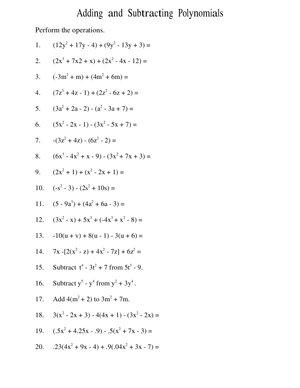
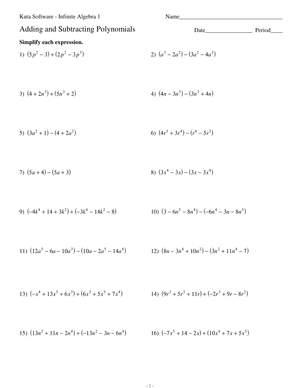
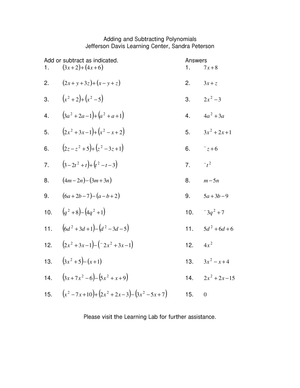
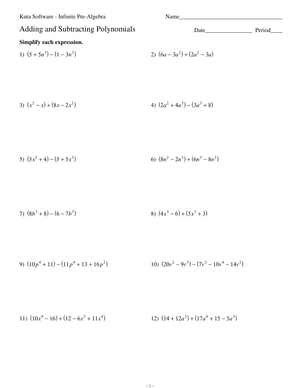
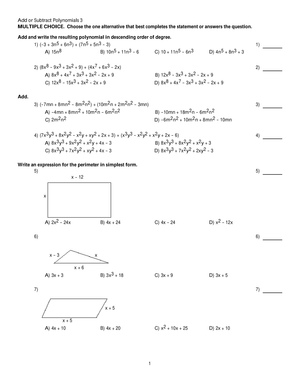
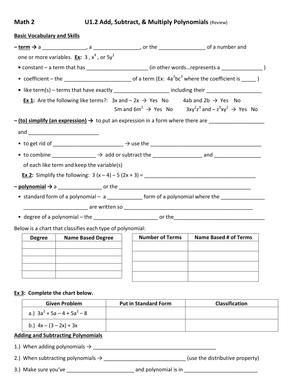
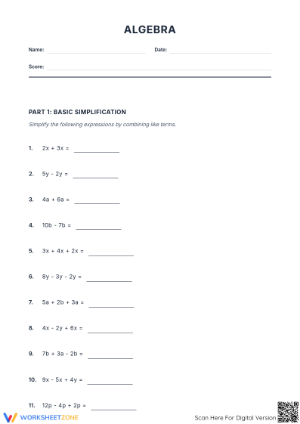
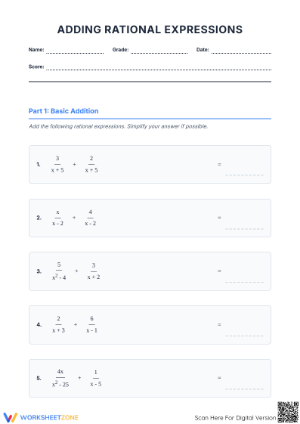
If your students are moving through the polynomials unit, you already know where they stumble. Adding and subtracting polynomials worksheets give you a fast way to isolate that one skill combining like terms and applying sign rules correctly before it gets buried under multiplication and factoring later in the course. These worksheets work well as a standalone practice set for the specific stretch of days when students are learning to treat polynomial expressions the way they already treat integers, just with variables and exponents attached.
This skill sits squarely in Algebra 1 for most course sequences, though you will also see it show up in pre-algebra as an early preview and in Algebra 2 as a quick review before tackling more complex rational expressions. Regardless of where it lands on your pacing guide, the goal of the worksheet practice stays the same: build fluency in matching terms by variable and exponent so students stop guessing and start recognizing structure.
The Core Skill: Combining Like Terms Correctly
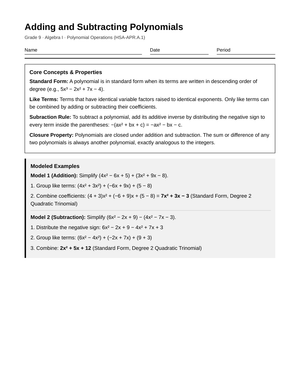
Every worksheet in this set is built around one procedure: combining like terms. That means constants pair with constants, x terms pair with x terms, x-squared terms pair with x-squared terms, and so on. Students who are new to this often try to combine terms that look similar but are not actually alike, such as adding a term with x to a term with x-squared. A well-sequenced worksheet surfaces this error early, in low-stakes single-variable problems, rather than letting it persist until a test.
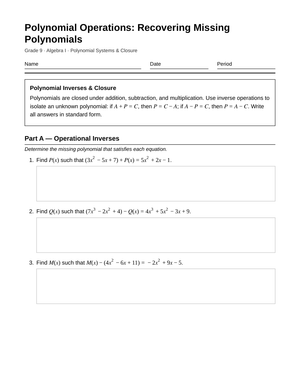
The most instructive worksheets do not just ask students to add polynomials. They pair addition problems with near-identical subtraction problems using the same two polynomials, so students can directly compare their answers and see exactly where the sign flip changes the result. That side-by-side contrast does more to correct the misconception than a dozen unrelated practice problems, because it isolates the one variable that actually matters: the negative sign.
Where Subtraction Breaks Down
Subtracting polynomials requires distributing a negative sign across every term of the second polynomial before combining like terms. This is the single step where students most often make errors. They will correctly flip the sign of the first term in the second polynomial and then forget to flip the rest, especially when the polynomial has three or four terms. A worksheet that includes several three-term and four-term subtraction problems, not just binomials, gives students enough repetition to make the full distribution automatic instead of partial.
One useful habit to build into your practice sets is having students rewrite the subtraction problem as an addition problem first, changing every sign in the second polynomial before they combine anything. This extra written step slows students down just enough to catch the sign errors that speed causes.
Sequencing Practice From Simple to Complex
Worksheets work best when they follow a clear progression. Start with single-variable binomials, such as adding two two-term expressions with only an x variable. Move to trinomials next, still single-variable, so students get comfortable tracking three separate term types at once. From there, introduce multi-variable expressions, such as polynomials with both x and y terms, which forces students to sort terms more carefully. Save multi-term, multi-variable subtraction problems for the end of the worksheet or for a second, more advanced worksheet entirely.
This kind of sequencing also makes a single worksheet usable across a range of student readiness levels. Struggling students can stop after the binomial section and still leave with a solid grasp of the core procedure, while students ready for a challenge can push into the multi-variable subtraction problems at the bottom of the page.
Classroom Implementation
Adding and subtracting polynomials worksheets fit naturally into several parts of a lesson. Use a short section of problems as a warm-up to check whether students retained the sign-distribution rule from the previous day. Use a full worksheet as independent classwork after direct instruction, giving you time to circulate and catch sign errors in real time. Assign a similar worksheet as homework once you have seen most students working independently and accurately during class.
For students who consistently make sign errors, try the vertical alignment method as a visual scaffold. Have students stack the two polynomials so that like terms line up in columns, similar to how they would stack numbers for column addition. This visual structure reduces the chance of a term being missed or mismatched, and it gives students a concrete way to check their work before moving on.
Standards Alignment and Lesson Planning
Adding and subtracting polynomials worksheets support CCSS.HSA.APR.A.1, which requires students to add, subtract, and multiply polynomials and understand they form a closed system analogous to integers. Documenting this alignment matters when you are building a pacing guide or preparing materials for a curriculum review, since it ties daily practice directly to a specific, citable standard rather than a general skill description.
According to the Common Core State Standards Initiative, CCSS.HSA.APR.A.1 frames polynomial arithmetic as a closed system, meaning that adding, subtracting, or multiplying two polynomials always produces another polynomial, the same way adding or multiplying two integers always produces another integer. Teaching this conceptual framing alongside the mechanical steps helps students understand why the procedure works, not just how to execute it.
Connecting to What Comes Next
Fluency with adding and subtracting polynomials sets students up for multiplying polynomials, which is typically the next skill in the sequence. Students who can quickly and accurately combine like terms will have an easier time simplifying the expanded expressions that result from multiplication, and later, from factoring. If a class is struggling with multiplication of polynomials, it is often worth stepping back to a quick review worksheet on addition and subtraction, since a shaky foundation there tends to resurface as confusion with distributing terms during multiplication.
Frequently Asked Questions
1. What grade level typically covers adding and subtracting polynomials?
This skill is most commonly taught in Algebra 1, which many students take in eighth or ninth grade, though it can also appear in a pre-algebra preview unit or as a review topic at the start of Algebra 2.
2. What is the most common student error when subtracting polynomials, and how can worksheets address it?
The most common error is forgetting to distribute the negative sign across every term of the second polynomial. Worksheets that include several multi-term subtraction problems, and that pair addition and subtraction of the same two polynomials side by side, give students the repetition needed to catch this mistake.
3. How many practice problems should a worksheet include for a single class period?
A worksheet with fifteen to twenty problems, sequenced from simple binomials to more complex multi-variable expressions, generally gives enough repetition for a single class period without overwhelming students who need more processing time.
4. How does this skill connect to later units like multiplying polynomials or factoring?
Students who are fluent in combining like terms move more smoothly into multiplying polynomials, since multiplication produces expanded expressions that still need to be simplified using the same term-matching skill, and that same skill later supports factoring.
5. Can these worksheets be used for both classwork and homework or review before a test?
Yes. A shorter version works well as a warm-up or quick formative check, a full worksheet fits independent classwork after direct instruction, and a mixed-difficulty version makes a solid homework assignment or pre-test review.













 Interactive Worksheet Maker
 Quiz Maker
 Word Search Maker
 Crossword Puzzle Maker
 Word Scramble Generator
 Sentence Scramble Generator
 Handwriting Worksheet Generator
 Name Tracing Generator
 Fill In The Blank Generator