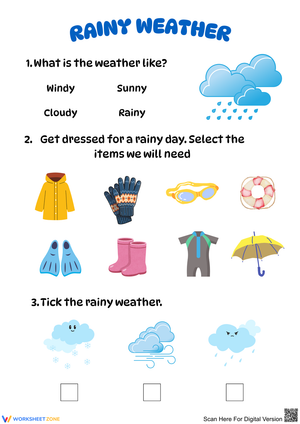
Rain worksheets for Kindergarten
These rain worksheets for kindergarten give teachers a set of standalone, print-ready pages that connect weather science to the literacy, math, and fine motor skills students are already building in the first months of school. Each worksheet uses bold visuals, short directions, and familiar rain-day images so that even pre-readers can engage with the task independently. The set works across multiple parts of the school day — not just a dedicated science block.
What Students Practice Across the Set
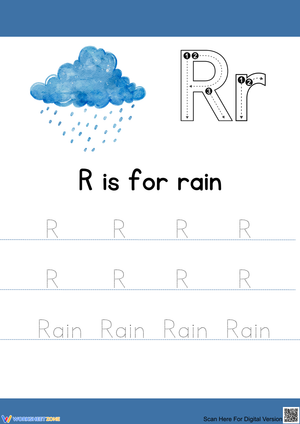
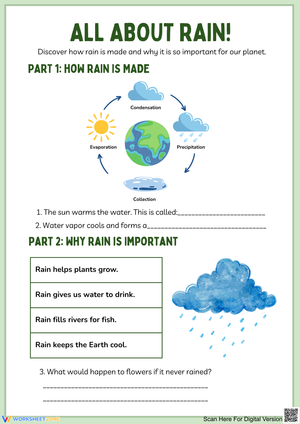
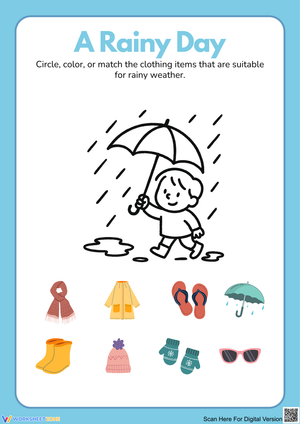
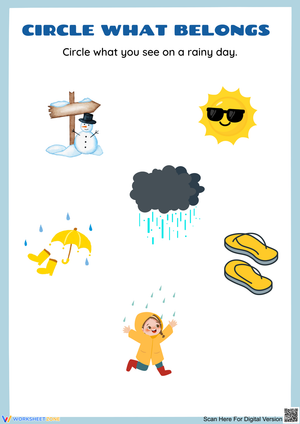
The worksheets cover the specific skills that show up in a typical kindergarten weather unit: tracing weather words (rain, cloud, puddle, umbrella, storm), counting and comparing sets of raindrops or boots, sorting images into rainy and not-rainy categories, matching rainy-day clothing to weather conditions, and circling or drawing sky observations. Several worksheets ask students to identify weather vocabulary by pointing to or coloring a named image — a format that works well for students who are still building letter-sound correspondence.
Because rain connects naturally to both science and everyday life, each worksheet stays close to things students have actually experienced: the sound of drops on a window, what goes in the backpack before walking to school in the rain, the look of a puddle at recess. That grounding makes vocabulary instruction easier because students already have the concept — they just need the word attached to it.
Standard Alignment
These worksheets align to NGSS K-ESS2-1, which asks kindergarteners to use and share observations of local weather conditions to describe patterns over time. That standard is typically introduced in the first half of the year when teachers are building observation vocabulary and establishing what "evidence" means at this age. The rain worksheets support the observational and descriptive language work that precedes data collection — students are learning to name what they see before they're asked to record it systematically. The counting and sorting tasks also connect to CCSS.MATH.CONTENT.K.MD.B.3, classifying objects into given categories and counting the number in each category.
How to Build These Worksheets Into Your Lesson Plans
The count-the-raindrops and color-the-clouds worksheets are well-suited to morning work while the class settles in — they require no reteaching, and students can start without waiting for whole-group directions. The sorting and matching worksheets fit better in a science center or small-group rotation, where a teacher can briefly model the category before students work. Save the tracing and labeling pages for days when you want a written record of vocabulary exposure, or for take-home folders early in a weather unit.
One sequence that works well: open with a two-minute sky observation from the window, add a quick class discussion about what students notice (gray clouds, no sun, wet pavement), then hand out the corresponding worksheet as a follow-up. That ordering turns the printable from isolated seatwork into the documentation step of a small inquiry. The worksheet feels purposeful rather than filler, and the oral discussion gives ELL students the language scaffolding they need before the written task.
Mistakes Students Make That These Worksheets Help You Catch
The sorting pages reveal a common conceptual gap: students frequently sort "windy" images into the rainy pile because they associate dark clouds with both conditions. When a student places a kite-flying scene in the rainy-weather category, that's a sign they're using visual mood rather than weather-specific evidence to make decisions. A quick conference — "What do you see in this picture that tells you it's raining?" — surfaces that reasoning fast.
On counting worksheets, kindergarteners who can rote-count to ten will still lose their place when counting small scattered raindrops because they haven't yet anchored one-to-one correspondence to a physical tracking strategy. These worksheets give teachers a concrete artifact to look at: if a student writes "9" on a page with seven raindrops, the issue usually isn't number knowledge — it's that they're not touching or marking each object as they count. That's the intervention target, and the worksheet makes it visible.
Adjusting the Worksheets for a Range of Learners
For students who need additional support — including those with limited English or delayed fine motor development — the tracing pages work best when paired with a verbal model. Say the word, point to the picture, have the student repeat, then trace. That three-step sequence reduces cognitive load at the written task because the concept is already activated. Students who freeze at open-ended coloring tasks do better when they're given a specific oral instruction first: "Color the cloud gray. Color the rain blue."
Students who are ready for extension don't need a harder worksheet — they need a harder question. After completing the matching or sorting page, ask them to tell a partner why someone would need an umbrella but not a swimsuit in the rain, or to draw one thing that changes when rain turns to snow. These oral extensions take thirty seconds to deliver and give advanced students something to think with while the rest of the class finishes. No additional prep required.
Frequently Asked Questions
Do these worksheets work for sub plans?
They do. Because the directions are short and the images carry most of the meaning, a substitute can read the task aloud once and students can proceed. The tracing and coloring pages in particular need no science background to facilitate — the visual is self-explanatory. Keep a few in your sub folder alongside your regular weather unit materials.
How many worksheets make sense for a single weather lesson?
One, usually. Kindergarteners do better with one clear task and a conversation attached to it than with a stack of pages. If you're running a longer center block, two worksheets with different skill focuses — say, one vocabulary and one counting — can work in sequence, but three or more in a sitting tends to reduce the quality of attention each one gets.
Can these worksheets be used outside of a dedicated weather unit?
Yes. Rain comes up whenever it's actually raining — which makes these pages useful as opportunistic lessons, not just planned unit components. A rainy morning is a natural moment to pull out an observation worksheet, do a quick window check, and spend ten minutes on weather vocabulary without derailing whatever else is on the schedule. That flexibility is part of what makes a rain-themed set worth having on hand year-round.
What if students have never experienced heavy rain or storms?
Adjust the discussion context but keep the worksheets as-is. Students in drier climates still encounter rain through books, videos, and classroom read-alouds. Before distributing any worksheet that asks for personal observation (what do you wear in the rain?), spend two minutes with a picture book or short video clip so students have a concrete reference point. The worksheet tasks themselves — tracing, counting, sorting — don't require firsthand experience to complete accurately.
Clear All