Dia De Los Muertos printable worksheets for the Classroom
These dia de los muertos printable worksheets give 3rd through 6th grade teachers a structured, ready-to-use entry point into one of the most culturally layered holidays on the fall calendar — one students frequently encounter through popular media long before they encounter accurate information. The set covers vocabulary acquisition, reading comprehension, symbol identification, ofrenda labeling, and visual art, with enough range to anchor a multi-day unit or fill individual social studies and ELA blocks during the week before November 1st.
The Specific Skills These Worksheets Target
The dia de los muertos printable worksheets in this set address six distinct skill areas, each on its own worksheet rather than bundled together. That separation matters — it lets teachers assign individual pieces based on lesson goals rather than working through the set from start to finish.
- Vocabulary matching and application: Students match Spanish terms — cempasúchil, ofrenda, papel picado, pan de muerto, calavera — to their definitions, then use selected terms in original sentences. This two-step structure moves students from recognition to production.
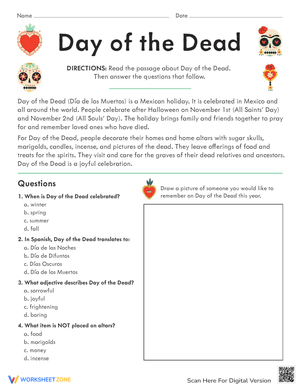
- Reading comprehension: Passages cover the Aztec and Catholic roots of the holiday, followed by literal and inferential questions. One passage addresses the UNESCO designation as Intangible Cultural Heritage of Humanity — a detail that anchors classroom discussion about cultural preservation.
- Ofrenda labeling: Students identify and label items on an illustrated altar — marigold petals, candles, water, salt, photographs of the deceased, and pan de muerto — connecting each object to its specific symbolic function.
- Venn diagram comparison: Students sort attributes of Halloween and Día de los Muertos into overlapping and distinct categories. This worksheet demands precision; students must justify every item they place in the shared zone.
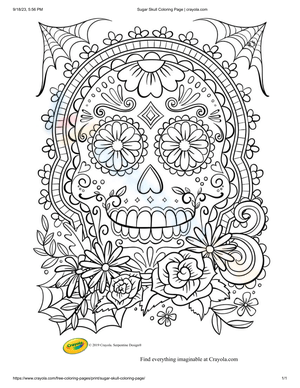
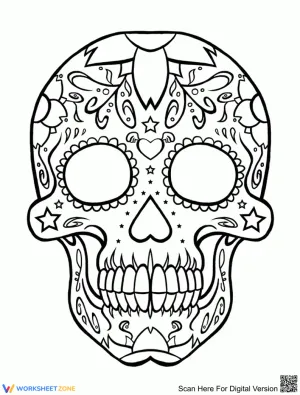
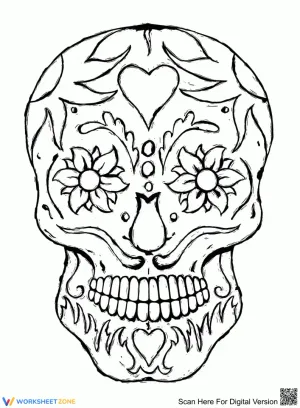
- Sugar skull symmetry: Students complete one half of a sugar skull design, practicing reflective symmetry while engaging with the visual tradition of decorating calaveras.
- Short constructed response: Students write 3–5 sentences explaining what the UNESCO recognition means for cultural preservation — a genuine argument prompt, not a summary task.
Why This Topic Earns Its Own Unit
The fusion of indigenous Aztec ritual and Spanish Catholic tradition that produced this holiday is genuinely complicated, and that complexity is exactly why students need structured reading and writing tasks rather than a quick class discussion. Aztec communities observed Mictecacihuatl, the Lady of the Dead, presiding over a month-long festival in which death was understood as continuation rather than conclusion. When Spanish colonizers introduced All Saints' Day and All Souls' Day onto the same calendar dates, those observances absorbed and reshaped existing practice rather than erasing it. Students who work through the reading passages and come to understand this layering develop a more accurate model of how cultures actually interact over time — a foundational concept in both social studies standards and literacy work at this level.
There is also a cognitive load argument for the worksheet format here. The holiday carries a dense vocabulary: six to eight Spanish-language terms, multiple symbolic objects with distinct ritual meanings, and a historical arc spanning pre-Columbian Mexico through twentieth-century popular iconography. Introducing vocabulary with visual anchors before moving to reading comprehension reduces the load that would otherwise compete with content understanding. Students who have already matched cempasúchil to its image and definition read the passage with more comprehension than students encountering the term cold.
Mistakes Students Make That These Worksheets Help You Catch
The most persistent error is the one students arrive with: writing or saying that Día de los Muertos is "basically Mexican Halloween." This conflation is understandable — both fall at the same time of year and both involve skeleton imagery — but it collapses a centuries-old tradition of grief, memory, and spiritual continuity into a commercial holiday about costumes and candy. The Venn diagram worksheet surfaces this error immediately. Watch for what students place in the center overlap. "Skeletons" and "late October or early November timing" belong there; "scary themes" do not. The holiday's tone is explicitly joyful, and students need to name that distinction in writing, not just nod at it during discussion.
A second error appears consistently in the ofrenda labeling worksheet: students describe the altar as a "worship shrine." The corrective is precise — ofrendas are not built to pray to the deceased but to welcome them back, providing water, food, and light for the return journey. That distinction has real cultural and doctrinal significance. Flag it before students begin labeling so the misconception does not get written in and reinforced.
Building These Worksheets Into Your November Lesson Plans
The calendar window matters here. The week between October 27 and November 1 is when Halloween excitement peaks in most classrooms, and that energy is an asset rather than a distraction. Students who carved a pumpkin the night before are immediately receptive to learning why marigold petals — not carved vegetables — guide spirits home in this tradition. Opening the unit on Monday of that week with the Venn diagram or the reading passage gives the cultural contrast immediate cognitive relevance. The juxtaposition lands harder when students are living inside it.
Station rotation works well with this set. One station runs the vocabulary matching and sentence-writing worksheet independently; a second pairs students for the ofrenda labeling activity, where conversation catches more errors than solo work does; a third is the sugar skull symmetry worksheet, which functions as productive quiet time after a discussion-heavy rotation. The dia de los muertos printable worksheets also hold up as reliable sub-day packets — they are self-contained and carry clear directions. Sequence them with the vocabulary worksheet as the entry task, reading comprehension second, and the art worksheet last. That order builds content knowledge before asking students to produce anything visual or creative.
Adjusting the Set for a Range of Learners
For students who need additional support, allow the vocabulary worksheet to remain visible during the reading comprehension task rather than being put away. The ofrenda labeling worksheet includes illustration cues that carry meaning without requiring strong reading fluency, making it accessible to ELL students who are still building English vocabulary but can connect cempasúchil to the marigold image. Students who struggle with extended writing complete the constructed response in a sentence frame or orally into a recording device.
Advanced students move past identification quickly. Give them the constructed response and push further — ask them to argue whether the United States should formally recognize Día de los Muertos as a national cultural observance. That task requires drawing on the UNESCO context, the historical background from the reading passage, and original reasoning. It is a genuine argument, not a restatement of facts. The dia de los muertos printable worksheets cover enough conceptual range that a single class session can have students working at genuinely different cognitive levels rather than just different quantities of the same task.
Standard Alignment
The reading passages and comprehension questions address CCSS.ELA-LITERACY.RI.4.3 (explaining events, procedures, ideas, or concepts in a historical text) and CCSS.ELA-LITERACY.RI.5.6 (analyzing multiple accounts of the same event or topic). The vocabulary work aligns with CCSS.ELA-LITERACY.L.4.6, which asks students to acquire and use general academic and domain-specific words. Social studies placement fits within NCSS Theme I (Culture) and NCSS Theme II (Time, Continuity, and Change), both of which appear in state frameworks including California's History–Social Science Standards for Grade 3 and New York's Social Studies scope and sequence. The symmetry worksheet supports CCSS.MATH.CONTENT.4.G.A.3 for classrooms running an art-math integration block alongside the cultural content.
Frequently Asked Questions
Is Día de los Muertos the same thing as Halloween?
No. Halloween traces to Celtic Samhain traditions filtered through European Christianity; Día de los Muertos grew from Aztec ritual merged with All Saints' and All Souls' Days. Both fall in late October and early November and both use skeleton imagery, but the tone, purpose, and meaning are entirely distinct. The Day of the Dead is explicitly joyful — families gather, cook the favorite foods of the deceased, and celebrate memory through music and offerings. The Venn diagram worksheet in this set builds that distinction through student writing rather than leaving it at the level of class discussion.
What age group are these worksheets best suited for?
The reading passages and constructed response tasks work best in grades 3–6. The vocabulary matching and ofrenda labeling worksheets reach down into grade 2 with teacher-led instruction; the symmetry worksheet works across the full K–6 range. For younger groups, the reading passage functions well as a read-aloud with the labeling worksheet used as a follow-up listening activity.
Can I use these materials respectfully in a classroom where some students have Mexican heritage?
Accuracy and specificity are the most reliable form of respect here. These worksheets emphasize the historical record — the Aztec roots, the colonial-era fusion, the UNESCO designation — rather than treating the holiday as exotic or decorative. Students with personal connections to the tradition often become the most valuable contributors to discussion when the material is grounded in fact rather than generalization. The worksheets treat the holiday as what it is: a sophisticated cultural tradition with a long, documented history, not a seasonal curiosity.
What is La Calavera Catrina and why does she appear on so many classroom materials?
La Calavera Catrina began as a political etching by José Guadalupe Posada around 1910 — a female skeleton wearing the elaborate European hat styles fashionable among Mexican elites of the era. The image was satirical, arguing that death equalizes everyone regardless of wealth or pretension. Diego Rivera later incorporated the figure into his 1947 mural Dream of a Sunday Afternoon in Alameda Park, cementing her as a cultural icon. She appears in classroom materials partly because she is visually striking and partly because her origin story makes an excellent text-based discussion prompt about art, class, and satire — exactly the kind of secondary source analysis that upper-elementary ELA standards ask students to practice.