


























Views
Downloads
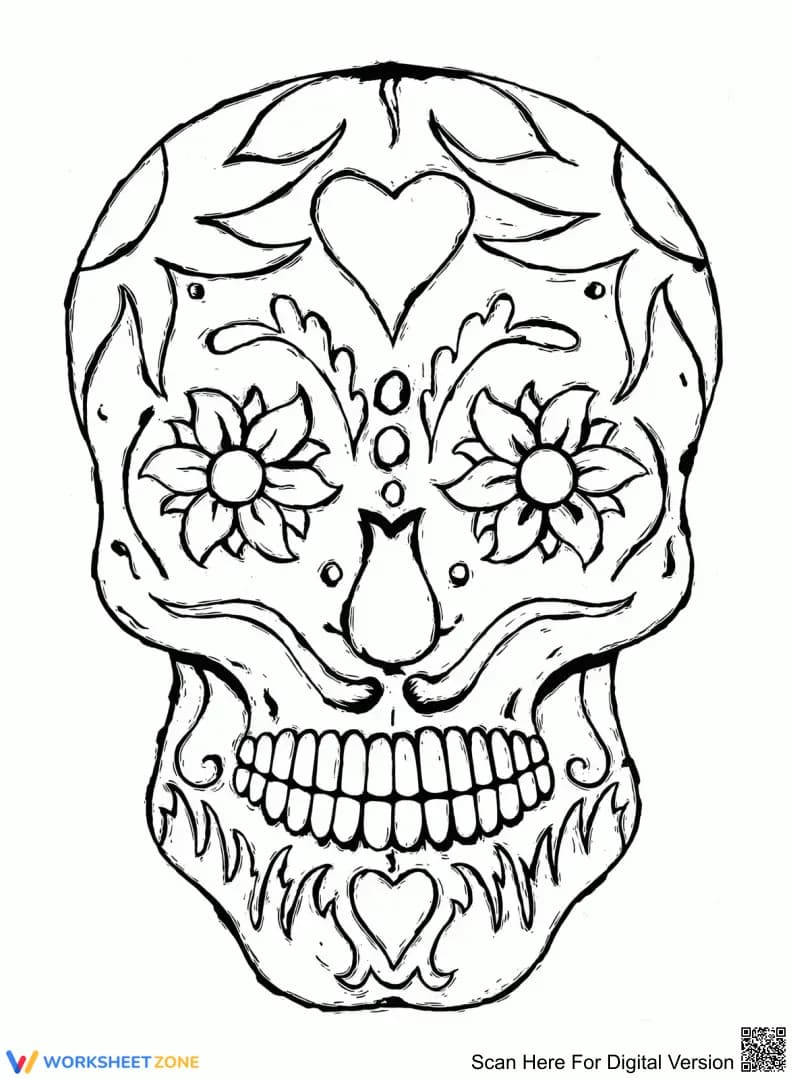

Skull with Flowers Coloring Page | Essential Art
Paste this activity's link or code into your existing LMS (Google Classroom, Canvas, Teams, Schoology, Moodle, etc.).
Students can open and work on the activity right away, with no student login required.
You'll still be able to track student progress and results from your teacher account.
This Grade 10-12 skull with flowers coloring page provides a sophisticated artistic outlet for students to explore intricate patterns and cultural symbolism. By engaging with this high-detail Calavera design, learners develop fine motor precision and visual literacy skills. It serves as an excellent supplemental activity for units on Mexican heritage, art history, or mindfulness.
At a Glance
- Grade: 10-College · Subject: English / Arts
- Standard:
CCSS.ELA-LITERACY.RI.10.7— Analyze various accounts of a subject told in different mediums- Skill Focus: Visual Arts and Cultural Symbolism
- Format: 1 page · 1 task · No answer key required · PDF
- Best For: High school art or cultural enrichment
- Time: 20–45 minutes
This single-page PDF features a high-resolution, black-and-white line drawing of a skull adorned with floral eye sockets and heart motifs. The design is optimized for high school and college-level complexity, offering narrow line weights that challenge older students' control. No additional teacher setup is required; the file is formatted for standard letter-sized paper and high-contrast printing.
The workflow for this resource is designed for maximum efficiency in a busy classroom. First, print the single-page PDF (30 seconds). Second, distribute the sheets to students along with colored pencils or fine-tip markers (1 minute). Third, review student work or facilitate a brief discussion on the cultural significance of sugar skulls (5 minutes). Total teacher prep time is under 2 minutes, making it an ideal sub plan or transition activity.
The primary standard addressed is `CCSS.ELA-LITERACY.RI.10.7`, which focuses on analyzing subjects across different mediums. Students apply this by interpreting visual symbolism and comparing it to textual descriptions of cultural traditions. This standard code can be copied directly into lesson plans, IEP goals, or district curriculum mapping tools.
Use this worksheet during a World Languages or Social Studies unit to introduce the iconography of Dia de los Muertos. It works best as a post-instruction activity where students can reflect on the lecture while working. Alternatively, use it as a formative assessment for color theory application; observe how students utilize complementary or analogous colors to fill the floral patterns. Expected completion time is 30 minutes.
This resource is tailored for high school students (Grades 10-12) and college learners who require more complex coloring tasks than elementary versions provide. It is particularly effective for students needing a calming, low-stakes creative break. Pair this with a short informational text about Mexican folk art or a direct instruction lesson on symmetry in design.
This artistic resource aligns with CCSS.ELA-LITERACY.RI.10.7, facilitating the development of visual literacy and creative expression through the medium of a Calavera-inspired design. Research from Fisher & Frey (2014) emphasizes the importance of visual scaffolds and non-linguistic representations in deepening student engagement with complex cultural themes. By providing a structured yet open-ended canvas, this worksheet allows older students to practice fine motor control and color theory application in a way that respects their developmental level. The inclusion of intricate floral and heart motifs encourages higher-order thinking regarding symbolism and aesthetic balance. According to the Fisher & Frey (2014) framework, such activities serve as vital "purposeful play" that bridges the gap between direct instruction and independent mastery. This 1-page PDF is a reliable tool for educators seeking to integrate art into broader humanities curricula without increasing administrative burden.


