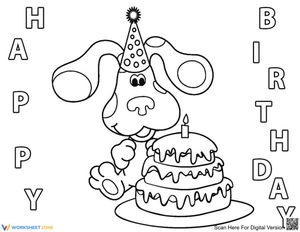
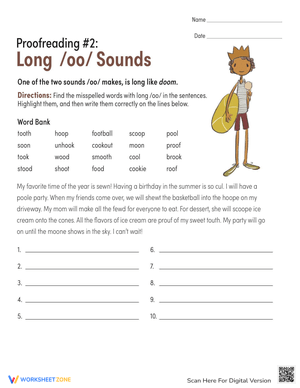
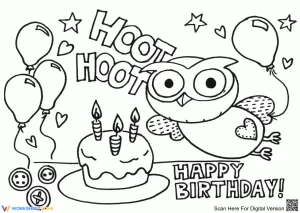
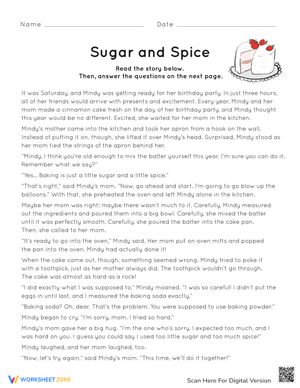
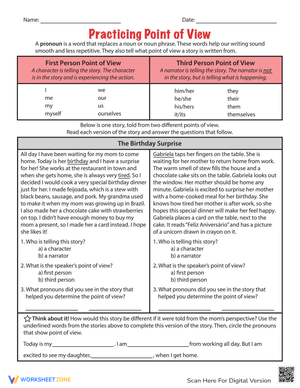
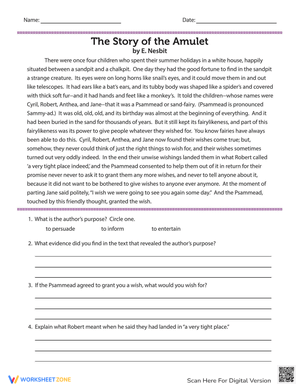
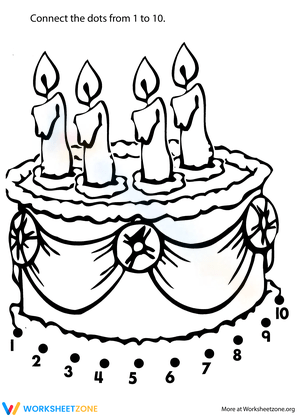
These birthdays pdf worksheets give K–2 teachers a cross-curricular entry point anchored in something students genuinely care about — which means the instructional sell-job is already done before the worksheet hits the desk. The set spans data collection and graphing, calendar sequencing with ordinal numbers, narrative writing, and fine motor development through tracing and cutting tasks.
What the Set Covers
Four skill areas appear across the worksheets:
- Data collection and graphing — students survey classmates on birth months, organize responses using tally marks, and construct bar graphs or pictographs from the results.
- Calendar and ordinal number work — filling in blank calendar grids, identifying specific dates, and applying ordinal language in context ("the third Wednesday," "the first Friday").
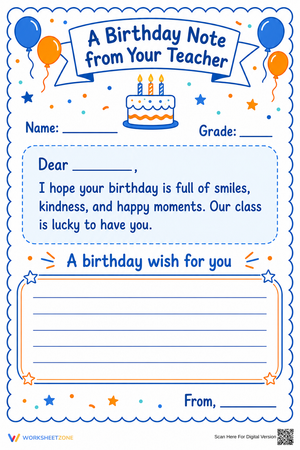
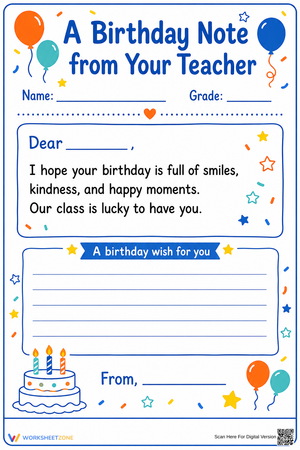
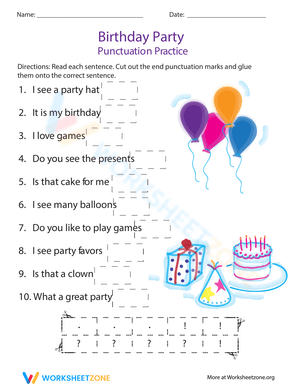
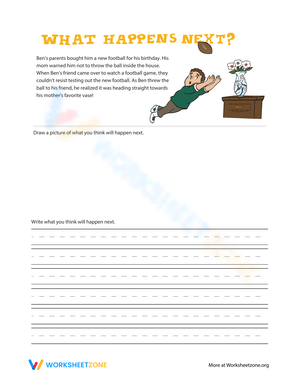
- Narrative and descriptive writing — structured prompts with sentence frames for emerging writers and open prompts for students who write independently.
- Fine motor development — letter tracing built around celebration vocabulary and a cut-and-sequence task where students arrange the twelve months in order to uncover a hidden birthday message.
What makes the graphing worksheets worth using is that every bar represents a real person in the room. Students check their own accuracy because they care whether the graph is correct — a motivation that does not exist when the dataset is fictional. That investment carries through the procedural steps that usually generate resistance: setting the scale, spacing bars evenly, deciding what to do with a month that has zero birthdays.
Why Birthday Month Data Works as a Teaching Tool
First-grade data lessons often collapse when the dataset feels manufactured. A tally chart of "favorite colors" produces technically correct graphs that students promptly forget. Birthday month data holds differently: students know exactly whose bar is tallest, they notice immediately when their own birth month is missing, and they argue — productively — over whether to count a July birthday for a student sitting right in front of them. The mathematical labor stops feeling arbitrary when the answer is about real people two rows away. Cognitive attention stays on the math — scaling, representing, comparing — rather than on why any of this matters.
Frequent Errors Worth Watching For in Student Work
On the graphing worksheets, the most consistent error is a scale mismatch: a student tallies nine October birthdays but draws only five bars, stopping when the column reaches the top of the page rather than adjusting the scale. Catching this before students move to the coloring phase matters, because it exposes a conceptual gap — they are treating the graph as decoration rather than representation. A thirty-second one-on-one check at the end of data collection prevents that misunderstanding from being reinforced through coloring and posting.
On the calendar worksheets, students who correctly name the months in sequence still stumble with ordinal suffixes. "April 3" becomes "April 3th" — a phonological error that mirrors how students hear "fourth" and overapply the -th to every numeral. Naming the pattern explicitly ("three doesn't take -th, it takes -rd — third, like third base") corrects it faster than repeated independent practice. In the writing section, the most common gap is temporal structure: students produce list-like sentences ("I want cake and balloons and a puppy") rather than a sequenced narrative. A three-box story map — beginning, middle, end — drawn before writing resolves this for most students without turning it into a separate lesson.
How to Build These Worksheets Into Your Lesson Sequence
The graphing worksheet works best as a September opener. Run data collection as a whole-class activity — students stand grouped by birth month, you tally on the board, then each student independently transfers the class data to their own worksheet and builds the graph. That gradual-release structure takes about twenty-five minutes and leaves a completed artifact worth posting immediately. Revisiting the same posted graph at the start of each new month — students track which birthdays occurred and compare running totals — turns a one-time task into a year-long data observation. That is a more accurate model of how analysts and scientists actually use data, and it costs nothing beyond pointing at the wall.
Calendar worksheets slot cleanly into morning meeting, where a single worksheet fills the six-to-eight-minute window before the day's first formal lesson. Keeping a small stack of birthdays pdf worksheets in an early-finisher folder means the set stays active across the year rather than being used once in September and shelved. The writing prompts serve a different function — pull one on a Friday free-write, or use one when a student finishes an assessment early. They do not need a dedicated lesson block to deliver value.
Adapting Each Worksheet for a Range of Learners
For students still solidifying number recognition, modify the graphing worksheets by pre-filling the month labels and scale so the task focuses on accurate counting and bar drawing rather than setup decisions. Students working above grade level extend the same worksheet by adding a written analysis: two sentences interpreting the graph and one prediction ("If we add next year's class, I think October will still win because..."). That extension raises the cognitive demand without replacing the core task or requiring a reprinted version.
The writing portion of these birthdays pdf worksheets comes with built-in variation. Students who need more structure use sentence frames; students who write fluently get the open prompt with a requirement to include at least three sensory details. For students receiving English language support, adding a small word bank with an illustration next to each term — "candle," "wish," "celebrate" — removes the vocabulary barrier so their attention stays on sentence construction. This is a two-minute paper modification, not a separate printing job.
Standard Alignment
The data and graphing worksheets align to CCSS.MATH.CONTENT.1.MD.C.4, which requires first graders to organize, represent, and interpret data with up to three categories and answer comparative questions about totals and differences. Most pacing guides place this standard in the second quarter — running the birthday graph in September as an informal preview gives students a concrete reference point when the formal unit arrives six to eight weeks later. The calendar sequencing worksheets support CCSS.MATH.CONTENT.K.CC.A.2 (counting forward from a given number in the known sequence) and connect to the broader measurement and data domain across kindergarten and first grade. The narrative writing worksheets address CCSS.ELA-LITERACY.W.1.3, which asks students to recount two or more appropriately sequenced events and provide some sense of closure — exactly what the three-box story map produces before students write a single sentence.
Frequently Asked Questions
Can these worksheets work for students who don't celebrate birthdays?
The graphing worksheet is built around birth month data, not celebration rituals, so a student who does not observe their birthday can still report their birth month and participate fully in collection, graphing, and analysis. The writing prompts are the area where sensitivity matters most. Keeping a parallel alternative available — "write about a day that felt meaningful to someone in your family" — means no student is put on the spot. Most students who do not celebrate birthdays engage readily with the math components, which is where the majority of the instructional time is spent.
How do the fine motor worksheets hold up for kindergartners versus first graders?
The tracing worksheets work well for kindergartners in the second half of the year, once students have developed basic pencil grip and control. Earlier in fall, the letter sizing may be too fine for students still building hand strength — in that case, project the worksheet under a document camera and use it for whole-class modeling rather than independent practice. First graders typically handle the cutting task without difficulty by October, but kindergartners in September often need the cutting lines slightly thickened or the shapes simplified before the task is productive rather than frustrating.
How many worksheets are in the set, and what subjects do they cover?
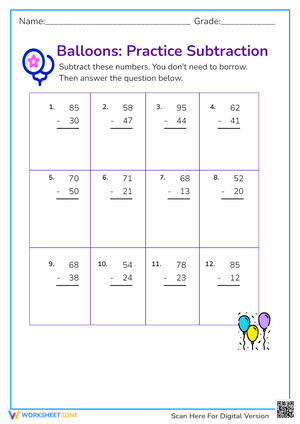
The set includes worksheets across four subject areas: mathematics (graphing and data), time and calendar (month sequencing and ordinal numbers), writing (narrative and descriptive prompts), and fine motor development (tracing and cutting). Each worksheet stands alone, so teachers pull individual ones based on the specific skill they are targeting rather than working through the set in a fixed order. The birthdays pdf worksheets in the collection span kindergarten-appropriate tracing tasks to second-grade data analysis, making the set usable across a two-to-three-year grade range without purchasing separate materials for each level.












 Interactive Worksheet Maker
 Quiz Maker
 Word Search Maker
 Crossword Puzzle Maker
 Word Scramble Generator
 Sentence Scramble Generator
 Handwriting Worksheet Generator
 Name Tracing Generator
 Fill In The Blank Generator