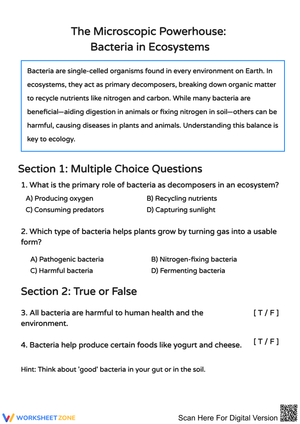
9th Grade Bacteria printable worksheets
These 9th grade bacteria worksheets give biology teachers a structured set of resources for moving students through prokaryotic cell anatomy, reproduction mechanisms, and ecological function — the three areas where freshman biology students most reliably hit conceptual walls. Each worksheet targets a discrete skill, so teachers can pull exactly what a lesson needs without sorting through a packet built around someone else's pacing.
What Each Worksheet Covers
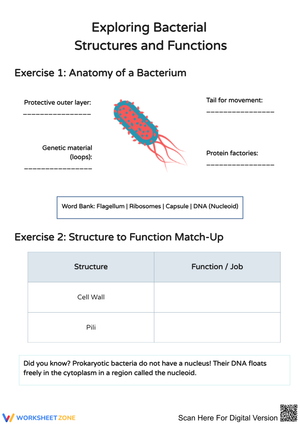
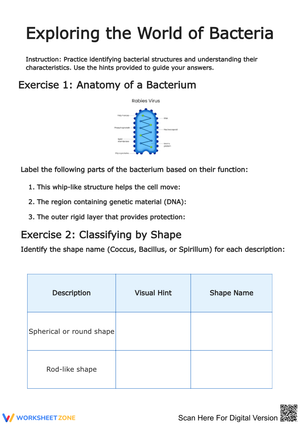
The set addresses bacterial cell structure first: students label diagrams identifying the nucleoid region, plasmids, ribosomes, cell wall, cell membrane, capsule, pili, and flagella — then match each structure to its function. That pairing matters because 9th graders can memorize organelle names without understanding why any of them exist. The worksheets push past label-and-move-on by asking students to explain, for example, why a capsule provides a selective advantage inside a host immune environment.
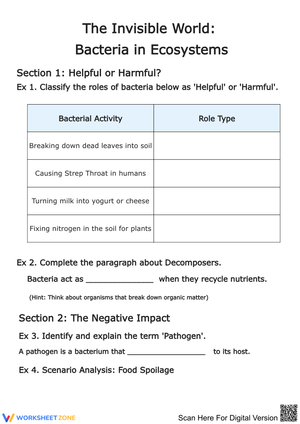
Shape classification — cocci, bacilli, spirilla — gets its own worksheet, with microscopy images students sort and name. Binary fission is treated through sequential diagrams students order and annotate, followed by growth curve problems where students calculate doubling time and identify limiting factors. Conjugation, transformation, and transduction each appear with process diagrams students trace step by step. One worksheet focuses specifically on how conjugation transfers plasmid-encoded antibiotic resistance, which connects bacterial genetics directly to a public health context 9th graders can actually care about. The ecological worksheets map bacterial roles in decomposition and the nitrogen cycle, requiring students to place nitrogen-fixing and nitrifying bacteria at the correct steps rather than simply copying a pre-labeled diagram.
Standard Alignment
These worksheets support NGSS HS-LS1-2, which asks students to develop and use models to illustrate the hierarchical organization of interacting systems that provide specific functions within multicellular organisms — and, by extension, within single-celled prokaryotes. The structure-function pairing throughout the cell anatomy worksheets is the direct instructional vehicle for this standard. Students are not just identifying parts; they are building an evidence-based claim that each component contributes to a specific life-sustaining process.
The antibiotic resistance and conjugation worksheets connect to NGSS HS-LS4-4, which addresses natural selection as the mechanism for changes in allele frequency over time. When students trace how resistance genes move between cells via plasmid transfer and then interpret a graph of a resistant population displacing a susceptible one, they are engaging in exactly the data analysis and explanation-construction that standard demands. Teachers using claim-evidence-reasoning frameworks will find the resistance worksheets already structured to support that writing process.
Where These Fit in the Day
The cell structure worksheets work best as post-lab synthesis tools — give students 20 minutes under the microscope first, then hand them the labeling worksheet so they are reconciling what they just saw with a detailed anatomical diagram. That sequence engages retrieval and comparison rather than passive copying, which is why students who do the lab first tend to retain the structures longer than those who see the diagram cold.
The binary fission growth curve problems are well suited to the Monday warm-up slot after a weekend gap. Returning to exponential growth math after two days off surfaces which students actually understood the concept and which students just followed along during Friday's lesson. The nitrogen cycle worksheets, by contrast, work better as mid-unit checks — usually around day four or five — when students have enough ecological background to see why the cycle matters but haven't yet reviewed it enough to have it locked down.
For conjugation and antibiotic resistance, small group work where each group traces a different horizontal gene transfer mechanism and then teaches it to the class produces noticeably better retention than individual seatwork. The diagrams in those worksheets double as presentation visuals, which gives the activity a real purpose beyond completing a worksheet for a grade.
Mistakes Students Make That These Worksheets Help You Catch
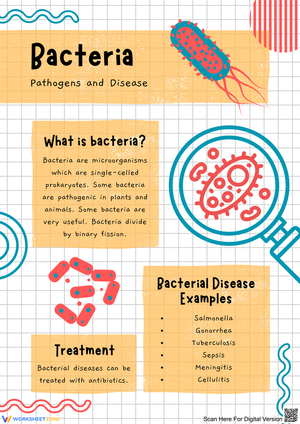
The most persistent error in prokaryote-eukaryote comparison is the belief that bacteria have no DNA — students who correctly state "no membrane-bound nucleus" frequently write on a subsequent question that bacteria lack genetic material entirely. The plasmid and nucleoid worksheets address this directly by asking students to describe where DNA is located and what form it takes, forcing them to distinguish between the absence of a nuclear membrane and the absence of DNA altogether.
On binary fission, students understand the concept of dividing in two but routinely misread growth curve graphs. They will identify the log phase correctly and then, when asked why growth slows, write "the bacteria run out of room" rather than specifying resource depletion, waste accumulation, or increased competition. The worksheet problems require students to name the limiting factor specifically, which moves them past the vague spatial reasoning toward actual population ecology logic.
The conjugation diagrams catch a third common error: students conflate the pilus with the channel through which DNA transfers. The pilus pulls cells into contact; the DNA moves through a cytoplasmic bridge. That distinction is invisible in lower-resolution diagrams, so the worksheets annotate both structures clearly and ask students to describe the sequence in writing — a step that forces them to hold both structures in mind simultaneously rather than using one label for both.
Frequently Asked Questions
Do these worksheets require microscopes or lab equipment to use?
No. The worksheets are self-contained and function independently of lab access. That said, the cell structure and shape classification worksheets pair naturally with prepared slide observation, and the learning is stronger when students use the worksheets after a microscopy activity rather than instead of one. If lab resources are limited, the worksheets still work — the diagrams are detailed enough to carry the conceptual load on their own.
At what point in a prokaryotes unit do these work best?
The cell anatomy and shape worksheets belong early — typically days one through three — because the vocabulary they establish (nucleoid, capsule, conjugation) appears throughout everything that follows. The reproduction worksheets fit mid-unit, after students have the structural foundation. The ecological worksheets work best near the end of the unit when students can see bacterial function at the scale of an ecosystem rather than just a single cell.
How do the antibiotic resistance worksheets handle the connection to natural selection, given that natural selection is sometimes taught separately in evolution units?
The resistance worksheets are written so they work in either context. When used inside a bacteria unit, the emphasis is on the mechanism — how conjugation moves resistance genes and why selective pressure from antibiotics favors resistant strains. When the same worksheet reappears in an evolution unit, teachers can use it as a concrete, fast-generating example of selection acting on a population. The worksheet itself doesn't change; the framing question the teacher asks shifts the focal standard.
Are these worksheets appropriate for students who struggle with reading-heavy science texts?
The worksheets are diagram-forward — most questions ask students to label, sequence, or annotate rather than read dense paragraphs and respond. The written explanation questions are scaffolded with sentence starters on the lower-level versions. That said, the conjugation and nitrogen cycle worksheets do require students to read and interpret process descriptions, so teachers working with students who have significant reading difficulties may want to pre-teach the key vocabulary before distributing those two worksheets specifically.
Clear All