


























1 / 2
0
Views
0
Downloads


0.0
0
Save
0 Likes
Share
Exploring the World of Bacteria Worksheet
0 Views
0 Downloads
Paste this activity's link or code into your existing LMS (Google Classroom, Canvas, Teams, Schoology, Moodle, etc.).
Students can open and work on the activity right away, with no student login required.
You'll still be able to track student progress and results from your teacher account.
Information
Description
What It Is:
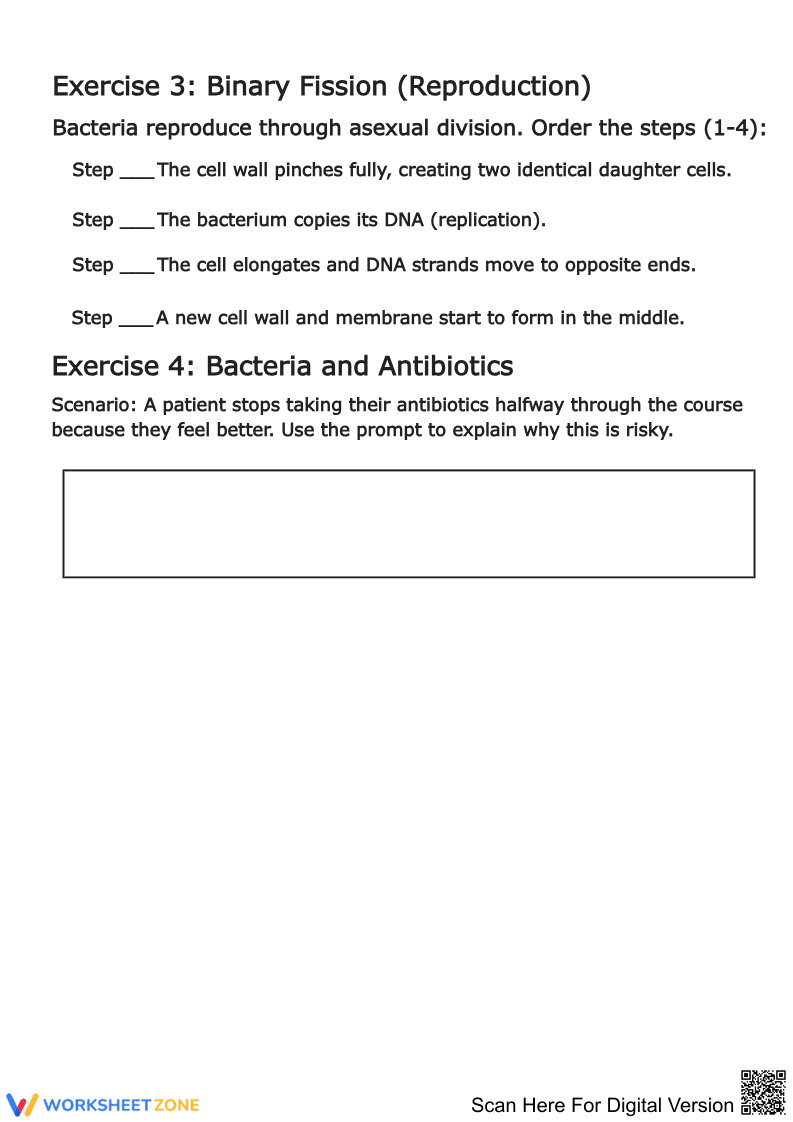
This worksheet helps students explore bacterial anatomy and classification by identifying key cell structures and distinguishing bacterial shapes such as coccus, bacillus, and spirillum. It includes labeling questions and a shape-classification table.
Why Use It:
It strengthens understanding of bacterial cell structure and morphology while reinforcing scientific vocabulary. The identification and classification tasks promote observation skills, concept retention, and critical thinking in life science units.
How to Use It:
• Label bacterial cell parts based on their functions (flagellum, DNA region, cell wall).
• Discuss how each structure supports bacterial survival and movement.
• Classify bacteria by shape using the provided descriptions and visual hints.
• Review answers together to reinforce terminology and correct misconceptions.
Grade Suitability:
Best suited for Grades 6–9.
• Middle school life science units on microorganisms and cells.
• Introductory high school biology review on prokaryotic organisms.
Target Users:
Science teachers, homeschool educators, tutors, and students studying microbiology basics.
This worksheet helps students explore bacterial anatomy and classification by identifying key cell structures and distinguishing bacterial shapes such as coccus, bacillus, and spirillum. It includes labeling questions and a shape-classification table.
Why Use It:
It strengthens understanding of bacterial cell structure and morphology while reinforcing scientific vocabulary. The identification and classification tasks promote observation skills, concept retention, and critical thinking in life science units.
How to Use It:
• Label bacterial cell parts based on their functions (flagellum, DNA region, cell wall).
• Discuss how each structure supports bacterial survival and movement.
• Classify bacteria by shape using the provided descriptions and visual hints.
• Review answers together to reinforce terminology and correct misconceptions.
Grade Suitability:
Best suited for Grades 6–9.
• Middle school life science units on microorganisms and cells.
• Introductory high school biology review on prokaryotic organisms.
Target Users:
Science teachers, homeschool educators, tutors, and students studying microbiology basics.


