9th Grade Osmosis and Tonicity Printable Worksheets
9th grade osmosis and tonicity printable worksheets give biology teachers a focused set of practice materials that moves students from surface-level vocabulary toward the reasoning skills a unit exam actually tests. Each worksheet targets a specific skill — labeling diagrams, predicting cellular responses, analyzing mass-change data — which makes it easy to slot individual exercises into warm-ups, guided practice, or end-of-class review without restructuring a lesson. The set covers water potential, tonicity classifications, and both plant and animal cell contexts in a sequence that builds rather than repeats.
What Students Practice Across the Set
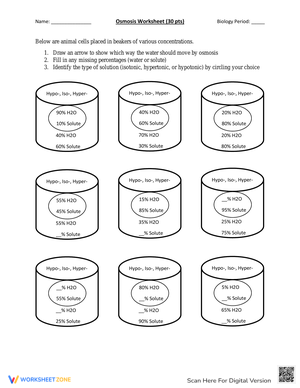
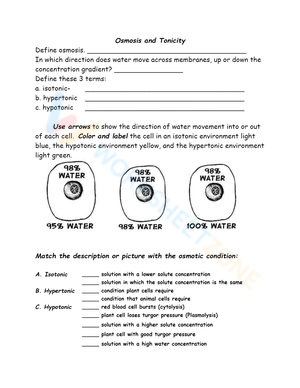
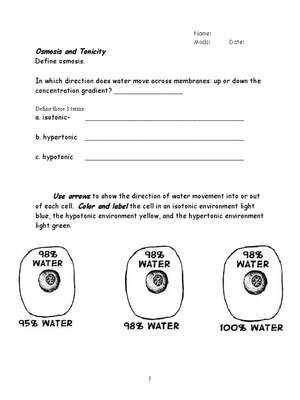
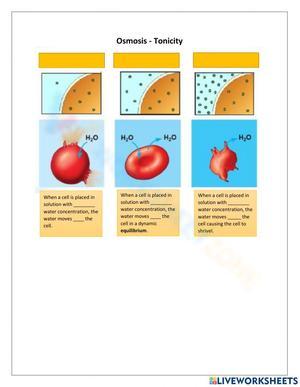
The worksheets move through several layers of the same core concept. Early exercises ask students to examine illustrations of cells in solutions of varying solute concentration, then label each solution as hypertonic, hypotonic, or isotonic and draw arrows indicating net water movement. A cell in a hypertonic solution — where the extracellular solute concentration is greater than the cell's interior — loses water, and arrows point outward. In a hypotonic solution, arrows point inward. That sounds clear enough, but drawing those arrows accurately requires understanding water potential, not just solute concentration, and that distinction is where most 9th graders first get stuck.
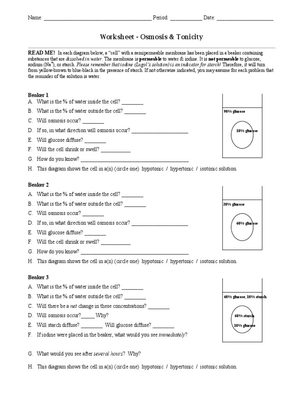
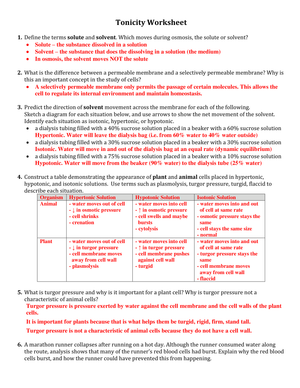
Later exercises shift to predictive scenarios and quantitative work. Students read a prompt — a red blood cell placed in a 10% salt solution, or a plant cell placed in distilled water — then predict the cellular response and justify it using accurate terminology. The data analysis exercises use the classic potato core lab format: students receive sample mass measurements taken before and after potato cores sit in solutions of varying sucrose concentration, calculate percent change in mass, plot the results, and identify the isotonic point of the tissue. That last step — reading a best-fit curve to locate zero percent change — is exactly the kind of quantitative reasoning that reappears in AP Biology and on state science assessments, so the practice earns returns well beyond this unit.
Vocabulary exercises close the gap between knowing a definition and applying a term correctly. Matching exercises cover solute, water potential, concentration gradient, dynamic equilibrium, and plasmolysis. The more demanding versions ask students to write original sentences using two terms together in a biologically accurate statement — which surfaces vague understanding that a simple matching exercise would miss entirely.
Plant Cells, Animal Cells, and Why the Distinction Matters
The comparison between plant and animal cells in different tonicity environments is where the unit gets genuinely interesting, and it's also where several persistent misconceptions take root. Red blood cells placed in distilled water swell and lyse — dramatic enough that students remember it. But plant cells in the same hypotonic solution become turgid without bursting, because the cellulose cell wall resists the inward pressure created by water entering the central vacuole. Students who have memorized "hypotonic means water moves in" will write "the plant cell bursts" unless a worksheet specifically prompts them to apply their knowledge of cell wall structure to the prediction. Several exercises in the set include exactly that prompt: explain why your prediction for the plant cell differs from your prediction for a red blood cell placed in the same solution.
Plasmolysis is the term that generates the most confusion on unit tests. When a plant cell loses water in a hypertonic environment, the cell membrane pulls away from the rigid cell wall — but students frequently describe this as the cell "shrinking," conflating plasmolysis with crenation. The structural distinction matters: in crenation, the animal cell membrane contracts inward because there is no wall to hold shape; in plasmolysis, the wall stays rigid while the membrane retreats. Worksheets that display a labeled before-and-after diagram of both processes side by side reduce that confusion more efficiently than any text explanation alone.
Error Patterns Teachers Should Anticipate in This Unit
The most consistent error in 9th-grade cellular transport has nothing to do with vocabulary — it's a directionality problem. Students reason that water moves away from where there is more solute, because "more solute means less room for water to stay." What they're actually doing is reasoning about solute movement, not water movement, and the logic is inverted. A student who writes that water moves from a salt solution into pure water has the gradient backwards. Predictive scenario worksheets expose this error quickly, because students must justify their arrows in writing — which makes the reversal visible on paper rather than hidden behind a correct multiple-choice guess.
A second pattern: students misapply the reference point when classifying solutions. A 3% salt solution is hypertonic relative to a red blood cell but could be hypotonic relative to a highly concentrated plant tissue. When exercises ask students to classify a solution without specifying the comparison point, answers fall apart. The stronger exercises in this set always name both the solution and the cell type, which trains students to ask "hypertonic relative to what?" — a habit that pays off directly on free-response items.
Where These Worksheets Fit in a Cellular Transport Unit
The labeling and vocabulary exercises work well as Monday warm-ups during this unit — eight to ten minutes, no materials required beyond the worksheet, low enough stakes that students settle in without anxiety. That retrieval window gets the relevant academic vocabulary active before instruction starts, which matters when the language load of cellular transport is as dense as it is. 9th grade osmosis and tonicity printable worksheets used in this warm-up role function as spaced retrieval rather than passive review, which reduces last-minute cramming before the unit test.
Predictive scenario exercises are most effective during guided practice, when students can talk through their reasoning before committing to an answer. Running them as small-group discussions — three or four students, five minutes, then a whole-class debrief — turns conflicting predictions into teaching moments. Students arguing over whether a potato slice in high-concentration saltwater will gain or lose mass are doing exactly the scientific reasoning this unit develops.
Use the data analysis worksheet as a post-lab activity the day after a hands-on potato core or dialysis tubing experiment. Students rarely get results that match the sample data provided, and that mismatch becomes a productive conversation about experimental error and why replication matters. A short "What Happens Next?" prediction exercise used as an exit ticket in the final five minutes of class gives a clean formative read on whether students can distinguish plasmolysis from crenation before the next day's lesson — information worth having before moving on.
Standard Alignment
These worksheets support NGSS HS-LS1-2, which calls on students to develop and use models to illustrate how molecules and cells interact within the hierarchical organization of a multicellular organism. Osmosis and tonicity sit at the molecular and cellular level of that hierarchy: water potential differences drive membrane transport, which drives cellular homeostasis, which connects upward to tissue, organ, and organism function. The labeling and arrow-drawing exercises address the modeling component of HS-LS1-2. The predictive scenarios and data analysis exercises ask students to use those models to explain and predict biological outcomes — the performance dimension of the standard. Vocabulary work is the prerequisite that makes the modeling communicable. Together, the set addresses all three dimensions of HS-LS1-2 without requiring a separate lab to satisfy the expectation, though the data analysis exercises pair naturally with hands-on work when time allows.
Adapting the Exercises Across Ability Levels
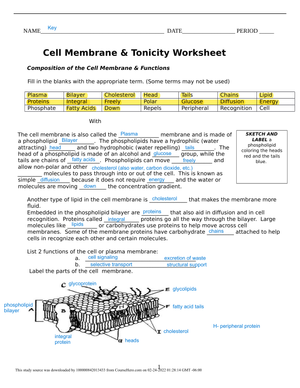
9th grade osmosis and tonicity printable worksheets in this set vary enough in cognitive demand that most mixed-ability classes can work from the same resources without one group finishing in three minutes while another can't begin. The labeling exercises include a vocabulary bank alongside each diagram, which keeps students still acquiring academic language from spending the period on terminology alone and lets them direct their attention to the directional reasoning the exercise is actually practicing.
Students who need more support benefit from the before-and-after cell diagrams in the predictive exercises. Rather than visualizing what happens to a red blood cell in saltwater from a written prompt alone, they are looking at two drawn cells and explaining the visible difference — which reduces working memory load enough to let the conceptual reasoning surface.
Advanced students get the most from the open-ended justification prompts. Asking a student who already understands basic directionality to explain — using water potential gradient and pressure potential correctly — why turgor pressure prevents a plant cell from lysing in a hypotonic solution requires the kind of precision that pushes a strong 9th-grade biology student toward AP-level thinking. The same worksheet, a more demanding expectation, a different learning outcome.
Frequently Asked Questions
What's the difference between osmosis and simple diffusion, and do these exercises address both?
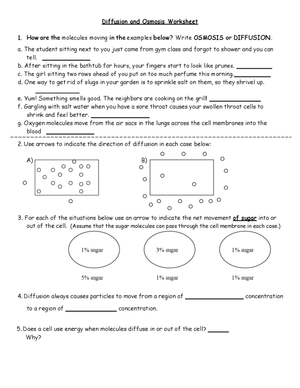
Simple diffusion moves solute particles down a concentration gradient without energy input. Osmosis is the specific case where water — the solvent — crosses a semi-permeable membrane from higher water potential to lower water potential. Both are passive; what differs is what's moving. Students routinely conflate them in diagrams because both show net movement across a membrane. Several worksheets include side-by-side diagrams asking students to label which process is occurring and explain how they can tell — a distinction that appears regularly on unit exams and state science assessments.
Why does finding the isotonic point matter in the data analysis exercise?
The isotonic point — where percent change in mass equals zero — tells students the sucrose concentration that exactly matches the solute concentration inside the tissue. Finding it from a graph requires reading a curve rather than just plotting points, and it gives osmosis a quantitative dimension that purely visual exercises can't replicate. Sample data built into the worksheet puts the isotonic point for potato tissue at approximately 0.3 to 0.4 M sucrose, a realistic value that gives students a meaningful benchmark when comparing it against their own lab results.
Do these worksheets include real-world context, or are they purely abstract?
The predictive scenario exercises are grounded in real biological and medical situations: why IV saline must match blood plasma concentration, what happens to plant cells when fertilizer-heavy runoff raises soil salinity, why slugs dehydrate when salt contacts their skin. A student who can explain the slug scenario accurately has internalized why water potential drives osmotic movement — not just memorized a direction. That level of understanding shows up on extended-response assessment items in ways that vocabulary matching alone doesn't produce.
How do these exercises fit alongside a hands-on osmosis lab?
The sequencing that works best in practice: use the labeling and vocabulary worksheets before the lab to establish the terms students will need when recording and discussing observations, run the lab, then bring in the data analysis worksheet the following day to formalize those observations mathematically. The 9th grade osmosis and tonicity printable worksheets in the data analysis category use a table format that mirrors a standard potato core or dialysis tubing setup, so students aren't learning to read a new structure — they're applying familiar math to their own lab data, which shortens the transition from lab to analysis considerably.
Clear All