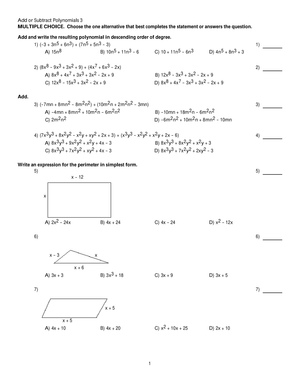
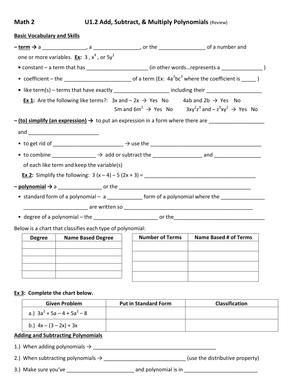
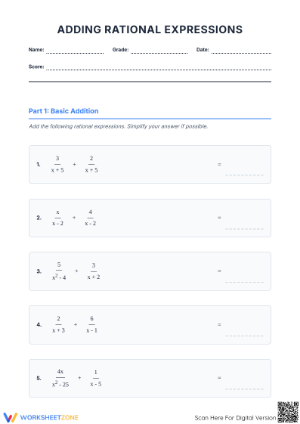
Adding and Subtracting Polynomials Printable Worksheets for 9th Grade
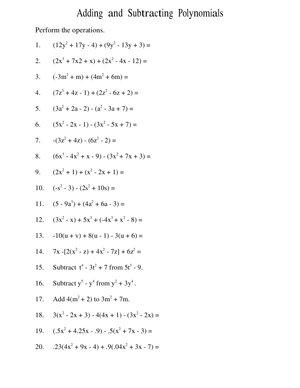
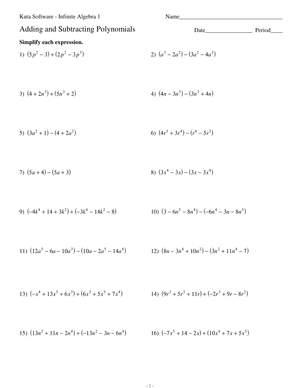
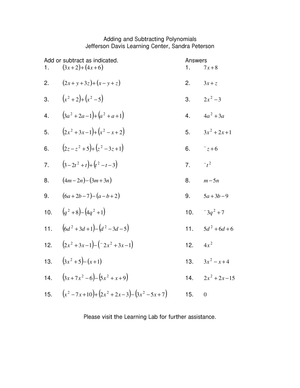
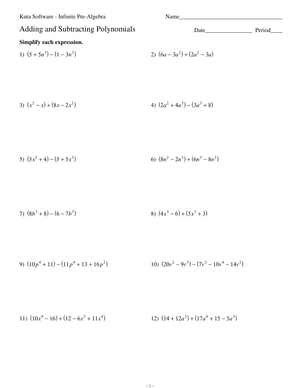
These adding and subtracting polynomials printable worksheets for 9th grade give Algebra 1 teachers a ready-to-use set of resources that move from identifying like terms through full polynomial subtraction with distributed negative signs. Each worksheet stands alone, so teachers can pull one for a Monday warm-up, drop another into a station rotation, and hold a third for skill review before a unit test — without overlap or repeated problems.
The Specific Skills Each Worksheet Targets
At the core, polynomial addition and subtraction ask students to do one thing consistently: combine terms that share identical variable parts and exponents, and leave everything else untouched. A term with x² cannot merge with a term that has x. A constant cannot absorb a variable term. That constraint sounds straightforward, but Grade 9 students encounter it for the first time in a symbolic form they haven't worked with before — moving from integer arithmetic into expressions that carry several moving parts at once.
The worksheets cover these connected operations:
- Sorting like terms before computing — students underline or annotate matching parts first, before touching any coefficients
- Adding polynomial expressions presented horizontally, with three or more terms per polynomial
- Distributing a subtraction sign across every term in the second polynomial before combining
- Rewriting results in standard form, with terms ordered from highest to lowest degree
- Working with multiple variables — expressions that include both x and y terms, where students must track two separate sets of like terms simultaneously
- Error analysis items — students identify and correct a worked example that contains a sign error or an unlike-term mistake
Addition problems appear first in the sequence. Students who handle addition accurately are far more likely to catch their own errors once subtraction enters the picture. That ordering also gives teachers a useful diagnostic checkpoint: if a student struggles with the addition-only items, the problem is almost certainly with like-term recognition or coefficient arithmetic — not with sign distribution.
Mistakes Students Make That Teachers Should Catch Early
The most persistent error in polynomial subtraction is partial distribution. Students apply the negative sign to the first term inside parentheses and treat the rest as unchanged. A student subtracting (4x² − 3x + 7) from another expression will correctly negate 4x² but carry forward −3x and +7 as if the parentheses weren't there. The sign on −3x should become +3x, and +7 should become −7. This error appears so consistently across a class that it's worth treating as a predictable instructional event rather than an individual mistake. When it clusters, the signal is clear: slow down, work through distribution explicitly, and have students mark each sign change on paper before combining anything.
A second error is subtler. Students combine unlike terms when variables look visually similar. In a longer expression, students will add 5x and 3x² — especially when those two terms sit near each other on the same line — because they see "x" twice and treat it as a match. That same error tends to disappear in vertical format, where stacking terms by degree makes mismatches visible at a glance. The gap in error rates between horizontal and vertical layouts is worth knowing when choosing which worksheet to assign and when.
A third pattern worth watching: dropped terms. Students rewrite their answers after combining and omit a term that had no matching pair. A trinomial minus a binomial still produces at least two terms in the result, but students who lose track during rewriting end up with fewer terms than the problem requires. Teaching students to count the unmatched terms before writing a final answer catches this before it becomes a habit.
How to Build These Worksheets Into Your Weekly Lesson Plan
The most practical placement for a quick-practice worksheet is the first five minutes of class. Three addition problems and two subtraction items let students settle in, activate prior knowledge, and give the teacher time to scan the room before direct instruction begins. That's not just routine-building — it's a fast formative read on what carried over from the previous day.
For a full independent-practice block, assign an entire worksheet and use the structure of the problems to pace movement around the room. When most students have finished the like-terms items and are moving into subtraction, that's the natural moment to pause, address the distribution step briefly, and release students to continue. The worksheet drives pacing rather than the teacher having to decide when to intervene without evidence.
Exit tickets work well when drawn from the final two or three problems on a worksheet — usually the items involving three-term polynomials or mixed operations. One addition problem, one subtraction problem, and a brief written response asking whether two given terms are like terms and why gives teachers three data points in under five minutes. The written explanation is consistently the most informative piece: students who correctly simplify by pattern but cannot explain why two terms cannot be combined need different follow-up than students who made arithmetic errors on coefficients.
When it comes to homework, adding and subtracting polynomials printable worksheets for 9th grade work best when the assigned problems follow a clear progression — straightforward items first, multi-step expressions toward the end — so that students who get stuck can still complete the accessible portion and come to class with partial work to discuss. That structure also protects against the homework routine collapsing entirely when a student hits a wall on the harder items.
Standard Alignment
These worksheets address CCSS HSA-APR.A.1, which requires students to add and subtract polynomials and understand that polynomials form a system closed under those operations. In a traditional Algebra 1 sequence, this standard typically arrives after students have worked through integer operations and variable expressions — exactly the prerequisite knowledge these worksheets assume. Most teachers introduce HSA-APR.A.1 in the first or second unit, well before multiplying polynomials or factoring quadratics, because both of those later skills depend on accurate like-term fluency. Assigning practice during that introductory window builds the accuracy students will need when polynomial operations become embedded in more complex tasks later in the course.
Adjusting the Set for Different Learner Levels
Adding and subtracting polynomials printable worksheets for 9th grade can serve students at different readiness points without requiring teachers to build separate resources from scratch. For students still shaky on integer operations, directing them to the addition-only items first and allowing work in vertical format reduces the visual tracking load. These students benefit from writing out every like-term group before computing anything — a step that slows them down initially but catches errors that mental shortcuts tend to hide.
For students who move quickly through the basic problems, the error-analysis items shift the task entirely. Instead of producing a correct answer, students must identify what went wrong in a flawed worked example and explain the error in writing. That demands understanding of why the steps matter, not just facility with the procedure — and it produces a different kind of class discussion, one focused on structure rather than answer verification.
Students who sit between those two groups often benefit from a partner-check routine: each student solves the same problem independently, then both compare answers and must locate the source of any disagreement. This keeps both students thinking rather than one student copying, and it surfaces errors neither would have caught working alone.
Frequently Asked Questions
What prior knowledge do students need before working through these worksheets?
Students need reliable integer addition and subtraction — including operations with negative numbers — before polynomial practice produces useful results. They also need to recognize what a variable term looks like and understand that exponents distinguish one term type from another. Students who cannot yet add and subtract negative integers fluently will make errors on these worksheets that look like polynomial mistakes but are actually arithmetic ones. Addressing integer operations first keeps later errors interpretable and keeps reteaching focused on the right skill.
How do teachers know when students are ready to move from addition to subtraction problems?
A practical threshold: students are ready when they can correctly identify like terms in a five-term polynomial and add two trinomials without dropping any terms. That combination is usually a better signal than a timed benchmark, because students who can do both have the attentional capacity to track what changes when a negative sign enters the picture. The addition-focused worksheets serve as that diagnostic — accurate and consistent addition work means subtraction practice can begin the next day.
Do these worksheets include answer keys?
Yes. Each worksheet comes with a corresponding answer key. Teachers can review a class set between periods, or students can self-check during station work without waiting for teacher confirmation. Answer keys also make peer-grading routines run cleanly — students circle errors on a partner's worksheet and record the correct answer without needing to ask what it should be.
Are these worksheets useful for students repeating Algebra 1?
Adding and subtracting polynomials printable worksheets for 9th grade work well in that context because the progression from simpler to more demanding expressions helps teachers identify exactly where prior gaps are — whether it's sign distribution, unlike-term confusion, or something earlier in the prerequisite chain. Students repeating the course often move through the addition items quickly and benefit most from the subtraction and error-analysis problems, which is where the skill tends to break down regardless of prior exposure.
Clear All