Author's Perspective printable worksheets for Grade 9
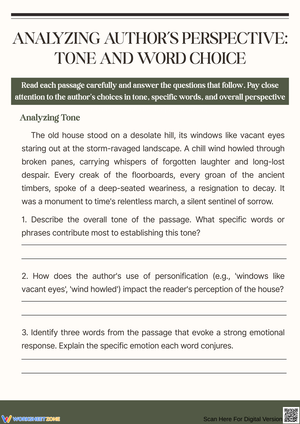
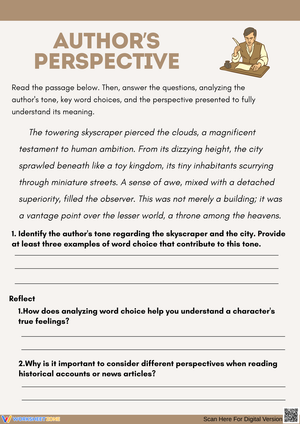
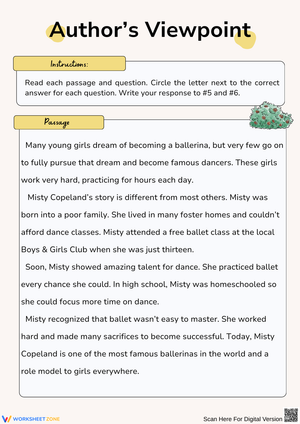
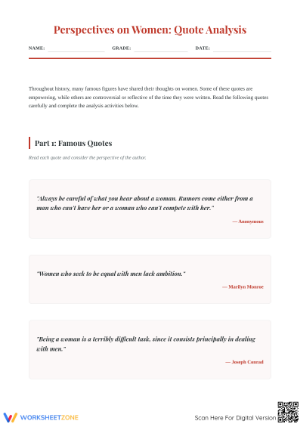
Author s perspective printable worksheets for 9th grade give teachers a concrete entry point into one of ELA's harder close reading demands — asking students not just to find what an author said, but to name the specific stance behind it and defend that reading with textual evidence. Each worksheet in the set pairs a grade-appropriate passage with evidence-based questions, an annotation component, and at least one written response prompt, keeping the analysis grounded in the text rather than in student opinion.
Grade 9 is a natural inflection point for this skill. Students entering high school can generally read for information — what did the author say? — but the CCSS progression at the 9–10 band shifts the expectation toward analysis: how does the author's viewpoint shape what gets included, what gets framed as credible, and what gets minimized or left out? That shift requires repeated, deliberate practice, and these worksheets deliver it in sessions short enough to fit real class time.
The Analytical Sequence Each Worksheet Builds
Each worksheet moves students through a clear, repeatable sequence. First, they identify the specific issue or question the author is addressing — not just the broad subject. Second, they name the author's actual stance on that issue in their own words. Third, they locate and quote evidence directly from the text. Fourth, they explain what that evidence reveals about the viewpoint.
One technique built into these worksheets consistently sharpens student analysis: students label each piece of evidence by type before writing their explanation. The four categories are word choice, claim, fact selection, and tone clue. That labeling step forces students to think about how a perspective gets constructed, not just where it appears on the page. Students who skip straight to explanation tend to produce circular reasoning — "the author thinks X because the author says X." Categorizing the evidence first breaks that pattern before it becomes a habit.
- Perspective identification: Students name the author's stance on a specific issue, not just the general subject.
- Evidence selection and quotation: Students locate and copy the exact words or phrases that reveal the viewpoint.
- Evidence labeling: Students sort their evidence into word choice, claim, fact selection, or tone clue before explaining it.
- Analytical writing: Students explain in complete sentences how the quoted evidence supports the perspective they identified.
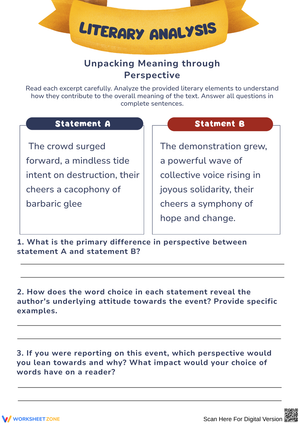
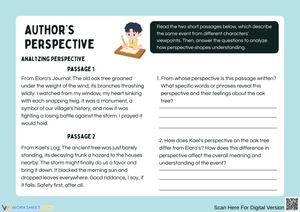
- Comparative tasks: Some worksheets set two short passages on the same issue side by side so students can identify where the perspectives diverge and what specific choices create that difference.
Teaching Perspective, Purpose, and Tone as Three Separate Things
The most stubborn confusion in this skill area is treating perspective, purpose, and tone as three names for the same observation. Purpose is why an author wrote the text — to inform, to persuade, to commemorate. Tone is the emotional register the language creates: measured, urgent, wry, indignant. Perspective is the specific stance the author takes on the subject itself, which can be subtle even when purpose and tone are obvious.
Consider an op-ed arguing against a proposed curfew for teenagers in a city park. The purpose is persuasion. The tone might be sharply critical or coolly analytical. But the perspective — the actual viewpoint — is that the curfew is unjust, ineffective, or rooted in distrust of young people. Students who collapse all three into "the author is against the curfew" are reading the surface. These worksheets push past that by asking students to name the stance precisely and then trace how purpose and tone work together to advance it.
Common Student Errors Teachers Should Anticipate and Address
The most persistent error is restating the topic instead of identifying a stance. A student writes "the author's perspective is about immigration policy" when the task requires something like "the author argues that current enforcement practices harm mixed-status families without meaningfully reducing unauthorized entry." Topic and stance are not the same thing, and this conflation shows up consistently in Grade 9 — even among students who are otherwise capable readers.
A second error: students quote the most emotionally charged sentence in the passage and treat the quotation as a complete answer without explaining what it reveals. Writing down "this law is a betrayal of our community's values" does not finish the analysis. The student still has to explain what viewpoint that language advances, why the author chose those particular words, and how the choice fits the rhetorical pattern of the text. Each worksheet builds an explanation prompt directly after the evidence slot because that explanatory step is where the actual thinking lives.
One subtler problem surfaces when students encounter passages that use neutral-sounding, restrained language. They often conclude that no perspective exists because they see no obvious opinion markers. These worksheets include several passages of that type specifically to train students to notice which details the author chose to include — and which plausible counterevidence got left out or minimized — as signals of perspective even when the tone stays measured.
How to Work These Worksheets Into Your Lesson Plans
Author s perspective printable worksheets for 9th grade fit several slots in the lesson week without demanding long setup. A single short passage works as a bell ringer: students come in, annotate for five to six minutes, then compare what they marked in a brief discussion before whole-class instruction begins. That structure gives teachers a real-time read on where students are before any new teaching starts.
For a mini-lesson sequence, model the evidence-labeling step with one passage as a class — narrating the thinking aloud, showing how to distinguish a loaded word choice from a stated claim — then release students to a second passage with a partner. The exit ticket application is equally practical: ask students to write one sentence naming the author's perspective and one sentence citing the strongest piece of evidence for it. Teachers who read those responses before the next class period get a clear map of who is ready for comparative work and who still needs reteaching on the difference between topic and stance — two very different instructional paths.
Standard Alignment
These worksheets address CCSS.ELA-LITERACY.RI.9-10.6, which asks students to determine an author's point of view or purpose in a text and analyze how the author uses rhetoric to advance it. The 9–10 standard represents a meaningful step up from the middle school version: rather than simply identifying point of view, students must now explain the rhetorical moves — diction, evidence selection, structural framing — that construct it. These worksheets practice exactly that progression, moving students from locating a perspective to analyzing how it is built into the text.
For work with literary excerpts, CCSS.ELA-LITERACY.RL.9-10.6 applies, covering how authorial choices shape narrator and character perspectives. Teachers whose departments track both informational and literary reading standards can use the set across text types without changing the core analytical framework students are practicing.
Adapting These Worksheets for Different Student Levels
Author s perspective printable worksheets for 9th grade accommodate a range of readiness levels without requiring entirely separate materials. The core sequence — identify the stance, quote evidence, label it, explain it — stays the same for all students. What changes is the amount of support built around that sequence.
For students who struggle with the written response prompts, a sentence frame at the explanation step makes a real difference: "This [label] reveals the author's perspective because ___." That frame keeps the analytical task fully intact while lowering the blank-page freeze that causes some students to stop working rather than attempt an imperfect sentence. It can be written on the board rather than printed on the worksheet itself, leaving each worksheet unchanged for other students in the room.
Students ready for deeper challenge can work with the comparative passage tasks, which ask them to articulate not just each author's individual stance but what specific choices make the perspectives differ — and which presentation is more persuasive, and why. That task mirrors the rhetorical analysis work students will encounter in AP Language courses and on college entrance exams, so using it with advanced ninth graders builds habits that pay off in later years.
Multiple choice items placed before constructed response tasks serve a diagnostic purpose in mixed-ability classrooms. When a student answers the multiple choice correctly but writes a weak explanation, the gap is likely a writing production issue rather than a conceptual one — and those two problems call for different responses. When a student misses both, reteaching the underlying concept is the right starting point.
Frequently Asked Questions
What is the difference between author's perspective, author's purpose, and tone?
Perspective is the writer's specific stance on the topic — the viewpoint being argued or expressed. Purpose is the reason for writing the text: to inform, to persuade, to reflect. Tone is the emotional quality created by the language choices: measured, indignant, wry, urgent. Strong Grade 9 analysis requires students to name all three separately and explain how purpose and tone work together to advance the perspective, not treat them as interchangeable.
What text types work best for these worksheets at Grade 9?
Editorials, op-eds, historical speeches, and opinion-driven informational articles make perspective most visible for students who are building the skill. Literary excerpts — especially first-person essays or narration with a strong authorial voice — also work once students are comfortable with the core analytical steps. The key is that the passage must carry a genuine, identifiable stance rather than a flat informational tone with no discernible viewpoint to analyze.
How do students write stronger evidence explanations on the response prompts?
Requiring students to label their evidence before writing the explanation is the most reliable move. Students who know whether they are working with a word choice, a stated claim, or a fact selection are better positioned to explain why that choice matters for the perspective. Without the labeling step, written explanations tend to be restatements: "The author says X, which shows the author thinks X." Naming the type of move the author made is what pushes students out of circular reasoning and into actual analysis.
Are these worksheets suitable for test preparation?
Author s perspective printable worksheets for 9th grade build the same evidence-based reading analysis that most state assessments and the SAT Reading section require. Those tests typically ask students to identify a writer's point of view, select the textual evidence that best supports it, and explain how specific details construct the perspective. The short-passage, evidence-quotation, and written-explanation format these worksheets use is directly parallel to that question structure, which means students practicing here are also rehearsing for the test format they will encounter later.
Clear All