8th Grade Revising Writing printable worksheets
These 8th grade revising writing printable worksheets resources give ELA teachers a focused set of standalone practice materials that target what revision actually requires at this level — not circling comma errors, but deciding whether a claim holds up, whether evidence is fully explained, and whether paragraph order serves the argument before a draft is ever finished.
The Skills Each Worksheet Builds
Revision at eighth grade means working on craft decisions that change meaning, not just appearance. Students at this level are writing argument essays, informative reports, and literary analysis — all of which demand distinct revision moves. Each worksheet isolates one or two of the following skills so students practice with genuine focus:
- Thesis and claim clarity: Students underline the central argument and rewrite it to be more specific or more defensible.
- Evidence elaboration: Students identify where evidence is dropped without explanation and draft the connecting sentences that tie examples back to the claim.
- Paragraph organization: Students reorder topic sentences, cut tangents, or rewrite conclusions that simply echo the introduction rather than adding insight.
- Transition quality: Students replace abrupt shifts with language that signals logical relationships — contrast, cause and effect, or continuation.
- Word choice and precision: Students mark vague or overused words and substitute language that carries more specific weight.
- Sentence fluency: Students combine choppy sentences, vary openings, and strip out repetition without losing meaning.
- Audience and tone: Students revise informal phrasing in argument writing to match academic register — without flattening voice out entirely.
The passage excerpts used across the set are intentionally short. Students can read the sample paragraph in under three minutes, which leaves most of the work time for actual revision thinking rather than just getting through the text.
Revision Errors Worth Anticipating Before the Lesson
The most predictable mistake in 8th grade revision work is conflation: students treat revision as proofreading and spend their time correcting punctuation while leaving untouched a thesis that does not actually take a position. A student might read the sentence "Pollution is a problem in many cities around the world" and mark it fine because there are no spelling errors. The more instructive teaching moment is getting students to see why that sentence is not a claim — it describes rather than argues, and no reasonable person would disagree with it.
A second consistent error involves evidence without elaboration. Students in eighth grade often include a quote or a statistic and then move immediately to the next point, as if the evidence speaks for itself. The revision skill being tested is whether they can write the sentence that explains how the evidence connects to the argument — not just that it does. That connecting sentence is the one most student drafts are missing, and it is the one most students do not think to add unless the worksheet directly prompts for it.
Sentence fluency errors are also common and specific. Students will vary sentence length reasonably in narrative writing but then revert to a series of similarly structured declarative sentences in argument pieces — subject, verb, object, period — eight or nine times in a row. That rhythmic monotony is harder to notice than a comma splice, which is exactly why it keeps appearing in unrevised drafts. Pointing to it explicitly, with a short excerpt where students count sentence openings, makes the pattern visible quickly.
Fitting These Worksheets Into the Week Without Redesigning a Unit
The format of each worksheet makes it easy to drop into existing instruction. A 10-minute bell ringer on thesis revision can lead directly into students rereading their own essay introductions. A Wednesday center activity on transition quality can reinforce a mini-lesson from Tuesday without any extra setup. The standalone nature of each worksheet means a teacher can use one on Monday for a warm-up and another on Friday for a peer review structure — in the same week, with the same class — and the two feel distinct rather than repetitive.
One of the most effective classroom moves is to pair each worksheet with a student draft from the same genre currently being written. When students practice revising an argument paragraph before they revise their own argument essay, transfer improves because the task feels immediately relevant rather than abstract. A single well-placed revision activity mid-draft — when students still have room to act on what they notice — can do more instructional work than four generic review exercises completed after the essay is submitted.
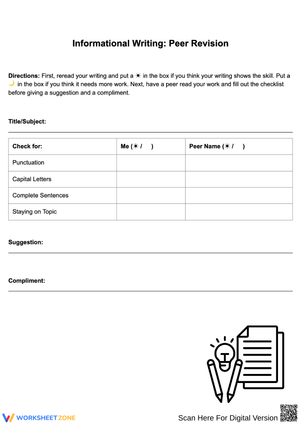
These 8th grade revising writing printable worksheets resources also work well for structured peer review. Instead of telling partners to "help each other," give each pair a worksheet with three targeted prompts: mark the claim, identify where evidence is strongest, note one place where a transition is unclear or absent. That structure keeps feedback focused on revision rather than proofreading, which is where most unguided peer review breaks down at this level.
Standard Alignment
The worksheets align to CCSS.ELA-LITERACY.W.8.5, which requires students to develop and strengthen writing by planning, revising, editing, rewriting, or trying a new approach with guidance and in response to audience and purpose. In practice, that standard gets taught most directly in the middle of a writing unit — after students have a working draft and before they move to final editing. These worksheets fit that window precisely, giving students a concrete revision task to complete while their own draft is still in progress, when the revision thinking is most transferable to their own work.
Adjusting Each Worksheet Across Ability Levels
Students who need more structured support do well with worksheets that present two or three rewrite options to choose from when revising a sentence or claim. The task becomes evaluative before it becomes generative, which lowers the initial difficulty without removing the thinking. Students further along can skip the choice format entirely and move to open-ended rewrites, then explain in one or two sentences why their revision strengthens the piece.
For intervention groups, the most useful approach is to focus one session on a single revision skill — say, evidence elaboration only — and repeat that same move across multiple short excerpts rather than rotating through several different skills. Repetition in a single session gives struggling writers a better chance of internalizing the core question: Does this sentence connect the evidence to the claim, or does it just repeat what the evidence says? That focused structure also helps teachers identify clearly which skill is the actual bottleneck, rather than attributing weak revision to general writing ability.
For students who are already strong revisers, the 8th grade revising writing printable worksheets set can serve a different purpose: giving them precise language for what they already do intuitively. Labeling a strong evidence elaboration sentence, explaining why a particular transition works, or comparing two versions of the same paragraph and articulating the difference — these tasks build the metalinguistic awareness that helps strong writers describe and improve their own craft decisions, not just make them by instinct.
Frequently Asked Questions
What is the difference between revising and editing, and how should I teach that distinction?
Revising addresses meaning, structure, and clarity — strengthening a claim, adding explanation to evidence, reconsidering paragraph order, sharpening word choice. Editing addresses correctness — punctuation, spelling, grammar, formatting. Teaching the distinction matters in 8th grade because many students default to editing when asked to revise, partly because errors are easier to spot than structural weaknesses. Keeping the two steps separate in instruction, and using worksheets that specifically target revision rather than mechanics, builds the habit of addressing the bigger issues first.
Can these worksheets be used for test prep?
Yes. Many standardized assessments at the 8th grade level include revision tasks — presenting a draft excerpt and asking students to identify the strongest revision to a specific sentence or paragraph. The 8th grade revising writing printable worksheets resources in this set mirror that format and build the analytical reading habit students need, because each task is short and focused rather than requiring a full essay response. Students who have practiced evaluating and rewriting short passages regularly are better positioned to work efficiently under timed conditions.
How do I decide which worksheet to use for a given lesson?
Match the worksheet to the current writing unit and the specific skill your class needs at that moment. If a recent draft review showed weak evidence elaboration across the board, use a worksheet that targets exactly that move. If students are about to do peer review for the first time in a unit, use a checklist-based worksheet that structures feedback around two or three specific revision points rather than asking partners to evaluate everything at once. The more directly a worksheet connects to what students are writing that week, the more likely the practice transfers to their actual drafts.
Clear All