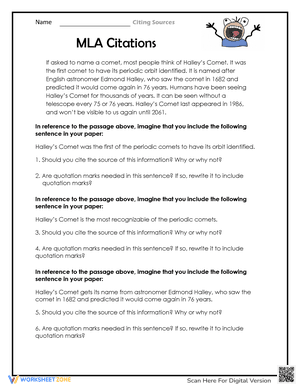
These 8th grade citing sources worksheets resources give teachers targeted, repeatable practice that breaks citation into manageable pieces — source identification, quoting, paraphrasing, summarizing, and assembling a Works Cited entry — without overwhelming students with formatting rules before they understand why citation matters. The challenge at this level is rarely student refusal; it's that students don't know what source details to capture while they're still reading. Each worksheet in this set addresses that problem at a specific stage of the research process.
What Each Worksheet Asks Students to Do
The 8th grade citing sources worksheets set moves students through the full arc of citation practice, one skill at a time. Rather than stacking quoting, paraphrasing, Works Cited formatting, and plagiarism awareness into one dense task, each worksheet isolates a single skill and gives students enough examples and practice items to actually internalize it.
- Identifying source parts: Students locate and label author, title, publisher or website name, and publication or access date from sample source documents.
- Quoting accurately: Students copy a passage exactly, add quotation marks, and write a lead-in phrase that names the source.
- Paraphrasing: Students restate a short passage entirely in their own words — which means restructuring the sentence, not swapping synonyms.
- Summarizing: Students reduce a multi-paragraph excerpt to its central claim and attribute it to the source.
- Recognizing plagiarism: Students analyze four versions of the same passage — copied without credit, word-swapped without credit, paraphrased with attribution, and quoted with attribution — and explain what distinguishes each one.
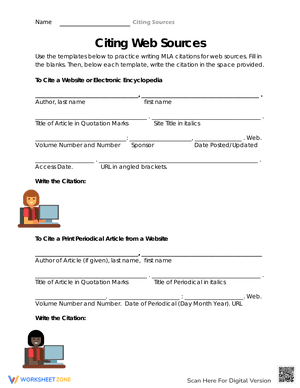
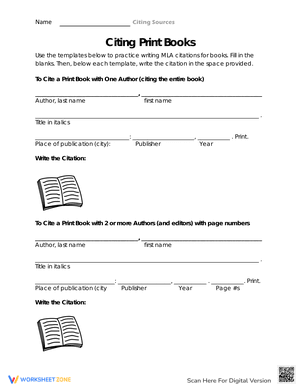
- Building Works Cited entries: Students assemble source information into MLA-style format for books, online articles, and websites, using a correctly formatted model entry as a reference.
That progression mirrors actual research behavior. A student who has practiced source identification separately from Works Cited formatting is in a far stronger position when those skills need to work together inside a drafted paper.
Errors Students Make That These Worksheets Help You Catch
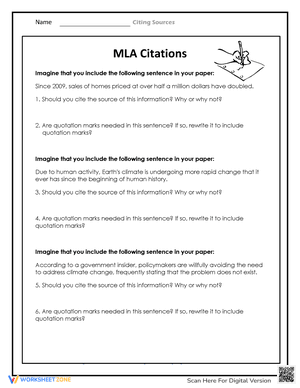
The most persistent citation error in eighth grade is not a punctuation mistake — it's the belief that changing a few words makes something original. A student will read: The ocean absorbs approximately 30 percent of the carbon dioxide humans release. Then write: The ocean takes in about 30% of the carbon dioxide that people emit. No quotation marks. No attribution. That's a paraphrase without credit, and most students genuinely don't see it as copying. They changed the words, so they believe the idea is now theirs. The plagiarism-recognition worksheets in this set address this directly by showing students examples side by side rather than asking them to absorb a definition.
A second pattern runs in the opposite direction: students paraphrase a sentence substantially but still wrap it in quotation marks — which misrepresents the source by implying those are the author's exact words. Both errors need explicit instruction, and the sorting tasks here force students to make the distinction rather than assume they already understand it.
Website citations produce a third recurring problem. Students record the URL and consider the job finished. They skip the article title, the website name, the author, and the date — the details that actually identify what was read and when. One worksheet asks students to annotate a sample webpage by marking each citable element before attempting any formatting at all. That step alone tends to break the URL-only habit more reliably than telling students to "include more information."
Where These Worksheets Fit in the Research Unit
Citation instruction works best when it runs alongside the research process rather than after it. The typical breakdown in middle school research writing is students who try to reconstruct source information the night before a paper is due, because they recorded facts but not the title, author, or URL that produced those facts. Teachers who use one worksheet per class session during the research unit — rather than saving all citation practice for a single day — prevent most of that problem before it starts.
In practice, that might look like this: during the first week of a research unit, students complete a source-identification worksheet at the same time they take their first set of notes, capturing author and title alongside the facts they're recording. In the second week, quoting and paraphrasing worksheets run as bell ringers or mini-lesson follow-ups — five to ten minutes of focused practice immediately after direct instruction. By the time students are drafting, Works Cited practice becomes a revision task rather than a new concept.
A teacher who turns to the 8th grade citing sources worksheets collection before a state writing benchmark can pull two or three targeted worksheets for a concentrated review — one on quoting, one on Works Cited format, one on plagiarism recognition — without needing to run a full research project to generate that practice.
Adapting These Worksheets for the Range of Students in Your Class
Students who struggle with citation benefit most from a narrowed process before attempting independent work. Start them with worksheets that include a partially completed entry — author name and title already provided — so the practice focuses on locating publication details and date rather than everything at once. Attribution sentence frames help as well: a short list of openers such as According to [author]... or In the article "[title],"... gives those students a reliable structure for introducing quoted or paraphrased evidence without getting stuck on phrasing.
Students who have the basic MLA pattern down need something that pushes past procedural compliance. A useful challenge: give them a single source passage and ask them to write a quote, a paraphrase, and a summary from the same material, then write one sentence explaining which form of citation they would choose for a specific argument and why. That decision-making task is closer to what real research writing demands and develops judgment rather than just accuracy.
Teachers working with English learners or in inclusion settings often find that the source-identification worksheets in this 8th grade citing sources worksheets set require a short vocabulary pre-teach before students can work independently. Terms like publisher, volume, and access date are unfamiliar to many eighth graders regardless of language background, and a single labeled example on the board before students begin reduces the two-minute freeze that otherwise happens when they encounter an unfamiliar citation field for the first time.
Standard Alignment
These worksheets align directly to CCSS.ELA-LITERACY.W.8.8, which requires students to gather relevant information from multiple print and digital sources, quote or paraphrase data and conclusions while avoiding plagiarism, and follow a standard format for citation. That standard comes up most often during argument and informational writing units that require multi-source evidence, and the targeted practice here gives students the repetitions they need without consuming entire class periods. The quoting and paraphrasing work also connects to CCSS.ELA-LITERACY.W.8.9, which asks students to draw evidence from texts to support analysis and reflection — a skill that depends on knowing when to quote, when to paraphrase, and how to attribute both accurately inside a piece of writing.
Frequently Asked Questions
What citation format should eighth graders use?
Most US middle school ELA classrooms introduce MLA format at grade 8. The practical approach is to reduce it to the fields students can reliably locate — author, title, source name, and date — before adding punctuation conventions and formatting details. Students who understand what each field represents retain the format far longer than those who memorize the pattern without knowing what the parts mean or why they're included.
When in a unit should citation instruction start?
The first day students touch a source. If they record even one piece of source information — a title, an author name — the first time they take notes, the habit begins. Waiting until the drafting phase to introduce citation almost guarantees students will have incomplete source records and will need to spend time tracking down information they already read once.
How do I teach plagiarism without putting students on the defensive?
Frame the conversation around authorship rather than dishonesty. When students understand that ideas belong to people the way songs or inventions belong to creators, plagiarism becomes a fairness issue rather than a rule to skirt. The sorting tasks in these worksheets — where students categorize examples rather than confess to past errors — keep the tone analytical and productive, which makes the concept land more cleanly than a lecture on consequences does.
Do these worksheets address digital sources specifically?
Yes. Several worksheets focus on websites and online articles as distinct source types, with practice on distinguishing article title from website name, locating a publication or "last updated" date, and identifying whether an individual author or a publishing organization receives credit. Those distinctions cause real confusion for students accustomed to print sources, because the layout of a webpage doesn't announce its citable elements the way a book's title page does.















 Interactive Worksheet Maker
 Quiz Maker
 Word Search Maker
 Crossword Puzzle Maker
 Word Scramble Generator
 Sentence Scramble Generator
 Handwriting Worksheet Generator
 Name Tracing Generator
 Fill In The Blank Generator