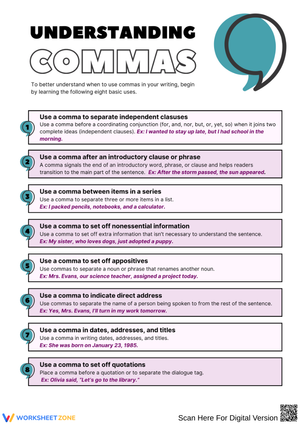
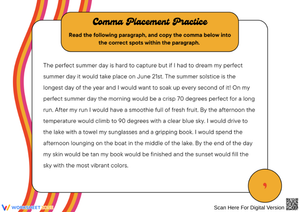
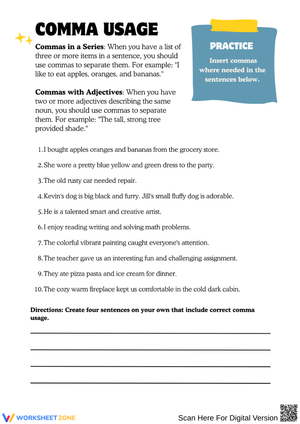
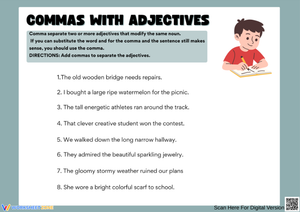
These 8th grade commas printable worksheets give teachers a rule-by-rule practice set built around the six comma situations that grade 8 students are expected to handle consistently in their own writing. Each worksheet zeroes in on one or two closely related rules — introductory elements, compound sentences, coordinate adjectives, items in a series, nonrestrictive appositives, and direct address — so teachers can assign exactly what a class or small group needs rather than handing out a sprawling punctuation review.
The Comma Rules Each Worksheet Targets
By 8th grade, students have technically seen most of these comma rules before. The problem is applying them when sentence structure is less obvious. Each worksheet in the set keeps the focus narrow, moving from controlled sentence work into short editing tasks within the same rule set.
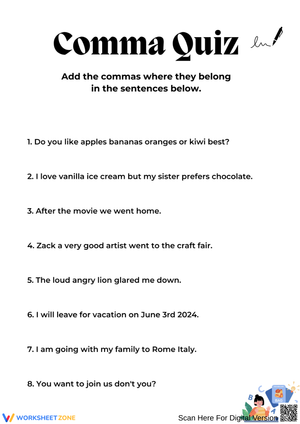
- Items in a series: Students insert, remove, and justify commas in three- and four-item lists, including series that contain internal phrases.
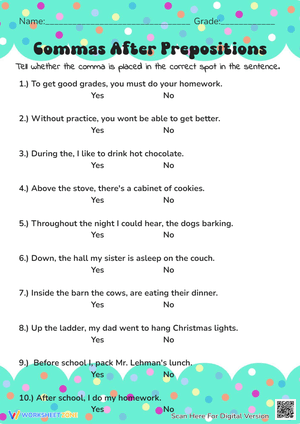
- Introductory elements: Practice covers single-word transitions, prepositional phrases, and full dependent clauses that open a sentence.
- Compound sentences: Students identify the coordinating conjunction and confirm that both sides are truly independent before placing a comma.
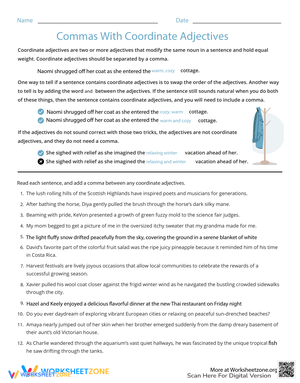
- Coordinate adjectives: Each worksheet on this skill asks students to apply the substitution test — does "and" work between the adjectives? — before punctuating.
- Nonrestrictive elements and appositives: Students mark which information is parenthetical and add or remove comma pairs accordingly.
- Direct address: Focused tasks help students distinguish a noun of direct address from a sentence subject.
The hardest skill for most 8th graders is the nonrestrictive/restrictive distinction. A student can correctly punctuate a list and still write "My sister who lives in Austin called me last night" without commas, because they have not yet worked out that the clause here limits which sister. The set gives this distinction more practice time than any other single rule.
Where 8th Graders Actually Go Wrong With Commas
The predictable error patterns are worth knowing before assigning any comma practice.
The most common mistake across the grade level is overuse around short introductory words. Students who understand that introductory phrases take commas will also write "After, she left" and "However, it is" because they have applied the rule too broadly. These worksheets include items that ask students to decide whether the opening element is substantial enough to warrant a pause — not just whether it precedes the main clause.
The coordinate adjective rule produces a specific error worth naming directly: students often apply a comma to any adjective pair. Present them with "a tall brick building" and many will write "a tall, brick building" because they have learned that adjectives before nouns can take commas — but not when one adjective modifies the noun-plus-adjective unit rather than the noun on its own. Having students apply the reorder test ("a brick tall building?") alongside the "and" test catches this much faster than re-explaining the definition.
Comma splices are frequent at this grade too. Many 8th graders join two independent clauses with a comma and no conjunction — not because they missed the rule, but because they cannot yet reliably locate where one independent clause ends. The editing tasks in the set ask students to bracket and label clauses before adding punctuation, which surfaces that underlying structural confusion rather than just marking the comma wrong.
Building These Worksheets Into Your ELA Week
The most efficient pattern most teachers land on is two to three days per rule: direct instruction with mentor sentences on day one, focused sentence practice on day two, and paragraph editing on day three. The worksheets fit that cycle cleanly because each one is organized around a single rule. Paragraph editing tasks work especially well on day three — students arrive with the rule in working memory and are ready to locate it in messier, less cued text.
For daily warm-ups, the sentence-level tasks on each worksheet split easily. Use five or six items at the start of class, finish the rest the next morning. That rhythm turns comma review into a low-stakes daily habit rather than a one-week grammar unit that disappears from student writing by the following Monday.
Small-group reteaching is another strong use for the set. When a round of paragraph editing reveals that a cluster of students still confuses restrictive and nonrestrictive clauses, pulling the focused worksheet on that rule gives those students a contained, workable task. Because answer keys are included, students can check their own work at the end of the group session — turning correction into a short conversation rather than a stack of papers to mark later.
Adjusting the Set Across Different Readiness Levels
For students who need additional support, the most effective adjustment is to limit the task to the sentence-level work on each worksheet and pair it with an anchor chart of the target rule. Shorter sentences with clear syntactic cues let students build accuracy on the rule without spending cognitive resources parsing unfamiliar vocabulary or complex clause structure.
On-level students work through the full sequence — sentence practice, then paragraph editing — and are asked to name the comma rule that applies to each correction rather than just inserting the mark. That labeling step forces explicit reasoning and makes errors much easier to diagnose during a quick review.
For students ready for extension work, the 8th grade commas printable worksheets pair well with a sentence-combining task: give students two simple sentences and ask them to merge them using a structure that requires commas — an appositive, a compound construction with a coordinating conjunction, or an introductory clause. The comma use becomes a consequence of a writing decision rather than a decontextualized exercise.
One honest limitation: students who freeze when reading an unfamiliar editing paragraph — because the topic or vocabulary is outside their experience — may struggle to apply comma rules they otherwise know. Reading the passage aloud together before independent work reduces that friction considerably.
Standard Alignment
These worksheets align to CCSS.ELA-LITERACY.L.8.2.a, which calls on students to use punctuation — including the comma — to indicate a pause or break in standard written English. That standard sits within the broader L.8.2 cluster requiring command of conventions across writing tasks, and it signals that by 8th grade, comma use should be accurate and purposeful rather than approximate.
In instructional terms, L.8.2.a does its real work when comma practice stays connected to revision. Teachers who use the 8th grade commas printable worksheets within a writing unit — asking students to flag the same comma decisions in their own drafts after completing the focused exercises — consistently report stronger transfer than those who keep grammar and composition in separate blocks.
Frequently Asked Questions
What comma rules does this set cover?
The worksheets address six rules that appear most frequently in 8th grade writing: items in a series, introductory elements, compound sentences with coordinating conjunctions, coordinate adjectives, nonrestrictive clauses and appositives, and direct address. Each rule gets its own dedicated worksheet with sentence practice and a paragraph editing component.
Do the worksheets include answer keys?
Yes. Answer keys support independent self-correction, station-based checking, quick small-group reteaching, and low-prep substitute plans. Having the key built into the set means the same worksheet can serve several different classroom purposes without additional preparation.
How do these worksheets fit into test prep or writing assessment review?
The paragraph-editing tasks within the 8th grade commas printable worksheets are the strongest assessment-prep component because they mirror how punctuation actually appears on passage-based editing questions — in context, across a range of rules, without labels telling students which rule applies. Isolated sentence drills are useful for initial rule practice, but switching to paragraph editing several days before a benchmark assessment gives students direct experience with the format they will encounter.
Are these worksheets challenging enough for students who already know the basic rules?
Students who have the basics down often still struggle with coordinate adjectives, nonrestrictive clauses, and comma overuse — areas where correct punctuation requires judgment, not just rule retrieval. The set includes enough complexity at those skill levels to challenge students who could correctly punctuate a simple series without hesitation. The sentence-combining extension tasks add a further layer of difficulty that keeps the practice meaningful for stronger writers.












 Interactive Worksheet Maker
 Quiz Maker
 Word Search Maker
 Crossword Puzzle Maker
 Word Scramble Generator
 Sentence Scramble Generator
 Handwriting Worksheet Generator
 Name Tracing Generator
 Fill In The Blank Generator