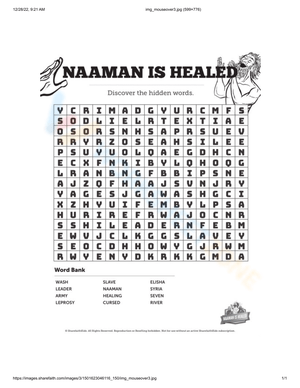
Naaman worksheets for 8th grade give teachers a text-based entry point into 2 Kings 5 that handles comprehension, character analysis, evidence-based writing, and theme identification — all inside a narrative compact enough for a single class period. The Aramean commander who seeks healing, rejects a prophet's simple instruction, then relents after his own servants reason with him covers a complete arc in fewer than thirty verses: pride, anger, reconsideration, obedience, healing. Every decision point in the plot is visible, which means students can follow character motivation without losing the thread of events.
Concepts and Skills Across the Set
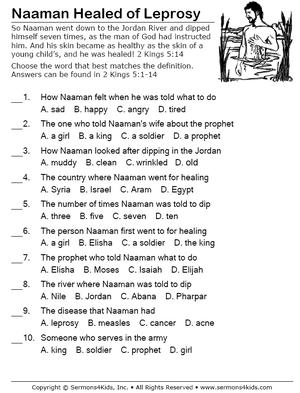
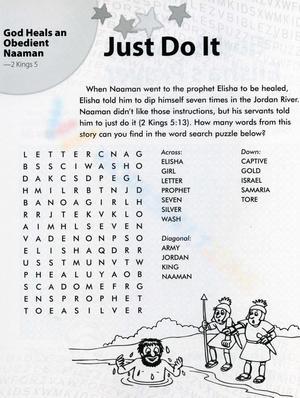
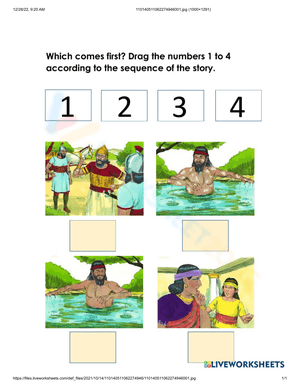
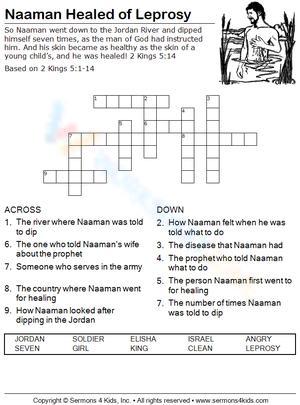
Each worksheet moves students from surface comprehension toward analysis. Sequencing questions track the story's key events — the servant girl's message, Naaman's journey to Israel, Elisha's instruction, Naaman's angry response, the servants' reasoning, and the healing in the Jordan — so students build an accurate mental map of the story before they analyze it. Vocabulary exercises pull words like commander, prophet, contempt, and obey directly from the passage and ask students to confirm meaning through context rather than definition-matching.
Character analysis drives the core of several worksheets. Students name a specific action for each major figure — Naaman, Elisha, the servant girl, Naaman's servants — and infer what that action reveals about that character. Cause-and-effect organizers ask students to explain how one choice produces the next event rather than simply listing what happened in order. Theme items direct students to notice repeated patterns across the story: who gives advice, who dismisses it, and who eventually listens. Each worksheet closes with a short constructed response requiring a claim and textual support. At 8th grade, students are expected to explain how specific choices reveal character traits rather than just describe what characters do — that expectation makes this passage particularly strong because the shift in Naaman's behavior is unambiguous and tied to distinct, citable moments.
Mistakes Students Make That These Worksheets Surface
The most predictable error is character freezing. Students write "Naaman is proud," which holds for the first half of the story, then apply that label to everything he does — including the moment he actually wades into the Jordan River. They collapse a character who changes into a static trait. Worksheet prompts that ask How does Naaman's attitude outside Elisha's house differ from his attitude at the river? force students to work across the full arc instead of pulling one adjective from the opening and stopping there.
The servant girl's structural role is consistently underwritten in student responses. A typical answer reads: "She told Naaman to go to Elisha." Students rarely push further to recognize that her single speech initiates the entire plot — a low-status character whose advice redirects a powerful man. Prompts that ask What would not happen if the servant girl had stayed silent? make that structural importance hard to ignore. Students who answer that question carefully produce much stronger theme statements about where wisdom actually comes from in this story.
Evidence quality is a third area. Students write "Naaman learned to be humble" as if the claim is self-evident, without anchoring it to any specific moment. The constructed-response prompts address this directly by asking students to name the action or event that shows the change, not just declare that change occurred. That distinction — between asserting something and supporting it with text — shows up clearly in student work and gives teachers a useful formative signal about where individual students are in their analytical writing development.
Building These Worksheets Into Your Lesson Plans
The most effective entry is a quick whole-class opener before the reading — three to five minutes on a single question about a time someone was told to try something simple when they expected something more dramatic. That framing primes students to notice the decision-making logic in the story before they encounter it. Then read 2 Kings 5 aloud or assign partner reading. Move into the worksheet's comprehension and sequencing section while students still have the text in front of them, and hold the character analysis and constructed response for the second half of the period.
For bell work, pull one cause-and-effect question from the set and give students five minutes at the start of class. For homework, the constructed-response prompt works well when students have already completed the reading and sequencing work in class — they have the details; the task is forming and defending a claim. Small-group days are particularly strong with this set: give one group Naaman's attitude arc, another the servant girl's role and what it implies about status and wisdom, and a third the cause-and-effect logic of the full plot. All three groups work from the same passage, then share evidence with the class. That structure produces discussion far more specific than a general open question about the story.
One consistent classroom observation: framing this passage as a decision-making text rather than a miracle story shifts how students engage. When they map each choice point — travel to Israel or stay home, wait at the door or leave in anger, follow the instruction or dismiss it — they treat the narrative as a sequence of problems worth thinking through. That framing also gives the teacher a natural path toward discussing peer influence, leadership, and why people sometimes dismiss straightforward solutions.
Adjusting the Set for Different Student Levels
For students who need more support, reduce the constructed-response requirement to a sentence frame — Naaman changes when _____ because _____ — and narrow the sequencing work to the three or four most essential events. A word bank for vocabulary items removes that barrier without touching the comprehension and analysis tasks. A structured cause-and-effect chart with the first event in each row already filled in lets students focus on explaining consequences rather than also recalling the triggering event.
Naaman worksheets for 8th grade also stretch well for students working above grade level. Ask those students to compare Naaman's response to Elisha's instruction with a character from another text who resists then accepts something they initially rejected — that comparison task requires them to hold this story's structure in mind while applying it somewhere new. A perspective-writing prompt asking students to write from the servant girl's point of view pushes both analytical and creative thinking: students have to infer what she observes in Naaman that leads her to speak up at all. A thematic extension prompt can ask students to identify a second theme beyond humility, argue for it with at least two pieces of textual evidence, and explain whether they find it more or less central to the story than the first.
Frequently Asked Questions
What grade level is this set written for?
These worksheets are written for 8th grade. The reading level, vocabulary support, and analytical tasks match the expectations for middle school readers at that level. Teachers working with advanced 7th graders or students in 9th grade who need additional reading support have used the set successfully with minor adjustments to the written-response expectations.
Can this set be used in a secular classroom?
Naaman worksheets for 8th grade treat 2 Kings 5 as a literary text — a short narrative with conflict, character development, and theme — rather than a devotional reading. The skills work (comprehension, character analysis, cause and effect, evidence-based writing) applies in both religious and non-religious instructional settings. Teachers in public school contexts use the story as a close-reading anchor the same way they would use any short narrative with a clear arc and traceable character change.
How long does each worksheet take to complete?
When students have already read the passage, most worksheets in the set take 20 to 35 minutes. Pairing the reading and the worksheet in one period typically requires 45 to 55 minutes. The constructed-response section is the most time-variable — some students draft quickly, while others benefit from two or three minutes of pre-writing before they begin.
Do the worksheets include answer keys?
Yes. Each worksheet includes a teacher answer key for the comprehension, vocabulary, sequencing, and cause-and-effect items. The constructed-response prompts come with annotated sample answers so teachers can calibrate expectations before grading student work. Naaman worksheets for 8th grade at this level should produce student writing that cites specific story events and ties evidence to a claim — the sample responses model that standard directly.












 Interactive Worksheet Maker
 Quiz Maker
 Word Search Maker
 Crossword Puzzle Maker
 Word Scramble Generator
 Sentence Scramble Generator
 Handwriting Worksheet Generator
 Name Tracing Generator
 Fill In The Blank Generator