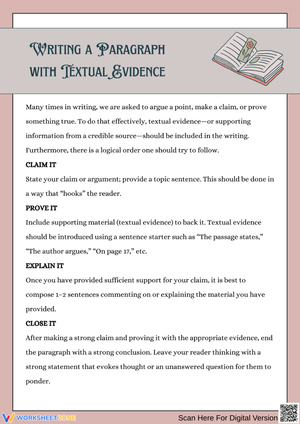
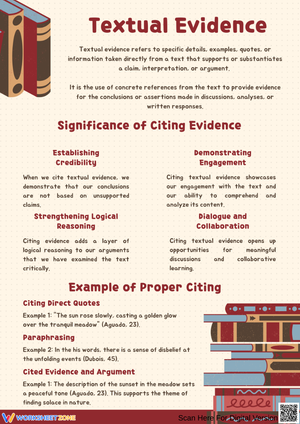
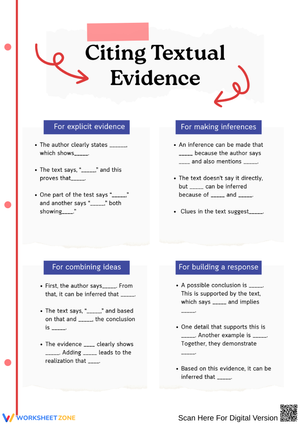
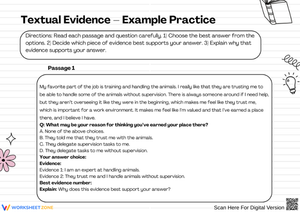
These 6th grade textual evidence printable worksheets give ELA teachers a concrete way to address a gap that appears consistently in grade-level reading response: students who understand what they read but cannot yet show how the text supports what they're claiming. At grade 6, the expectation shifts from retelling to analysis, and that shift is harder than it sounds. Each worksheet in this set builds the same three-part move — state a claim, select a specific detail or quotation, explain the connection — across both literary and informational passages.
The Specific Skills Targeted
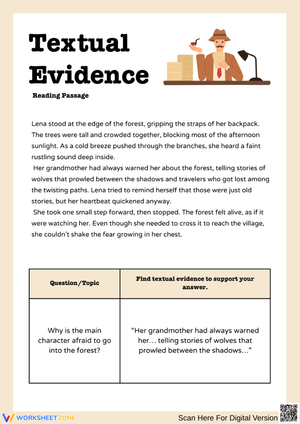
Every worksheet anchors a short, focused reading passage to text-dependent questions that require actual proof, not general memory of the reading. Students underline and annotate, then answer. The question types vary across the set to keep the cognitive demand from going flat:
- Selecting the strongest piece of evidence from two or three given options and justifying the choice in writing
- Copying a direct quotation, then writing a follow-up explanation sentence that connects the quote to the claim
- Paraphrasing a detail in their own words and noting where in the text they found it
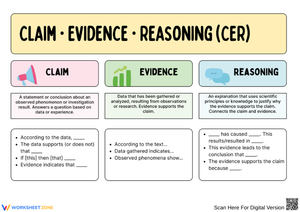
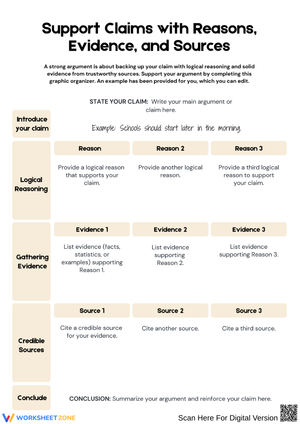
- Completing a full claim-evidence-explanation response with a prewritten prompt as the entry point
- Identifying when a provided quotation does not support a given claim — the task students resist most, because it requires them to articulate why something doesn't work, not just find something that does
Informational and fiction passages both appear throughout the set. With fiction, students support claims about character motivation, conflict, or theme. With informational text, they locate details that develop a central idea or back up an argument. Because the response structure stays the same in both genres, students stop treating textual evidence as a fiction-only or nonfiction-only skill and start using it as a default habit in written response.
Frequent Student Errors Worth Watching For
The most reliable error pattern at this grade is treating the quotation as the explanation. A student will write The text says "he walked away without looking back" and stop, assuming the quote proves the point without further comment. These worksheets make that gap immediately visible because every response format includes a separate explanation line. A blank explanation line tells you exactly where the student's thinking stopped — more informative, honestly, than a paragraph that buries the same gap inside four vague sentences.
The second pattern is choosing vivid evidence over relevant evidence. A student supporting a claim about a character being determined will sometimes cite a sentence about the storm growing stronger — dramatic, yes, but not proof of the character trait. The evidence-selection questions in this set specifically address that confusion by giving students multiple options and asking them to justify their choice, which forces evaluation of relevance rather than just picking the most interesting line in the passage.
Students also apply sentence frames mechanically once they learn them. The text states... gets copied onto every response whether or not the introduction fits the context. That rigidity needs separate teacher modeling to address, but the volume of practice in this set gives students enough repetitions that some begin modifying the frames on their own after a few weeks — which is a useful signal about readiness for more independent writing work.
Working These Worksheets Into Your Weekly Lesson Plans
The most reliable entry point is as a follow-up to a whole-class close reading lesson. Students have just annotated a passage together — now they move to an independent worksheet with a passage they haven't seen or marked yet. That shift, from supported annotation to independent written response, is where most 6th graders still need practice, and ten to twelve minutes of quiet writing reveals exactly where the reasoning breaks down.
Bell ringers are another strong fit. A single question with an evidence box and explanation line takes about seven to eight minutes — just enough to fill the window before a lesson opens without cutting into instruction time. Some teachers use 6th grade textual evidence printable worksheets resources as Monday warm-ups after morning announcements, rotating between fiction and informational passages so students build both response types across the week without the practice feeling repetitive.
For small-group instruction, the evidence-selection questions are the most productive items. Pull three or four students who consistently write thin responses and work through one question together before anyone writes anything — not rereading the passage again, but talking through which piece of evidence is stronger and why. That oral rehearsal usually produces more precise explanation sentences than students generate when they go straight to writing.
Exit tickets are another reliable use. Prewrite the claim on the worksheet, and have students add only the evidence and explanation sentence before leaving. Scored on a two-part rubric — one point for relevant evidence, one point for a complete explanation — this becomes a fast formative check that takes about three minutes to read through after class.
Standard Alignment
These worksheets target CCSS.ELA-LITERACY.RL.6.1 and CCSS.ELA-LITERACY.RI.6.1. Both standards require students to cite textual evidence when explaining what a text says explicitly and when drawing inferences. In classroom terms, RL.6.1 appears in response-to-literature writing — supporting a claim about character, conflict, or theme with specific lines from the story. RI.6.1 appears when students explain how a detail in an informational passage supports a central idea or an author's argument. Both standards are assessed directly on most state ELA exams in grades 6 through 8, and both reward the same underlying habit: returning to the text for proof before committing to a claim in writing.
Differentiating the Set for Mixed-Ability Classrooms
The core expectation holds at every level: students answer with proof from the text. What varies is the degree of support surrounding the task. Students who struggle with academic writing can use the included sentence frames — One detail that supports my answer is... and This shows that... — which provide a starting point without doing the reasoning for them. These frames keep the writing moving so students spend their working time on selecting and explaining evidence rather than on how to begin a sentence.
For students who are ready for more, two adjustments work without any additional materials: require two pieces of evidence instead of one, and ask which piece is stronger and why. That comparative reasoning task is harder than it looks and keeps students engaged who would otherwise rush through a single-evidence response and stop working two minutes into independent time.
On the reading side, passages in the set vary in length and complexity. Starting students who read below grade level on the shorter informational passages — where supporting details often sit closer to the surface of the text — keeps the skill practice moving while comprehension instruction happens through other means. The 6th grade textual evidence printable worksheets in this set make that kind of adjustment straightforward because the task structure stays consistent: change the passage, and students are still practicing the same analytical move.
Frequently Asked Questions
How long does each worksheet typically take to complete?
Most worksheets in this set take between eight and fifteen minutes, depending on passage length and the number of questions. A single bell-ringer question with an evidence box runs about seven to eight minutes. A complete claim-evidence-explanation response with a longer passage takes closer to twelve to fifteen. That range makes the set flexible across bell ringers, mini-lesson follow-ups, and longer independent work blocks.
Can I use these worksheets with a class novel instead of the included passages?
The response structure on each worksheet — evidence box, explanation line, full written response format — transfers directly to any passage. Many teachers cover the printed passage and have students respond to a chapter or excerpt from a class novel using the same format. The structure holds regardless of the text source, which is part of what makes these worksheets reusable across multiple units in a year.
Do the worksheets address paraphrasing, or only direct quotation?
Both appear throughout the set. Some questions ask for a direct quote; others ask students to restate the evidence in their own words and note where in the text they found it. Teachers working toward a state assessment that specifically rewards paraphrased evidence can prioritize those questions during review weeks without skipping the citation work entirely.
How do I know when a student is ready to drop the sentence frames?
A reliable sign is when students start modifying the frame instead of copying it verbatim — adding a character name, changing the verb, or skipping the frame entirely and writing a complete introduction on their own. That's the point where 6th grade textual evidence printable worksheets practice starts converting into the more flexible analytical writing expected in grades 7 and 8, and it usually shows up gradually in student work rather than all at once.












 Interactive Worksheet Maker
 Quiz Maker
 Word Search Maker
 Crossword Puzzle Maker
 Word Scramble Generator
 Sentence Scramble Generator
 Handwriting Worksheet Generator
 Name Tracing Generator
 Fill In The Blank Generator