Printable Grade 6 Analogy Practice for Vocabulary and Word Relationships
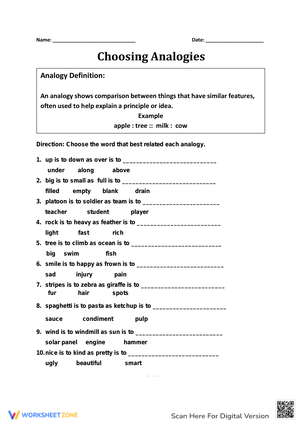
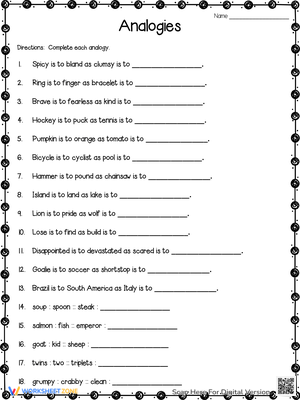
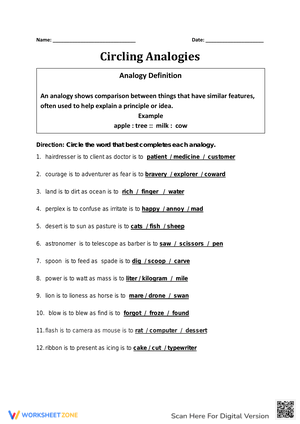
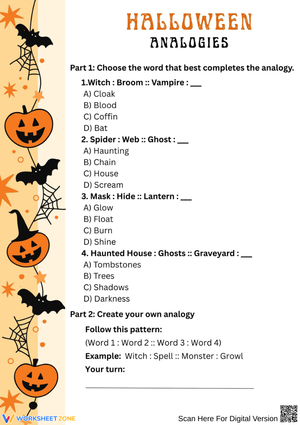
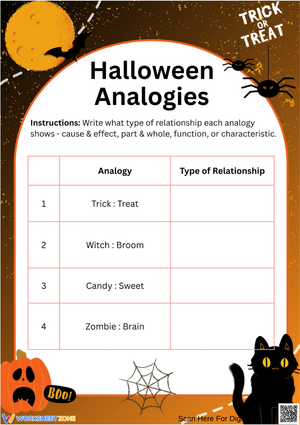
6th grade analogies pdf worksheets give language arts teachers a printable, low-setup resource for pushing vocabulary instruction past definition recall and into relational thinking. Each worksheet asks students to identify the connection between a word pair — part to whole, function, category, cause and effect — and then transfer that same relationship to a second pair. That two-step process makes the task useful not just as vocabulary practice but as a quick read on how flexibly students understand word meaning and logic.
The Relationship Types Students Work Through
Sixth grade is the moment when vocabulary work stops being mostly about definitions and starts requiring students to show how words relate to one another. The analogy format makes that demand explicit. Students cannot guess by reading tone or picking a word that sounds familiar — they need to name the relationship between the first pair before they can find the correct second pair. Each worksheet mixes synonym, antonym, part-to-whole, function, category, characteristic, and cause-and-effect items, giving students repeated practice with all the relationship types they encounter in middle school reading, not just the ones easiest to format as multiple-choice.
The structure also gives teachers a concrete vocabulary-building routine without requiring a full reteach. A set that spirals previously taught Tier 2 and Tier 3 words into analogy items lets teachers revisit terms from a unit on ecosystems, ancient civilizations, or argumentative writing without pulling those words into a separate activity. The reasoning stays the same; the content rotates.
Student Error Patterns Worth Watching in This Work
The errors that surface in analogy practice are rarely about carelessness. The most consistent pattern in sixth-grade classrooms is what might be called relationship skipping: a student sees "gills : fish" and immediately searches for another aquatic word instead of first asking what the structural connection is. When the correct answer required recognizing a part-to-whole relationship, choosing a thematic associate instead signals a skipped reasoning step — not missing vocabulary. That distinction matters because the instructional response is different. Modeling the identification step aloud, using sentence stems like "This shows a ___ relationship because ___," addresses the actual breakdown more directly than more vocabulary review would.
Cause-and-effect items produce a second reliable error: direction reversal. A student may understand both words — "drought" and "crop failure" — but complete the pair with a cause when the prompt established an effect-to-cause structure. Catching that error on a short, isolated item is far more efficient than finding the same confusion buried in a reading response two weeks later. Grouping errors by relationship type across a class takes about three minutes of scanning and gives teachers a direct next step for the following morning.
How to Build These Worksheets Into Your Weekly Language Routine
A sequence that holds up in many sixth-grade ELA classrooms: on Monday, project two or three items while students settle in after morning meeting. Work through the relationship identification aloud — don't just confirm the answer, name the structure explicitly. Midweek, hand out a full worksheet for independent or partner practice. On Thursday, pull students who missed function or cause-and-effect items into a brief small group using only that relationship type. Friday's last few minutes can hold two or three fresh items as a formative check. That rhythm keeps the skill visible without consuming the block, and it gives students multiple low-stakes exposures to the same reasoning process across the week.
These 6th grade analogies pdf worksheets also hold up in low-supervision situations where routine matters more than novelty. Substitute plans, makeup packets, and homework folders all benefit from resources that carry their own clear directions and require no platform login. A substitute who has not taught analogy work can distribute the material and follow the answer key; a student who missed class can work through each worksheet independently. That reliability is genuinely useful at the middle school level, where ELA teachers often face unexpected absences mid-unit.
What Analogy Work Reveals About Vocabulary Depth
A correct analogy answer is three cognitive moves compressed into one item: the student recognized the first relationship, translated it into a search criterion, and found a second pair that matched. A wrong answer is equally informative. A student who chooses a semantically related word representing the wrong relationship type has adequate vocabulary but broke down at the relational step. A student who picks a word without a clear connection to either pair may simply lack vocabulary for the terms involved — two different instructional problems, visible in the same item. Using 6th grade analogies pdf worksheets as low-stakes formative data, rather than graded assignments, produces more honest student work: students who understand the task show it clearly, and students who are guessing become visible through their error patterns.
The worksheet functions as evidence, not just as something to return with a grade. Teachers who read errors by relationship type get a direct next instructional step — explicit part-to-whole modeling if that column shows the most misses, or cause-and-effect sentence frames if students are consistently reversing direction.
Adjusting the Worksheets Across a Range of Learners
For students who need additional support, narrowing practice to synonym, antonym, and simple function pairs first limits the number of relationship types in play without removing the reasoning demand. The multiple-choice format helps here because students evaluate options against the first pair rather than generating a completion from memory. A brief reference card listing the relationship types by name with one example each — not the answers, just the categories — keeps those students working independently and gives them language to use when they explain their thinking.
Students who move through the standard items quickly earn the most from open-response extensions: write a new analogy pair using the same relationship type, or explain in a sentence why each wrong answer choice fails. The second task is harder than it sounds. Articulating why a distractor is wrong requires naming the correct relationship clearly, and that is exactly where genuine understanding reveals itself. Many students who ace the multiple-choice items find this genuinely difficult, which makes it a useful indicator of depth.
Standard Alignment
These worksheets address CCSS.ELA-LITERACY.L.6.5, which covers understanding figurative language, word relationships, and nuances in word meanings at the sixth-grade level. The analogy format maps most directly to L.6.5b, which asks students to distinguish among the connotations of words with similar denotations. In instructional terms, that standard is what moves vocabulary work away from synonym lists and toward the nuanced relational word knowledge students need for text analysis, academic discussion, and precise writing. Analogy practice is one of the more efficient ways to address L.6.5b across multiple vocabulary items in a single class session.
Frequently Asked Questions
What relationship types appear in the worksheets?
Each worksheet covers a mix of synonym, antonym, part-to-whole, function, category, characteristic, and cause-and-effect pairs. That range keeps practice aligned to the full scope of word relationships students encounter in middle school reading, not just the types that are easiest to test in a multiple-choice format.
At what point in a unit does analogy practice fit best?
It works at multiple points. Early in a unit, analogy items activate prior vocabulary knowledge and surface gaps before direct instruction begins. Midunit, they reinforce newly introduced terms through a different format than the lesson itself, which supports retention without feeling repetitive. After a unit, they work as a review structure that asks students to reconnect with terms through relationship thinking rather than rote recall.
Are these worksheets suitable for both intervention and enrichment in the same classroom?
Yes. The 6th grade analogies pdf worksheets in this set vary in difficulty by relationship type — synonym and antonym pairs are accessible entry points for students who need additional support, while cause-and-effect and function items offer genuine challenge for students who move through the basics quickly. Teachers running differentiated small groups can assign items by relationship type rather than by worksheet, keeping all students working on the same core skill at different levels of complexity.
Can these be used for substitute plans or homework without teacher setup?
Both formats work. Each worksheet carries enough internal direction that students can work independently without preview or modeling from a teacher. That makes these resources dependable for sub plans, makeup work, and homework packets — situations where a teacher cannot be present to introduce the task or clarify the format before students begin.
Clear All