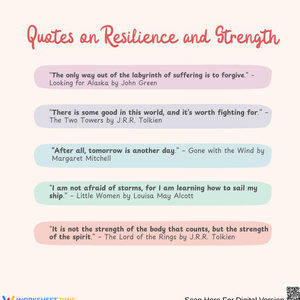
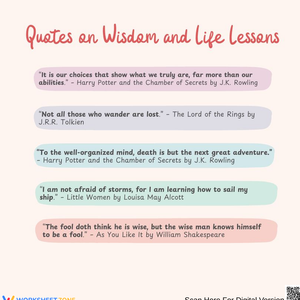
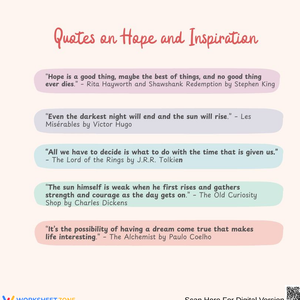
5th grade quotation marks printable worksheets give teachers a reliable way to revisit dialogue punctuation at exactly the point in the year when students are expected to apply it accurately in their own narratives and reading responses. By grade 5, most students have seen quotation marks before — but consolidating the skill into consistent, independent use is a different challenge. Students who handle direct speech correctly during whole-group instruction will still drop the comma inside the closing mark or forget the second quotation mark when a speaker tag splits the sentence.
The Specific Skills These Worksheets Build
The most useful practice at this level moves past recognition and into editing and application. Students who only circle quotation marks in mentor text are not practicing the same mental move they need during revision. The tasks in these worksheets ask students to:
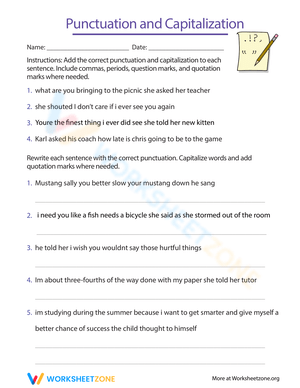
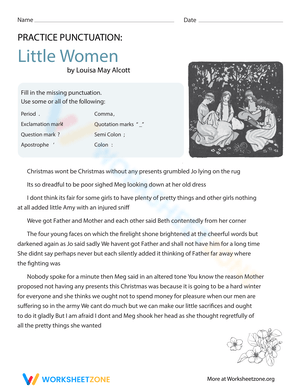
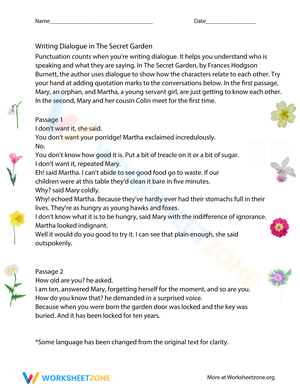
- Insert missing quotation marks into complete dialogue sentences
- Correct comma placement inside and outside quoted speech
- Fix end punctuation in sentences where the speaker tag follows the quoted words
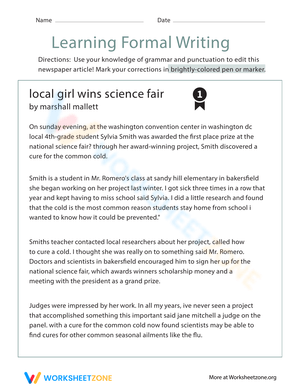
- Identify and remove extra or misplaced quotation marks
- Rewrite dialogue so it reads correctly, rather than just marking errors
- Apply quotation marks to titles where the task calls for that distinction
The mix of task types matters. Each worksheet that combines correction and rewriting gives a clearer picture of student understanding than a run of identical insert-the-mark drills. A student can get all the insertion items right without knowing why the punctuation changes when the speaker tag moves from the beginning of a sentence to the end — and that gap shows up immediately in narrative writing.
Patterns in Student Work That These Worksheets Help Surface
The most telling grade 5 errors are not always the most obvious ones. Students reliably miss the closing quotation mark — but the subtler problem is comma placement. Many students learn that dialogue needs a comma but misplace it outside the closing mark: they write "Let's go", she said rather than "Let's go," she said. Another consistent pattern: students add quotation marks around a character's internal thoughts rather than only around spoken words, blurring the line between what is said aloud and what is felt or described. A short editing worksheet makes that distinction visible in a controlled context before it becomes a fixture in a finished narrative draft.
When errors on a completed set match what is showing up in student writing folders, the exercise becomes a quick diagnostic rather than routine practice. Sorting 5th grade quotation marks printable worksheets into two or three error categories takes about five minutes and provides enough information to run a targeted small-group reteach without pulling the whole class back into a lesson most students no longer need.
How to Fit These Worksheets Into Your Planning Without Adding Prep
The most natural placement for this kind of practice is the 10 to 15 minutes before students begin drafting or revising dialogue-heavy writing. Using each worksheet as a warm-up primes students to notice punctuation before they open their own notebooks — and that connection is worth making explicit. After correcting sample dialogue, ask students to look at the last paragraph of their current draft and check the same conventions they just practiced.
Beyond the writing block, these resources fit several other classroom slots without much setup:
- Bell ringers before grammar mini-lessons, especially during a narrative writing unit
- Literacy center tasks for students who have finished a draft and need a focused editing round
- Exit tickets — one or two items on a sticky note works as a fast oral or written check at the end of a writing conference
- Sub plans, because the directions are self-contained and the tasks have clear correct answers
- Targeted homework when a student's draft shows a consistent punctuation pattern the class has already discussed
Small-group use is especially productive here. Four students who all placed commas incorrectly in recent writing can work through the relevant items together, correct each other's reasoning aloud, and discuss why the punctuation shifts when the speaker tag moves from the front of a sentence to the end. That kind of talk — students defending a punctuation choice to a peer — transfers more reliably into their own drafts than independent correction alone.
Standard Alignment
The Common Core State Standards Language strand establishes a K–5 punctuation progression in which direct-speech conventions are introduced before grade 5 and carried forward as part of the language conventions students are expected to control by the end of elementary school (CCSS.ELA-LITERACY.L.5.2). At fifth grade, accurate quotation mark use falls under the editing and conventions standard — the same expectation students encounter during on-demand writing assessments and standardized editing tasks. The practical placement of these worksheets is during the revision and editing phases of the writing cycle, not during initial drafting, when students' attention is rightly focused on generating ideas rather than monitoring punctuation.
Adjusting Each Worksheet for Students at Different Points in Their Understanding
5th grade quotation marks printable worksheets are naturally tierable because the tasks vary in cognitive demand. Students who are still shaky on the basic convention benefit most from the correction items — locating where quotation marks are missing is a lower-stakes entry point than rewriting a sentence from scratch. Students who have the basic rule down but stumble on comma placement can work the same items with a narrowed focus: skip the quotation marks entirely and concentrate only on comma position relative to the closing mark.
For students who need a stronger challenge, the rewriting items produce the most useful evidence. Instead of only correcting a given sentence, ask them to write a second version of the same dialogue — speaker tag first, then speaker tag last — and explain in one sentence why the punctuation changes between the two versions. That generative task reveals whether understanding is deep or surface-level in ways that correction items cannot. For students who need more guided support before working independently, talking through the first two or three items aloud as a small group gives them a clear reference point without altering each worksheet in ways that would obscure what they actually know.
Frequently Asked Questions
What quotation mark skills should 5th graders have solid control of by the end of the year?
By the end of grade 5, students should punctuate direct speech accurately in their own writing — including correct comma placement, the position of end punctuation relative to closing quotation marks, and quotation marks with titles when required. The harder benchmark is transfer: students who can correct sample sentences during a lesson should also catch the same errors during independent revision of their own drafts.
Can these worksheets double as a quick informal assessment?
They work well in that role, especially when used before or after a revision task. Collecting each worksheet after independent work gives a snapshot of what students control without a long grading process. The results are most useful when teachers look for patterns across a full class set rather than scoring each item in isolation — three students making the same comma error is actionable; one student making it might just need a quick conference.
Do students who covered quotation marks in earlier grades still need this practice?
Consistently, yes. Students who received direct-speech instruction in grades 3 or 4 often retain the broad idea — dialogue needs quotation marks — but lose precision on the details as time passes and their writing grows more complex. Using 5th grade quotation marks printable worksheets as spiral review keeps those fine points active during a year when students are writing longer narratives and citing text evidence in responses, both of which require punctuation accuracy that earlier instruction alone rarely sustains.












 Interactive Worksheet Maker
 Quiz Maker
 Word Search Maker
 Crossword Puzzle Maker
 Word Scramble Generator
 Sentence Scramble Generator
 Handwriting Worksheet Generator
 Name Tracing Generator
 Fill In The Blank Generator