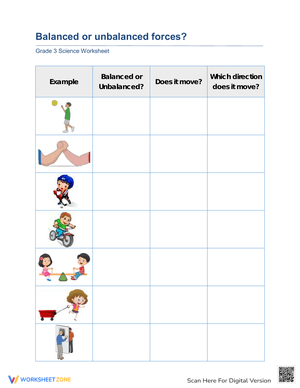
Push a chair, pull a door, kick a ball, or watch a book stay still on a desk, and students are already seeing forces in action. 4th grade balanced and unbalanced forces worksheets help turn these everyday moments into clear science learning. At this grade level, students begin to understand that forces can change an object’s motion, direction, or speed. They also learn that not every force causes movement; sometimes forces are equal, and the object stays still.
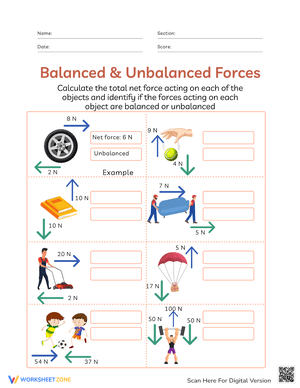
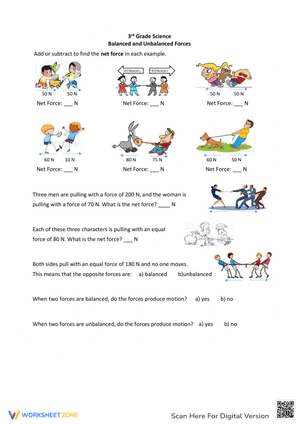
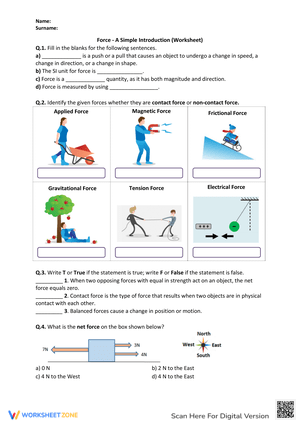
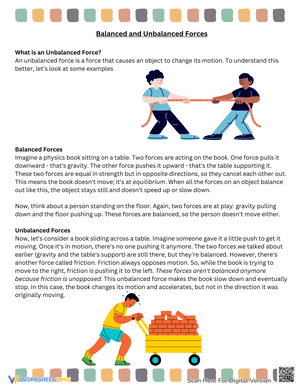
The difference between balanced and unbalanced forces can be tricky at first. Balanced forces happen when equal forces act on an object in opposite directions, so the object does not change its motion. Unbalanced forces happen when one force is stronger than another, causing the object to move, stop, speed up, slow down, or change direction. Worksheets give students a visual way to compare these ideas through arrows, diagrams, sorting tasks, short explanations, and real-life examples.
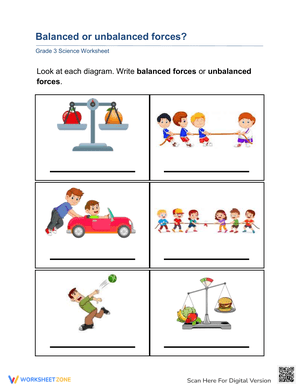
In a 4th grade science lesson, force worksheets work best when they connect to movement students can test. Learners might look at a picture of a tug-of-war game and decide whether the forces are balanced or unbalanced. They might analyze a ball rolling down a ramp, a box being pushed across the floor, or a swing moving back and forth. For students who enjoy hands-on investigation, teachers can connect this topic with 4th grade science fair projects to help them explore motion, friction, gravity, and pushes or pulls in a more experimental way.
Good 4th grade balanced and unbalanced forces worksheets should do more than ask students to circle answers. They should help students explain why an object moves or stays still. A strong activity may include force arrows, vocabulary practice, matching examples, cause-and-effect questions, and short written responses. Students can also use balancing act worksheets to strengthen their understanding of balance, comparison, and equal versus unequal forces in a more visual format.
When students understand balanced and unbalanced forces, they begin to see physics in ordinary life. A bike slows because of friction. A soccer ball moves because of a kick. A heavy box stays still until enough force is applied. These worksheets help 4th graders build vocabulary, interpret diagrams, make observations, and explain motion using evidence. Whether used in class, during homeschool science, or as review before an assessment, they give students a practical foundation for understanding how forces shape movement in the world around them.
Frequently Asked Questions
Question 1: What should 4th grade balanced and unbalanced forces worksheets include?
Strong 4th grade balanced and unbalanced forces worksheets should include clear diagrams, force arrows, real-life examples, vocabulary terms, and short explanation questions. Students should practice identifying whether forces are equal or unequal and explaining how that affects motion. Helpful worksheets may also include sorting activities, matching tasks, and scenarios involving pushes, pulls, friction, gravity, and changes in speed or direction.
Question 2: How do these worksheets help students understand force and motion?
These worksheets help students connect abstract science vocabulary to visible examples. Instead of only reading definitions, learners analyze pictures, compare force directions, and decide whether an object will move or remain still. This supports deeper understanding because students must think about cause and effect. Over time, they become more confident explaining why an object speeds up, slows down, changes direction, or stays at rest.
Question 3: What are good real-life examples of balanced and unbalanced forces for 4th graders?
Good examples include a book resting on a table, a tug-of-war game, a ball being kicked, a box being pushed, or a person sitting on a chair. A book on a table shows balanced forces because gravity pulls down while the table pushes up. A kicked ball shows unbalanced force because the kick changes the ball’s motion. These everyday examples help students see that force and motion are part of normal life.
Question 4: How can teachers make balanced and unbalanced forces lessons more engaging?
Teachers can make the lesson more engaging by pairing worksheets with simple demonstrations. Students can push toy cars, compare objects on ramps, test friction on different surfaces, or act out tug-of-war scenarios. After the hands-on activity, worksheets help students record observations, label forces, and explain what happened. This combination of movement, discussion, and written practice makes the concept easier to understand and remember.












 Interactive Worksheet Maker
 Quiz Maker
 Word Search Maker
 Crossword Puzzle Maker
 Word Scramble Generator
 Sentence Scramble Generator
 Handwriting Worksheet Generator
 Name Tracing Generator
 Fill In The Blank Generator