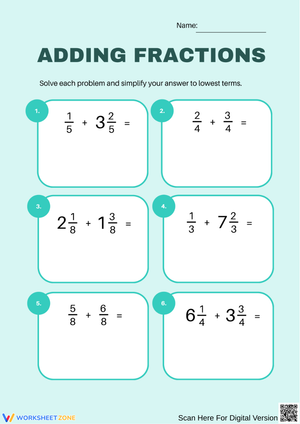
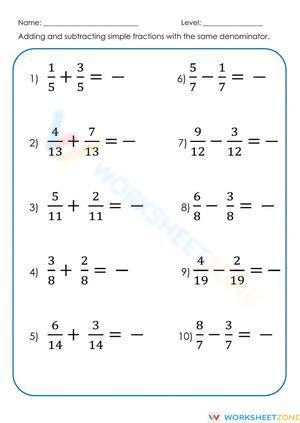
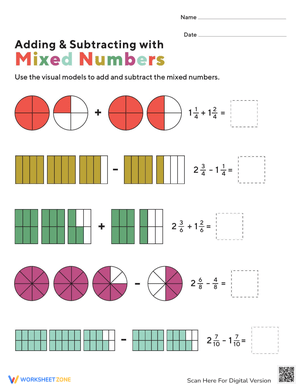
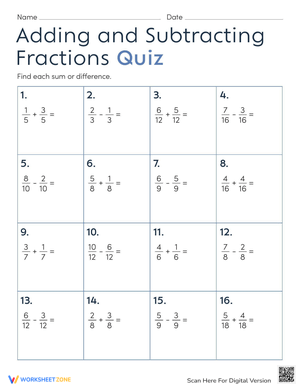
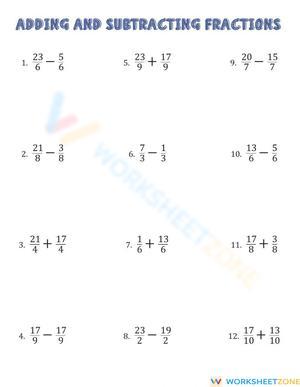
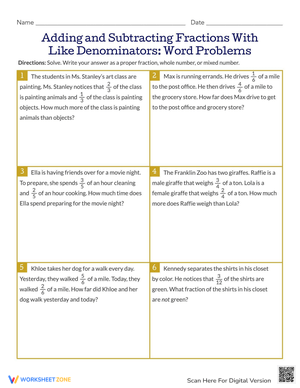
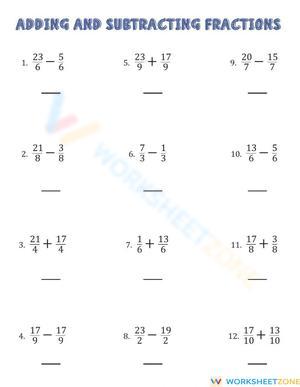
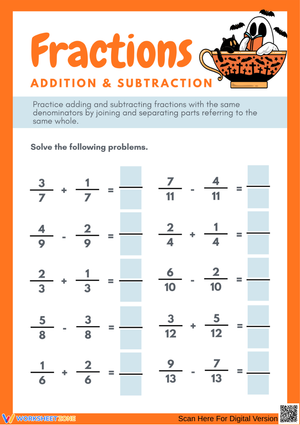
These 4th grade adding and subtracting fractions worksheets like denominators printable pdf give teachers a focused set of practice resources for one of the conceptually trickiest transitions in fourth-grade math — the shift from recognizing fractions to actually operating on them. Each worksheet targets the same-denominator case specifically, which is where the conceptual groundwork must be secure before students move to unlike denominators in fifth grade.
What Students Practice Across the Set
The work on each worksheet stays close to the core operation, but problem types rotate across the set to build different kinds of fluency. Students add and subtract fractions with these denominators:
- Halves, thirds, and fourths — the fractions students already know from third-grade measurement
- Fifths and sixths — common in recipe and division contexts
- Eighths and tenths — the denominators most likely to appear in measurement and money problems at this grade
Several worksheets pair computation problems with labeled fraction bars so students shade in the model, write the corresponding equation beneath it, then confirm that both representations match. Others use number lines students annotate as they solve. Word problems appear in a dedicated section on most worksheets rather than scattered throughout, which lets teachers assign the computation problems during initial instruction and return to the word problems once students have the mechanics under control.
Improper fractions and mixed numbers appear in the later worksheets in the set. Students who can add 3/5 + 4/5 and write the result as 1 and 2/5 are demonstrating more than computation fluency — they are showing that they understand what "more than one whole" means in fraction terms, which is exactly the conceptual bridge 4.NF.B.3 is building toward.
Student Mistakes That Show Up Repeatedly in This Work
The most common error in like-denominator addition is also the most durable: students add both numerators and denominators. A student who understands fraction notation will still sometimes write 3/8 + 2/8 = 5/16, treating the denominator as another number to operate on rather than a label describing piece size. The visual models on each worksheet make this contradiction visible immediately — if the student's equation says 5/16 but their shaded fraction bar shows five pieces out of eight, the mismatch is right in front of them. That moment of noticing the conflict is more instructive than being told the rule again.
Mixed-number subtraction surfaces a second, subtler error. When a problem like 3 and 1/5 minus 1 and 4/5 requires regrouping, students often subtract the smaller fraction numerator from the larger one regardless of position — arriving at 2 and 3/5 instead of the correct 1 and 2/5. Getting students to physically rewrite 3 and 1/5 as 2 and 6/5 before touching the subtraction sign — and say out loud what they traded and why — reduces this error more reliably than repeating the rule does.
Standard Alignment
These resources align with CCSS 4.NF.B.3, which addresses understanding and performing addition and subtraction of fractions. Standard 4.NF.B.3a asks students to understand these operations as joining and separating parts referring to the same whole — the conceptual foundation the visual-model worksheets target directly. Standard 4.NF.B.3b requires students to decompose a fraction into a sum of fractions with the same denominator, which appears in problems where students write 5/6 as an addition expression in more than one way, such as 2/6 + 3/6 or 1/6 + 4/6. This standard sits at fourth grade deliberately: it extends the third-grade work of placing fractions on number lines and recognizing equivalence. Students who arrive without that base tend to treat fraction addition as symbol manipulation, which is why the visual-model problems matter even for students who compute correctly on the first attempt.
Building These Worksheets Into Your Lesson Plans
The 4th grade adding and subtracting fractions worksheets like denominators printable pdf work best when they follow at least one concrete class experience — a fraction bar activity, a number line discussion, anything that gives students a physical referent before they encounter abstract equations. Using the first worksheet as a whole-group experience, projecting it while students work their own copy, typically takes 15 to 20 minutes and brings errors to the surface before students practice them independently.
Later worksheets slot naturally into small-group rotation blocks. While the teacher pulls struggling students for reteaching with manipulatives, the rest of the class works through a worksheet on their own. Because complexity increases across the set — single-step addition first, then two-step subtraction, then mixed-number problems with regrouping — it is easy to assign different worksheets to different groups without making the distinction obvious.
The word problem sections are most productive Thursday or Friday, after computation fluency is established. Assigning those problems on day two, before the mechanics are automatic, overloads working memory: students spend cognitive resources parsing the language of the problem and executing the fraction operation simultaneously, and errors appear that look conceptual but are really just overload. Waiting two or three days costs nothing and produces noticeably cleaner work.
Adjusting the Set for Different Student Levels
Students who need more support do better starting on the fraction bar worksheets before moving to bare equations. The visual model gives them a self-check they can run independently — shade the answer, write the equation, compare the two — and that verification loop builds independence faster than teacher correction after the fact. Making it an explicit classroom expectation that everyone uses the model removes the stigma for students who genuinely need it.
Students moving ahead can be asked to verify each answer using a second strategy: rewrite the subtraction as a missing-addend problem, or generate a real-world context that matches the equation. Asking them to write two different addition expressions that both equal the same fraction extends the 4.NF.B.3b decomposition work without requiring separate materials.
The 4th grade adding and subtracting fractions worksheets like denominators printable pdf also work well in peer tutoring pairs during independent practice. A student who explains the fraction bar model to a partner while pointing to specific segments of the diagram is consolidating understanding in a way that silent solo practice does not replicate — and the student receiving the explanation often asks questions that neither would have thought to ask alone.
Frequently Asked Questions
Do these worksheets include mixed numbers?
Yes. Several worksheets include problems where the sum of two fractions exceeds one whole, requiring students to express the answer as a mixed number. A section of the set focuses specifically on adding and subtracting mixed numbers with like denominators, including problems that require regrouping a whole into fractional parts before subtracting.
Are answer keys included?
Each worksheet comes with a corresponding answer key. Keys show answers in simplified form where applicable, with improper fractions converted to mixed numbers, so teachers have a clear reference for what a complete and fully reduced answer looks like.
What denominators appear across the set?
Problems use denominators of 2, 3, 4, 5, 6, 8, and 10. These were selected because they appear in the 4.NF standards and in measurement and real-world division contexts students encounter at this grade — ruler increments, measuring cup quantities, and basic equal-sharing situations.
Can these be used for formative assessment or test prep?
The 4th grade adding and subtracting fractions worksheets like denominators printable pdf are not formatted as test simulations, but the problem types — computation and word problems drawn from 4.NF.B.3 — match what students encounter on most fourth-grade state assessments. Teachers use them as a pre-unit check to identify gaps, as exit tasks after a lesson, and as evidence for deciding whether the class is ready to move forward.













 Interactive Worksheet Maker
 Quiz Maker
 Word Search Maker
 Crossword Puzzle Maker
 Word Scramble Generator
 Sentence Scramble Generator
 Handwriting Worksheet Generator
 Name Tracing Generator
 Fill In The Blank Generator