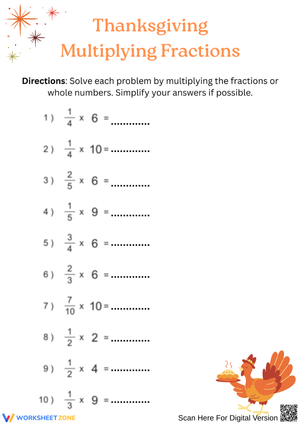
These 4th grade multiply fractions by whole numbers worksheets give students structured, incremental practice at exactly the right moment in their mathematical development — when the repeated addition reasoning from earlier grades needs to connect directly to multiplicative thinking. The set covers visual models, the standard algorithm, and applied word problems, so teachers have everything needed to move students from first exposure through procedural fluency.
What Students Practice Across the Set
Each worksheet targets a discrete skill within 4.NF.B.4, so teachers can assign based on where a student actually is rather than moving the whole class in lockstep. The progression runs from unit fractions forward — students first work with expressions like 3 × 1/4 before encountering 3 × 3/4, which requires them to hold two quantities in working memory at once. Specific skills across the worksheets include:
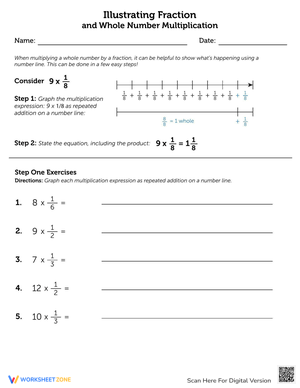
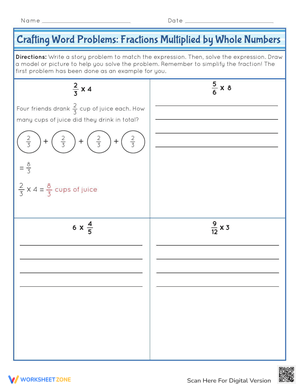
- Translating a multiplication expression into repeated addition — writing 4 × 2/5 as 2/5 + 2/5 + 2/5 + 2/5 before calculating, so the connection between operations stays visible.
- Completing number line models by marking equal fractional jumps and labeling the endpoint, then confirming the result with the algorithm.
- Using tape diagrams to shade and count equal fractional parts, supporting students who need to see the size of the pieces before they trust the arithmetic.
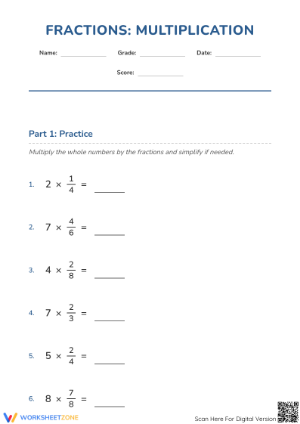
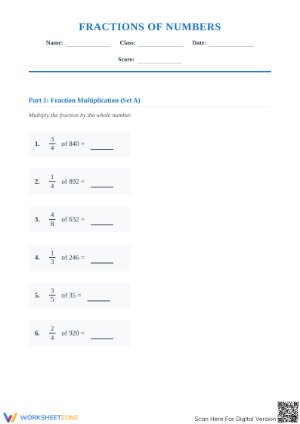
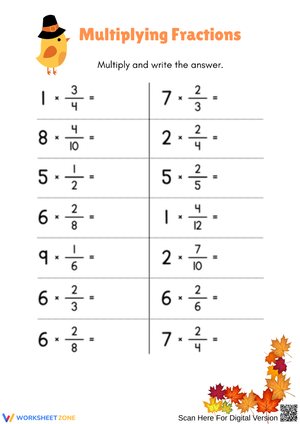
- Applying the standard algorithm — n × (a/b) = (n × a)/b — with scaffolded blank spaces in early worksheets and no scaffolding in later ones.
- Converting improper fraction results into mixed numbers, which Grade 4 students frequently treat as optional rather than required.
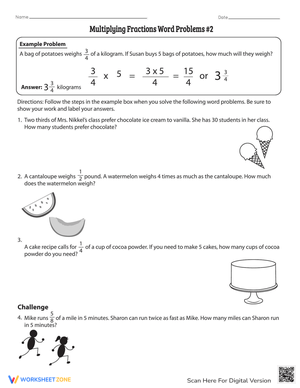
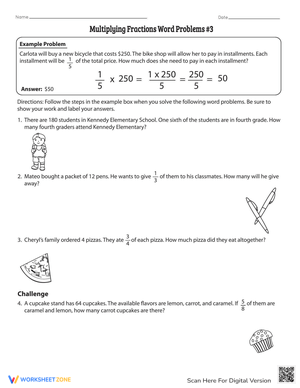
- Solving single-step and multi-step word problems set in contexts involving measurement and recipes, where students must identify which quantity is the whole number and which is the fraction before setting up the equation.
Standard Alignment
These worksheets align to CCSS Math 4.NF.B.4, which addresses multiplying a fraction by a whole number. Within the standard's three-part structure, the worksheets cover all three components: understanding a fraction a/b as a multiple of 1/b (4.NF.B.4a), understanding a multiple of a/b as a multiple of 1/b (4.NF.B.4b), and solving word problems involving multiplication of a fraction by a whole number (4.NF.B.4c). In classroom terms, 4.NF.B.4 typically arrives in the third quarter of 4th grade, after students have worked through fraction equivalence and comparison. Teachers who introduce this set before students are secure with 4.NF.A.1 — fraction equivalence — will find that the conversion practice surfaces gaps from the prior standard rather than building the new one.
Frequent Student Errors Worth Watching For
The single most durable error in this skill is multiplying both parts of the fraction — a student who knows the rule "multiply the tops" will still write 2 × 3/4 = 6/8 after a long weekend or a distracting class period. The error makes intuitive sense to a child who has just learned that multiplication applies symmetrically, and correcting it requires returning to the tape diagram or number line rather than just restating the rule. A student needs to see that 6/8 and 6/4 don't describe the same amount of the same-sized pieces.
A second error appears specifically on word problems: students correctly identify the fraction and the whole number but reverse them in the equation. They write 2/3 × 4 and get the correct answer, but when they're asked to interpret the expression, they explain it backwards — "2/3 groups of 4" instead of "4 groups of 2/3." At this grade level the distinction matters for building conceptual groundwork, even though the product is the same. The word problem worksheets ask students to write the equation and then annotate what each factor represents, which surfaces this confusion before it becomes invisible.
Conversion errors are a third consistent category. Students who arrive at 15/8 often stop there, treating the improper fraction as a complete answer. Building the conversion step into the worksheet's answer format — rather than leaving it as an optional note — trains students that the process has a final stage.
How to Build These Worksheets Into Your Lesson Plans
The visual model worksheets work best early in the unit as guided practice during the first 15–20 minutes of a lesson, when a teacher can circulate and catch students who are drawing misaligned jumps on the number line. Assigning them independently before that guided pass produces more errors than learning. The algorithm-only worksheets, by contrast, are strong Monday morning warm-up material once the concept is established — four to six problems done quietly before the lesson begins functions as spaced retrieval without requiring a separate review day.
Word problem worksheets are most useful mid-unit rather than at the end. Using them before students have full procedural fluency forces them to reason about the operation contextually, which is harder and more productive than applying a memorized procedure to a familiar problem type. Saving all word problems for end-of-unit review means students get one concentrated dose of application practice right before the test — not enough repetition to make the skill stable.
For formative assessment, a single number line worksheet reviewed quickly before the next day's lesson tells you more than a quiz. A student who marks the right number of jumps but lands in the wrong place understands multiplication as repeated addition but is miscounting fraction size. A student whose jumps are irregularly spaced is still estimating rather than measuring. These are different instructional problems with different next steps, and the worksheet makes them visible in about three minutes of scanning.
Adjusting the Worksheets for a Range of Learners
Students who are not yet secure with equivalent fractions should work only with unit fraction problems — 3 × 1/4, 5 × 1/6 — across the first several worksheets. The denominator stays fixed, and the only variable is how many groups. This isolates the multiplicative reasoning from the added complexity of a multi-part numerator and prevents students from developing the numerator-and-denominator error before they've internalized the correct structure.
For students who move through the standard problems without difficulty, the most effective extension is problems where the whole number is large enough that the conversion requires multi-step division — something like 7 × 5/6, which gives 35/6 and converts to 5 and 5/6. These students can also be given multi-step problems that combine multiplication and addition of fractions in a single scenario, which previews the reasoning they'll need in 5th grade without formally introducing new standards.
Students who freeze when shown an unfamiliar paragraph-length word problem benefit from worksheets that break the problem-solving process into labeled steps: underline the fraction, circle the whole number, write the equation, solve, convert. This format can feel mechanical, but it gives anxious students a procedure for reading the problem that is separate from the mathematical procedure — reducing the cognitive interference between literacy demands and computation.
Frequently Asked Questions
Do students need to simplify their answers on these worksheets?
The worksheets require conversion of improper fractions to mixed numbers, which is the Grade 4 expectation under 4.NF.B.4. Full simplification to lowest terms is a 4th grade skill but is not the primary focus of this standard — students who reduce 6/4 to 3/2 before converting are doing more work than required and sometimes confuse themselves in the process. The answer format on each worksheet specifies what form the answer should take.
At what point in the unit should I introduce the algorithm worksheets?
After students can accurately complete a number line or tape diagram problem without prompting, they're ready for algorithm practice. For most classes that transition happens around the third or fourth lesson. Moving to the algorithm before the visual model is solid produces faster completion rates and weaker retention — students who skip the model stage tend to struggle when problems are presented in unfamiliar formats on assessments.
Can these worksheets be used with 5th graders who need to backfill this skill?
Yes, and the scaffolded visual model worksheets are particularly useful in that context. Fifth graders who missed 4.NF.B.4 solidly often have a surface-level algorithm that breaks down when they encounter multiplying fractions by fractions. Working back through the unit fraction logic with these worksheets typically resolves the gap in two or three sessions rather than requiring a full reteach of the 5th grade standard.













 Interactive Worksheet Maker
 Quiz Maker
 Word Search Maker
 Crossword Puzzle Maker
 Word Scramble Generator
 Sentence Scramble Generator
 Handwriting Worksheet Generator
 Name Tracing Generator
 Fill In The Blank Generator