Grade 12 Bill of Rights Worksheets: Advanced Civics Analysis
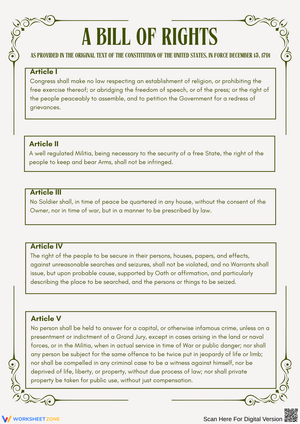
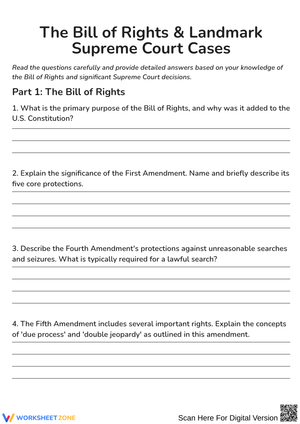
The bill of rights worksheets printable for 12th grade arrive at a precise moment in a student's civic development — the year they can vote, and the year constitutional protections stop being abstract history and start being personally relevant. This set gives government and civics teachers structured analytical work built around the first ten amendments: document-based questions, scenario-based prompts, and landmark case analyses that require seniors to cite constitutional text in support of a legal argument.
What the Set Covers
The analytical demands across these resources match what a senior government course actually requires. Students underline operative phrases in constitutional text, annotate how courts have interpreted those phrases across different historical periods, and apply the judicial balancing test — individual liberty weighed against a compelling government interest — to specific fact patterns rather than generic hypotheticals. Several worksheets ask students to write structured legal briefs: a claim, cited constitutional evidence, and a rebuttal of the opposing argument. That format rarely appears before senior year, and early student drafts usually show it.
The bill of rights worksheets printable for 12th grade build competency across a specific range of skills:
- Tracing selective incorporation through the 14th Amendment's due process clause
- Distinguishing substantive from procedural due process in case-based analysis
- Identifying the constitutional reasoning in landmark Supreme Court holdings
- Sorting speech into protected and unprotected categories using actual case doctrine, not broad principles
- Applying Fourth Amendment precedent to digital privacy and school search scenarios
- Evaluating how the Eighth Amendment's evolving standards of decency test has shifted capital punishment jurisprudence over the last half-century
The Conceptual Jump That Defines Senior-Year Government
Most students arrive in 12th grade believing the first ten amendments have always bound state governments. That assumption is wrong, and it blocks accurate reading of most modern constitutional law. These worksheets walk through the historical sequence: the original amendments limited only the federal government, the 14th Amendment created the mechanism for applying those rights to the states, and the Supreme Court spent most of the 20th century deciding — case by case — which rights qualified as fundamental. Students who understand that sequence can read McDonald v. City of Chicago or Mapp v. Ohio with comprehension. Students who don't are pattern-matching without legal reasoning behind it.
The substantive versus procedural due process distinction gets more careful treatment in this set than most textbooks provide. Seniors need that distinction because it explains why the Court has recognized unenumerated rights — privacy, for example — that are not explicitly written in the constitutional text. That reasoning is also actively contested political and legal territory that appears on the AP Government exam and in first-year law school coursework alike.
Student Errors That Show Up in the Work
The most persistent misconception in this unit: students treat civil liberties and civil rights as interchangeable. In essay responses, this produces arguments that run the First Amendment and the Equal Protection Clause together as though they protect the same thing through the same mechanism. A student who writes "the civil rights guaranteed by the First Amendment" in a legal brief has already lost the analytical thread. The worksheets require students to categorize specific cases into one concept or the other with written justification, which makes the distinction concrete in a way that lecture alone does not.
A second consistent error surfaces in free speech analysis. Students learn that the First Amendment protects speech, then over-apply that rule in scenario responses — arguing that all speech is protected because "Congress shall make no law." They miss the categorical exceptions: incitement to imminent lawless action, true threats, and obscenity are not protected, and courts apply specific tests to each. When students encounter a Brandenburg v. Ohio fact pattern on a worksheet and try to reason toward an answer without knowing the Brandenburg test, the gap is visible immediately. That visibility is exactly what makes formative assessment productive.
Recommended Lesson-Planning Strategies for This Unit
The most effective deployment of the bill of rights worksheets printable for 12th grade is as the primary instructional vehicle throughout the unit — not as end-of-unit review. Assign the document-based question worksheets before lecture. Students who struggle with primary source text before class discussion arrive with specific questions, which shifts the room from passive listening to genuine inquiry. After each lesson, a short analytical worksheet reveals within one class period whether students can apply the day's doctrine before the next concept is introduced.
One instructional move worth repeating: run a moot court activity using the landmark case worksheets, and require students to argue the side they personally disagree with. Seniors forced to defend a position against their own instincts have to leave emotional reasoning behind and work from constitutional text and legal precedent. The writing that comes out of that constraint is noticeably more specific and legally grounded than what students produce when arguing their preferred position.
These worksheets also work well as Monday warm-ups after a weekend break. A single analytical scenario that recaps the prior week's doctrine — before new material is introduced — uses spaced retrieval to strengthen retention in ways that massed end-of-unit review does not.
Standard Alignment
These worksheets align with the College, Career, and Civic Life (C3) Framework for Social Studies, specifically D2.Civ.3.9-12, which asks students to evaluate the relationship between constitutional principles and government action, and D2.Civ.6.9-12, which asks students to analyze how laws protect individual rights while serving the common good. The argument-construction prompts on these worksheets directly mirror the AP Government free-response format, making the set useful for both standard government courses and AP exam preparation without requiring separate materials for each.
Adjusting the Set for a Range of Learners
For students who stall on dense legal text, the most useful support is not a simplified version of the worksheet but a constitutional terminology reference — a glossary of operative phrases and their judicial definitions — that students consult during the task without reducing its analytical complexity. The goal at this grade level is to remove vocabulary barriers, not lower the cognitive demand of the reasoning.
The bill of rights worksheets printable for 12th grade also extend naturally for students in AP Government or pursuing pre-law coursework. Those students can produce comparative analyses alongside the standard worksheet task — contrasting U.S. constitutional protections with those in the Universal Declaration of Human Rights, or tracing how the Supreme Court sequenced the incorporation of different amendments over time. Each worksheet establishes the core analysis; the comparative extension adds depth without requiring a separate assignment built from scratch.
Frequently Asked Questions
What is the legal difference between civil liberties and civil rights?
Civil liberties are fundamental freedoms protected from government interference — free speech, religious exercise, protection against unreasonable searches — established primarily through the first ten amendments. Civil rights protect individuals from unequal treatment based on protected characteristics, with the 14th Amendment's equal protection clause as the constitutional anchor. The two concepts overlap in classroom discussion, which is why the conflation is so common. The worksheets address this by requiring students to categorize specific cases into one framework or the other and explain the constitutional basis for their answer.
How does the Court decide whether a right is fundamental enough to apply to the states?
The Court asks whether the right is deeply rooted in the nation's history and tradition and implicit in the concept of ordered liberty. If it meets that standard, it applies to state governments through the 14th Amendment's due process clause. The worksheets on selective incorporation guide students through the historical timeline — noting, for example, that Second Amendment protections were not incorporated until McDonald v. City of Chicago in 2010, decades after most First Amendment protections were applied to the states. Students analyze the Court's reasoning in specific decisions and identify the standard the justices used.
Can the government impose restrictions on free speech or public assembly without violating the First Amendment?
Yes, under specific conditions. The government can impose content-neutral time, place, and manner restrictions on public assembly, provided those restrictions leave open alternative channels for expression. For speech, certain categories fall outside constitutional protection entirely: incitement to imminent lawless action under the Brandenburg test, true threats, and legally obscene material. The scenario-based worksheets on this topic give students a fact pattern and ask them to apply the relevant judicial test to determine whether a restriction is constitutional. Students who default to "the First Amendment protects all speech" miss these questions consistently until they learn the categorical framework.
How has the meaning of "cruel and unusual punishment" changed since the Founding?
The Court interprets the Eighth Amendment against what it calls "the evolving standards of decency that mark the progress of a maturing society" — a phrase from Trop v. Dulles (1958) that has shaped capital punishment doctrine ever since. A punishment considered acceptable in 1791 may be unconstitutional today because the Court evaluates current societal consensus, not historical practice alone. The worksheets on this topic ask students to trace the Court's reasoning in Roper v. Simmons and Atkins v. Virginia, identifying what evidence the justices used to measure evolving standards and how that evidence shaped the holdings.
Clear All