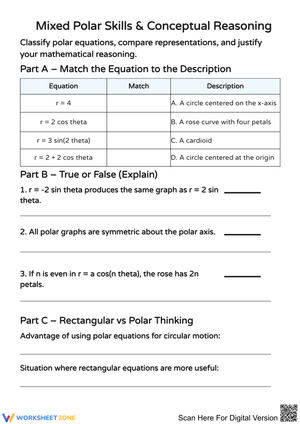
12th Grade Precalculus Printable Worksheets for Classroom Practice
These 12th grade precalculus worksheets cover the full spread of a typical senior math course — functions and transformations, polynomial and rational models, exponential and logarithmic equations, trigonometric identities, complex numbers, conics, vectors, matrices, sequences, series, and introductory limits where the course includes them. Each worksheet targets a specific skill so teachers can pull exactly what a lesson needs without sorting through a mixed packet first.
The Specific Skills Targeted
Topic organization is what makes this set practical in a Grade 12 classroom. Precalculus is a genuinely wide course — the distance from function transformations to matrix operations is substantial — and students arrive at each unit with different levels of readiness. Worksheets organized by skill let teachers assign a rational functions page to one group and a prerequisite algebra review to another without designing a second lesson. The core skill areas across the set include:
- Function behavior, domain and range, inverses, and transformation sequences applied to parent functions
- Polynomial division, end behavior, and graphing rational functions including asymptote identification
- Exponential growth and decay models alongside logarithmic equations requiring change-of-base reasoning
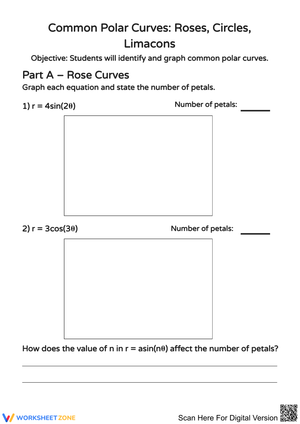
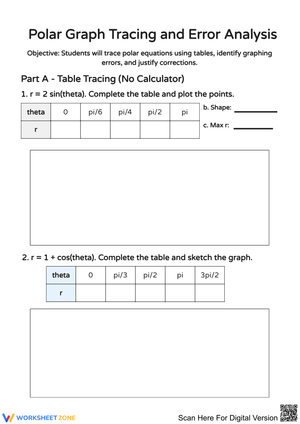
- Trigonometric functions in both degree and radian measure, graphing sinusoidal curves, and verifying identities
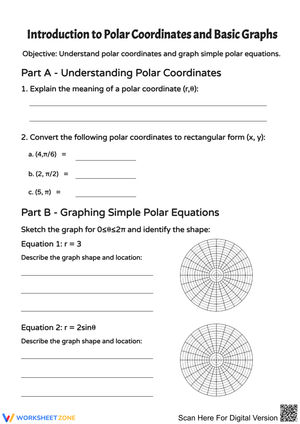
- Complex number arithmetic, polar form conversion, and De Moivre's theorem where included
- Conic sections — ellipses, hyperbolas, and parabolas — in standard and general form
- Vector operations, dot product, and matrix arithmetic including systems solved by row reduction
- Arithmetic and geometric sequences, series notation, and convergence concepts for introductory limit work
Within each topic area, problem sequences move from direct procedural practice into multi-step or applied items. A logarithms worksheet, for instance, starts with expanding and condensing log expressions before asking students to solve equations where the variable appears as an exponent on both sides. That progression matters because it shows teachers exactly where a student's reasoning breaks down — whether the trouble is with log properties or with the algebra that follows once they've correctly applied them.
Standard Alignment
These worksheets align to the Common Core State Standards for Mathematics at the high school level, with particular relevance to the Functions (F), Algebra (A), and Number and Quantity (N) domains. HSF-BF.B.3 covers transformations of functions; HSF-TF.A and HSF-TF.B address trigonometric functions and their applications; HSA-REI and HSA-APR apply to rational and polynomial work; HSN-VM covers vector and matrix operations. For teachers in states that have adopted alternative standards frameworks, the topic coverage maps to equivalent senior-level expectations in most cases. Precalculus is typically positioned as the final course before AP Calculus or college-level math, which means these skills are also assessed on the SAT, ACT, and AP Precalculus exam — all of which test function behavior, trigonometry, and logarithmic reasoning directly.
Common Student Mistakes Teachers Should Anticipate and Address
Senior precalculus has a consistent set of error patterns that appear regardless of how carefully a topic was introduced. In logarithmic work, the most persistent mistake is treating log(a + b) as log(a) + log(b) — students overapply the product rule in reverse. On trigonometry worksheets, the errors concentrate in two places: students who have memorized the unit circle will still place sin(5π/6) in the wrong quadrant when they're solving equations rather than evaluating, and students who can verify an identity correctly on a homework page will reach for a calculator to confirm it on a quiz, which derails the reasoning entirely.
With vectors and matrices, the confusion tends to be conceptual rather than procedural. Students learn to multiply matrices correctly but then apply matrix multiplication to a situation calling for a dot product, or they confuse scalar multiplication with the cross product. These aren't careless errors — they reflect genuine uncertainty about what each operation measures. A short error-analysis problem on the worksheet, where students identify the mistake in a worked example, catches this faster than another set of computation problems.
Rational functions produce a recurring asymptote error worth watching: students identify vertical asymptotes correctly but then assume the graph can never cross a horizontal one, which isn't true. When a worksheet asks them to find intersection points between a rational function and its horizontal asymptote, that assumption collapses quickly — and the conversation that follows is more productive than re-explaining the rule from scratch.
Smart Ways to Work These Worksheets Into Your Week
The most reliable entry point is bell work. A three-to-five problem worksheet at the start of class accomplishes two things simultaneously: it settles the room while instruction begins and it surfaces which students haven't consolidated the previous day's work. For spaced retrieval, choose a topic from two units back — a brief logarithm review during the vectors unit, for example — rather than repeating whatever was covered yesterday. That spacing is where retention actually builds.
During guided practice, the partial-release structure works well with these worksheets. Assign the first cluster of problems, pause, and correct together before students continue independently. This is especially useful in trigonometry units, where an uncorrected sign error in the first problem propagates through every identity that follows. Catching it midway through the worksheet costs two minutes; leaving it until grading costs a week of confusion.
Station rotations are another strong fit. One station handles procedural fluency — students complete a focused set of problems on, say, graphing transformations. A second station presents an application problem requiring the same skill in context. A third asks students to find and explain the error in a completed worked example. The same worksheet can anchor any of those stations depending on which problems you assign. For sub plans, these pages hold up well independently: the format is predictable, the directions are brief, and students in a Grade 12 math class can work through them without needing in-the-moment clarification.
Adjusting the Worksheets for a Range of Learners
Mixed-readiness is a structural feature of most Grade 12 precalculus classes, not an exception. Some students arrive with strong Algebra 2 foundations; others are still solidifying that work. One practical adjustment is selective problem assignment: rather than modifying the worksheet, assign the core procedural items to students who need concentrated practice and the multi-step extension problems to students who are ready to apply the skill in less familiar contexts. The class stays on the same topic, the teacher manages one page, and the level of demand is differentiated without producing two separate lessons.
For students who struggle with prerequisite gaps, pairing a current-skill worksheet with a short review strip — five problems on factoring or solving linear systems — identifies whether a student is missing the precalculus concept or whether older algebra is breaking down underneath it. That distinction matters enormously for deciding whether to reteach or remediate. Students who are ready for extension can work through problems that add a modeling layer or require justification alongside calculation, which also doubles as preparation for first-semester college math expectations.
Frequently Asked Questions
What topics do these 12th grade precalculus worksheets cover?
The set covers the full range of a standard Grade 12 precalculus course: functions and transformations, polynomials and rational functions, exponential and logarithmic models, trigonometric functions and identities, complex numbers, conic sections, vectors, matrices, sequences and series, and introductory limits. Each worksheet targets one skill, making it straightforward to assign a focused page for reteaching after a quiz or exit ticket.
How do these worksheets fit into a mixed-skill class where some students need Algebra 2 review?
Assign selected problems rather than the full worksheet when a student needs concentrated practice at a lower demand level, and use the extension items for students who are ready to move faster. A brief prerequisite check — five problems on prerequisite algebra — run alongside a current precalculus worksheet quickly distinguishes between a gap in the new material and a gap in the older skills that underlie it. That distinction changes the reteaching plan entirely.
Can these be used for SAT, ACT, or AP Precalculus preparation?
The skill coverage aligns well with what those assessments test: function behavior, trigonometric reasoning, logarithmic equations, and conic section properties appear across all three. The worksheets aren't formatted as timed test simulations, but teachers doing targeted test prep can pull topic-specific pages for focused review in the weeks before an exam.
Clear All