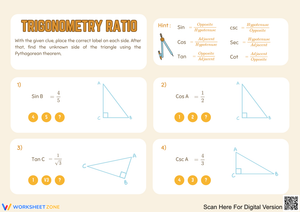
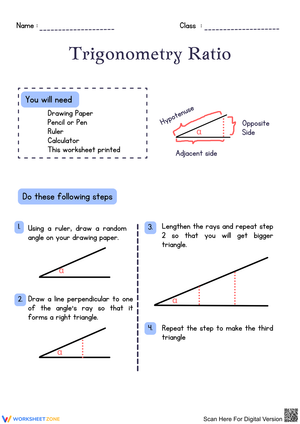
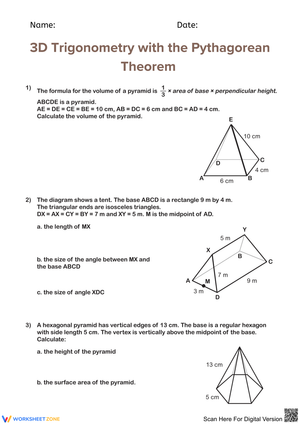
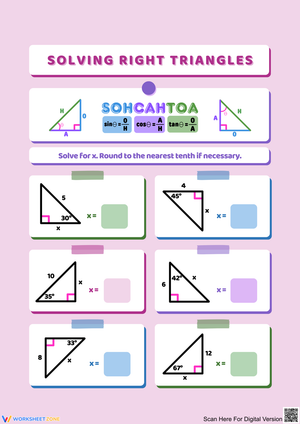
These 12th grade trigonometry worksheets give students structured, rigorous practice across the full arc of senior-year trig — from radian measure and the unit circle through identity proofs, function transformations, and oblique triangle applications. The set is built for the Pre-Calculus or advanced math course where trigonometry isn't a standalone chapter but a thread running through the whole year, and where the stakes are real because Calculus comes next.
What's Inside the Set
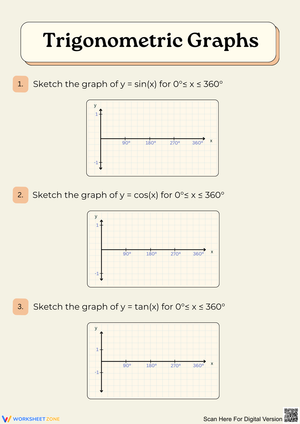
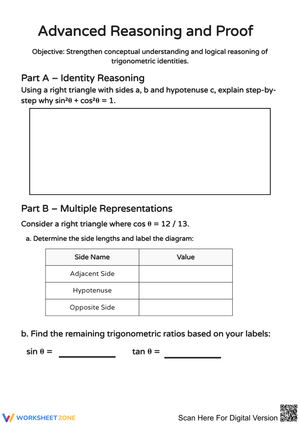
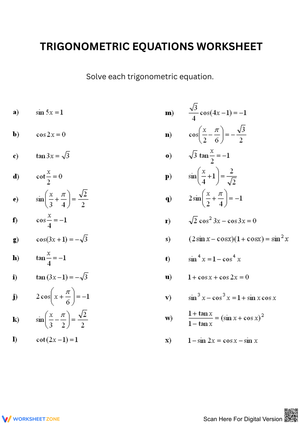
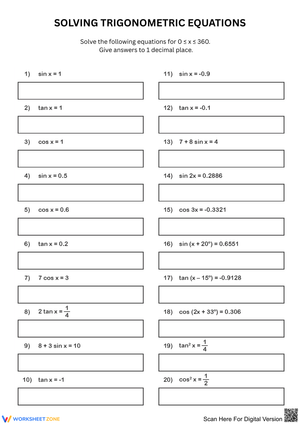
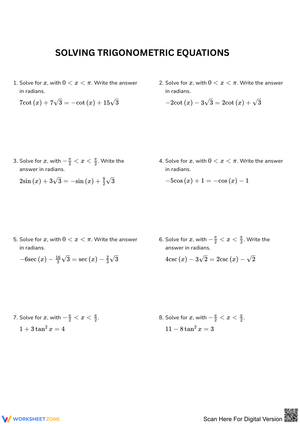
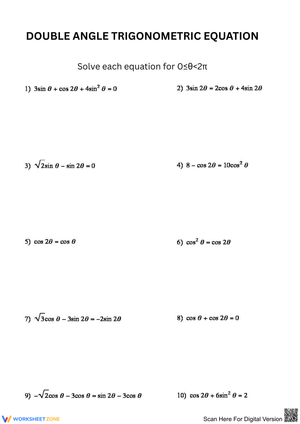
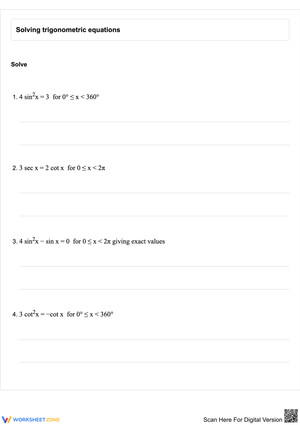
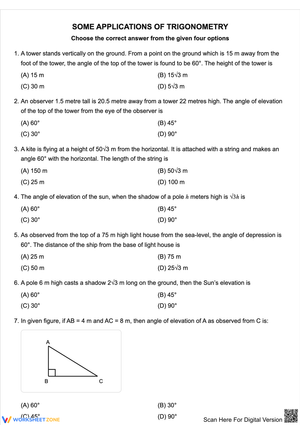
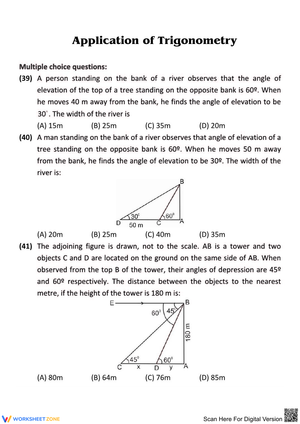
The worksheets cover five distinct content areas, each with its own problem types and cognitive demands. Radian measure and unit circle work asks students to convert between degree and radian form, locate reference angles, and produce exact values — not decimal approximations — for any standard-position angle. Identity worksheets move from verifying Pythagorean identities to applying sum and difference formulas, double-angle formulas, and half-angle formulas in multi-step simplification and formal proof. Graphing worksheets have students sketch and interpret sine, cosine, and tangent curves under transformations — amplitude shifts, period compressions, phase shifts, and vertical translations — and also write equations from given graphs, which reverses the direction of reasoning students are used to. Modeling worksheets place periodic functions in context: height as a function of time, temperature cycles, wave mechanics. Oblique triangle worksheets practice the Law of Sines and Law of Cosines for missing sides and angles, including the ambiguous SSA case where students must determine whether zero, one, or two triangles exist.
Standard Alignment
The set addresses several standards under the Common Core High School Functions domain. HSF.TF.A.1 and A.2 cover radian measure and unit circle exact values — the foundational skills that appear in the first cluster of worksheets. HSF.TF.B.5 targets modeling with trigonometric functions, which the contextual application worksheets address directly. HSF.TF.C.8 requires students to prove the Pythagorean identity and use it to find trigonometric values, which the identity proof worksheets build toward systematically. On the geometry side, HSG.SRT.D.10 and D.11 address the Law of Sines and Cosines, including derivation — the oblique triangle worksheets cover the application side of both standards. Teachers in states that have adopted post-CCSS frameworks will find these map cleanly to equivalent standards because the content at this level is largely consistent across state adoptions.
Mistakes Students Make That These Worksheets Help You Catch
The unit circle produces one of the most persistent errors in senior math: students who have the coordinates memorized in the first quadrant will flip sine and cosine outputs when they move into quadrants II, III, and IV because they're applying the mnemonic mechanically rather than understanding the signs. You'll see a student write sin(5π/6) = √3/2 — the correct magnitude, wrong sign — and feel confident about it. The unit circle worksheets address this by requiring students to mark reference angles and record quadrant sign rules before producing the value, making the reasoning visible rather than buried.
Identity proofs generate a different failure mode. Students attempt to work both sides simultaneously, crossing manipulations between left and right, which isn't a valid proof structure. They arrive at something that looks like a true statement and call it done. The proof worksheets enforce a strict one-side-only format. This frustrates students initially — especially those who are strong algebraic manipulators and feel constrained — but it builds the logical discipline that AP Calculus and college math courses expect.
In graphing, the phase shift calculation trips up even solid students. The formula y = A sin(Bx − C) + D produces a phase shift of C/B, and students routinely read the phase shift as C, skipping the division. A worksheet item that gives B = 2 and C = π and asks for the shift will reliably surface this if you watch for it during circulation.
How to Build These Worksheets Into Your Lesson Plans
The identity worksheets work well as warm-ups during the two or three days after initial instruction, when students need low-stakes repetitions before a graded task. Five minutes at the opening of class — one simplification, one verify-or-disprove — keeps the algebra warm without consuming the lesson period. Because identity work is heavily sequential (you can't apply double-angle formulas fluently if you're still uncertain about Pythagorean identities), using these as daily check-ins also tells you quickly which students need re-teaching before you move forward.
The oblique triangle worksheets run well as station rotations mid-unit, particularly if you set up one station for Law of Sines cases and one for Law of Cosines cases and have students decide independently which tool applies before solving. The decision-making step — often skipped when problems are pre-sorted by type in a textbook — is exactly what students lose on assessments, and the stations format forces it. Plan about 12 minutes per rotation for the more complex problems.
The modeling worksheets belong later in the unit, after graphing is solid, and they read naturally as a Friday task or end-of-week synthesis: the problem context gives students something to talk about, which makes collaborative work more productive than on a purely procedural worksheet.
Why This Format Works for This Skill at This Level
Twelfth-grade trigonometry sits at an unusual cognitive intersection: the procedures are learnable through practice, but the connections between them — why the unit circle produces periodic functions, why identities are structurally equivalent rather than just numerically equal — require something closer to mathematical reasoning than drill. Worksheets that mix procedural items with short justification prompts ("explain why this identity holds in quadrant II") serve both demands without requiring a full proof every time. That balance matters because students preparing for AP Calculus or a college placement exam face both types of questions, and a worksheet diet of only computation leaves them unprepared for the interpretive problems.
Spaced retrieval is also worth building in deliberately. Unit circle fluency degrades faster than most teachers expect once the class moves on to graphing, and students who can produce exact values in week three of the unit will approximate in week seven. Dropping a short unit circle column into a graphing worksheet — not as review busy-work but as a retrieval practice item tied to the day's content — maintains fluency without re-teaching.
Adjusting the Worksheets for a Range of Learners
For students who are still consolidating radian measure, the identity and graphing worksheets can be paired with a reference card that gives the unit circle coordinates. The goal at that point is identity manipulation, not recall, and removing the memory load keeps the cognitive focus where it belongs. Pull the card once the unit circle is automatic — usually within two weeks of consistent warm-up practice.
Students ready for extension respond well to being handed the modeling worksheets open-ended: instead of a structured Ferris wheel problem, give them a real dataset — average monthly temperatures for a city, tidal heights, daylight hours — and ask them to write and justify the sinusoidal equation. This is the kind of task that appears in IB Mathematics and AP Precalculus assessments, and it requires students to wrestle with period and phase shift in a way that a scaffolded problem doesn't.
For students who struggle with the abstract logic of identity proofs, reducing the task to verification before proof helps. Ask them to confirm that both sides equal the same decimal for two or three input values — this doesn't prove the identity, and they should know that, but it gives them a foothold and makes the algebraic proof feel like confirmation of something they've already observed rather than a leap into the unknown.
Frequently Asked Questions
Do these worksheets include the ambiguous case for the Law of Sines, or only the straightforward cases?
The oblique triangle worksheets include SSA problems where students must determine whether the given information produces zero, one, or two valid triangles. These are labeled, so you can assign them selectively — the ambiguous case is often taught a day or two after the basic Law of Sines, and the worksheets are sequenced accordingly.
My students are in a Pre-Calculus course rather than a course labeled "Grade 12 math." Do these still fit?
Yes. The content covered in these 12th grade trigonometry worksheets maps directly onto the trigonometry units in most Pre-Calculus courses, regardless of what the course is called. The skill progression — unit circle, identities, graphing with transformations, modeling, oblique triangles — matches the standard Pre-Calculus sequence used by the major textbook publishers.
How much class time should I plan for the identity proof worksheets?
More than you'd expect if your students haven't done formal proof before. A worksheet with six to eight identity proofs typically takes 20–30 minutes for a student who understands the content — longer early in the unit, shorter as fluency builds. Avoid assigning these as homework until students have done several in class with access to feedback, because students who get stuck on proof structure tend to sit with the confusion rather than work through it, and the practice has no value if the approach is wrong from the first step.












 Interactive Worksheet Maker
 Quiz Maker
 Word Search Maker
 Crossword Puzzle Maker
 Word Scramble Generator
 Sentence Scramble Generator
 Handwriting Worksheet Generator
 Name Tracing Generator
 Fill In The Blank Generator