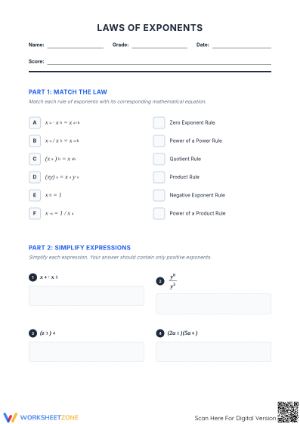
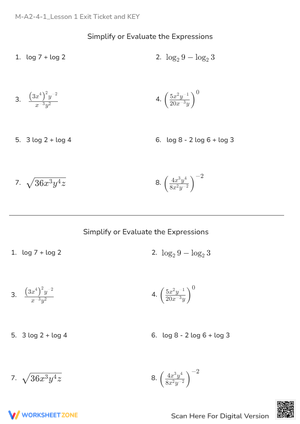
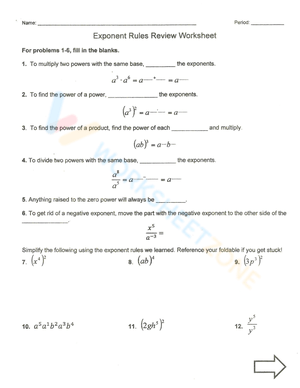
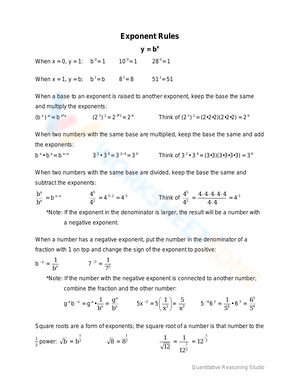
These 11th grade numbers printable worksheets cover three topics that mark a genuine shift in how students understand what a number is: the complex number system, rational exponents, and matrix operations. Each worksheet targets one specific skill within those areas, so teachers can pull a conjugate division exercise for a Friday warm-up or assign a scalar multiplication worksheet as independent practice without sorting through material that doesn't fit the lesson.
What's Inside the Set
The complex number worksheets move through arithmetic in a deliberate sequence. The first group covers addition and subtraction of expressions in a + bi form — mostly a matter of combining like terms and building familiarity with the notation. Multiplication worksheets carry the heavier conceptual load: students apply the distributive property across two binomials, then substitute negative one for i², collapsing a four-term polynomial into a two-term complex number. The division worksheets require students to rationalize denominators using complex conjugates — multiplying both numerator and denominator by the conjugate before simplifying. A separate group of worksheets focuses on plotting complex numbers on the coordinate plane, pairing algebraic notation with a visual representation that many students need before the procedures fully settle.
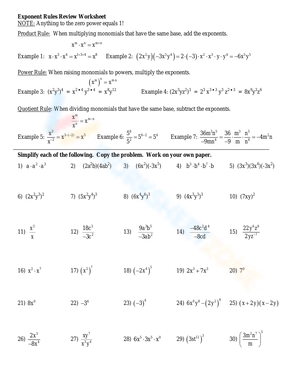
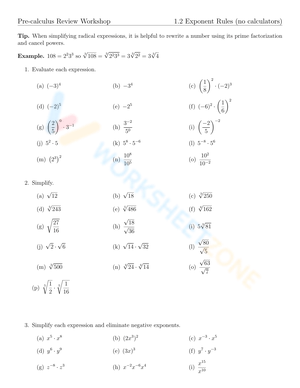
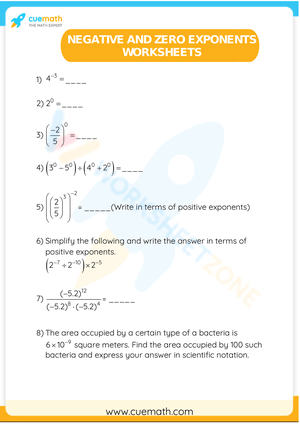
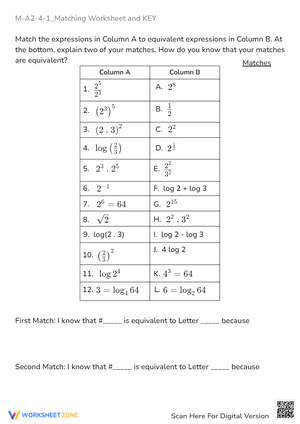
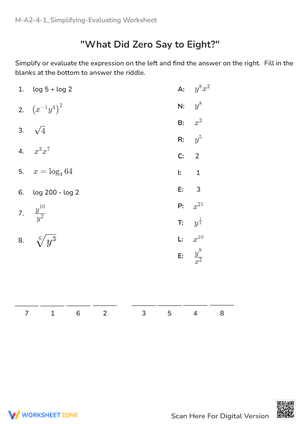
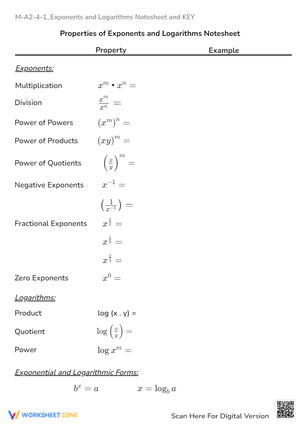
The rational exponent worksheets address two interrelated skills: translating between radical notation and fractional exponent form, and simplifying expressions using exponent properties. Problems range from evaluating 27^(2/3) without a calculator to rewriting nested radicals as a single fractional exponent before applying the quotient rule. Negative rational exponents get dedicated practice — they appear more frequently on assessments than many teachers expect, and students handle them much less reliably than positive ones. The matrix worksheets begin with addition, subtraction, and scalar multiplication, then continue into matrix multiplication and determinants. Every matrix worksheet uses generous spacing between rows and columns so students can write partial products legibly during computation, a formatting decision that prevents a disproportionate share of arithmetic errors.
Mistakes That Surface Consistently in Student Work
The most persistent error in complex number multiplication is treating i² as an unreduced variable rather than a constant equal to negative one. Students who have spent years leaving x² as x² carry that habit directly into complex number work. They apply the distributive property correctly, produce a four-term expression, combine like terms, and then stop — writing something like 3 + 2i² as a final answer. The error lives in the last step because the earlier steps consumed most of their attention. Catching it early requires returning to the definition of i before students begin practice, not after an incorrect answer appears.
With rational exponents, the most specific error pattern involves negative bases. Students who correctly evaluate 8^(2/3) as 4 will frequently freeze at (−8)^(2/3). Many reach for a calculator, encounter an error message or an unexpected result depending on how the device handles fractional powers of negatives, and give up — rather than recognizing that the cube root of negative eight is negative two, and squaring that gives four. These 11th grade numbers printable worksheets sequence problems so that negative-base examples follow a run of positive-base problems, giving students time to internalize the procedure before the notation adds another layer.
Matrix multiplication produces a distinct category of errors. The most common is row-column confusion: students multiply across two rows rather than multiplying a row from the first matrix against a column from the second. Even students who can describe the procedure correctly make this mistake under any mild time pressure. A smaller but consistent error appears in scalar multiplication — students who correctly distribute a scalar across a 2x2 matrix will skip an entry in a 3x3 matrix, almost always the center element of the middle row.
Fitting These Worksheets Into Your Weekly Planning
Complex number worksheets work well as the entry task at the start of a period — five problems covering operations from the previous day, completed independently in the first eight minutes before direct instruction begins. Because the arithmetic is self-contained and requires no reference material, error patterns show up quickly. A student who distributes correctly and combines like terms but leaves i² in the final answer is easy to identify and redirect before the misconception deepens.
Rational exponent worksheets benefit from distribution across the week rather than a single extended practice block. Students who work through a conversion worksheet on Monday, a simplification worksheet on Wednesday, and a mixed-format review on Friday retain the rules more reliably than students who do the same volume in one sitting. The brief gaps between sessions force students to reconstruct the procedure rather than copy it from short-term memory — that's exactly what spaced retrieval produces over time.
For matrix multiplication, a simple pairing routine reduces coordination errors considerably: one student works through the computation on the worksheet while a partner tracks the correct row-column pairs, pointing to the relevant column as each element is calculated. These 11th grade numbers printable worksheets reserve space inside each result cell for partial products, which supports that step-by-step process during the early stages of learning the procedure. Once students are accurate with 2x2 matrices, that formatting aid matters less — but it is genuinely useful during the first several sessions.
How to Tier These Worksheets Across Your Class
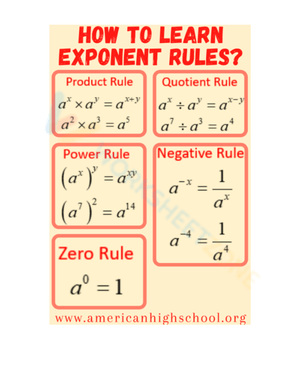
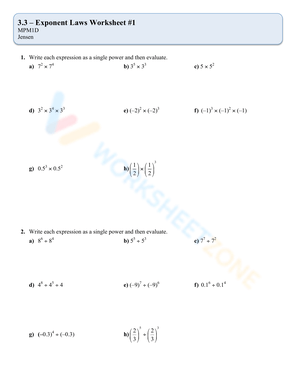
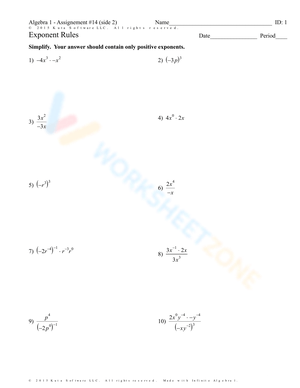
Students who are unsteady on integer exponent rules will struggle with rational exponents from the start — not because fractional exponents are harder in principle, but because both the new notation and the underlying properties demand attention simultaneously. A brief integer exponent review before the rational exponent worksheets is more efficient than trying to address both gaps during the same lesson. Students who can apply the product, quotient, and power rules fluently to integers typically move through the fractional exponent worksheets without procedural breakdowns.
For students who move through complex number operations without difficulty, the natural extension is working in reverse: given a pair of complex conjugates as solutions, reconstruct the quadratic equation that produced them. These 11th grade numbers printable worksheets don't go that far — they focus on the four arithmetic operations — but a teacher can create that challenge from within the same worksheet by covering the original problem and presenting only the answer, asking students to write backwards from the solution.
Matrix worksheets tier naturally by matrix size. Students still making row-column errors in 2x2 multiplication should stay with 2x2 problems until the procedure is fully automatic. Students who complete 2x2 work accurately and efficiently are ready for the determinant worksheets, which introduce a distinct algorithm rather than simply applying the multiplication procedure to a larger grid.
Standard Alignment
The complex number worksheets address CCSS N-CN.A.1 and N-CN.A.2. N-CN.A.1 establishes the definition of i and the general form a + bi; N-CN.A.2 requires students to add, subtract, and multiply complex numbers. In most Algebra 2 courses these standards appear early in the second semester, before the quadratic formula unit that depends on them. The rational exponent worksheets align to CCSS N-RN.A.1 and N-RN.A.2, which address the conceptual equivalence between rational exponents and radicals and the extension of exponent properties to fractional powers. These standards appear at the start of Algebra 2 or at the end of Algebra 1 in accelerated tracks. Matrix operations fall under CCSS N-VM.C, the vector and matrix operations cluster, which establishes that matrix multiplication is non-commutative — a structural property that distinguishes it from real number arithmetic and that students need explicit reminders of even after they learn the procedure.
Frequently Asked Questions
Why do students keep making the i² simplification error even after the rule has been reviewed?
The issue is working memory, not comprehension. Multiplying complex numbers requires several sequential steps — distributing, collecting like terms, then substituting — and the substitution step drops out under cognitive load because it comes last. Students who produce four terms correctly and then stop have not forgotten the rule; they have run out of attention. Short practice sets that isolate multiplication without mixing in division or addition reduce the number of operations competing for attention at once, and the substitution step becomes automatic more quickly as a result.
How are the translation problems between radical and fractional exponent notation structured?
Each rational exponent worksheet presents problems in both directions — some ask students to rewrite a radical as a fractional exponent, others ask students to convert a fractional exponent into radical form. Several problems within each worksheet present both forms and ask students to confirm equivalence by evaluating each. The denominator-as-index relationship is reinforced across multiple problems before fifth roots appear, giving the pattern enough repetitions to settle before the numbers get less familiar. Students who see only one direction of translation tend to recognize it in that direction only, so the bidirectional structure is deliberate throughout.
Can the matrix worksheets work for students who have never encountered matrices before?
The addition and scalar multiplication worksheets are appropriate for first exposure — those operations extend arithmetic students already know, and the primary instructional task is developing accurate row-column tracking habits. Matrix multiplication worksheets are not suited to a first-day introduction; they assume the student has already seen the row-column procedure demonstrated and needs practice executing it, not learning it from scratch. Teachers introducing matrix multiplication for the first time should work through at least two or three examples as a class before assigning the independent practice worksheet. The determinant worksheets assume full fluency with matrix multiplication and introduce a distinct algorithm that cannot be learned without first understanding matrix structure.