10th Grade Trigonometric Ratios Printable Worksheets
These 10th grade trigonometric ratios printable worksheets give teachers a focused practice sequence that runs from side-labeling basics through inverse trig applications—staying inside right-triangle trigonometry rather than mixing in unit-circle content that belongs later in the course. Each worksheet targets a specific decision point rather than asking students to repeat the same calculation type until the skill feels automatic.
The Specific Skills Each Worksheet Targets
The set covers six practice areas that follow the actual progression of a trig ratio unit.
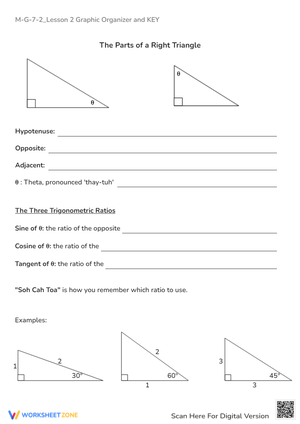
- Side identification: Students mark the opposite side, adjacent side, and hypotenuse relative to a specified angle—not the longest or shortest side, which is a shortcut that collapses when the reference angle changes.
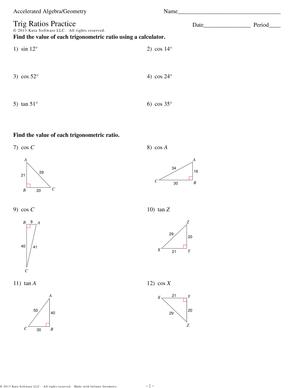
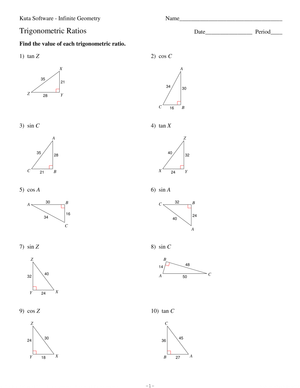
- Ratio naming: Students express the sine, cosine, or tangent of a marked angle as a fraction using labeled side lengths.
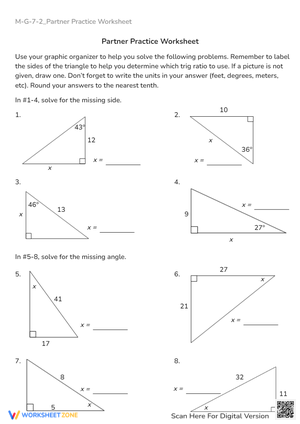
- Missing side problems: Students use a known angle and one side to find a second side with a calculator.
- Missing angle problems: Students apply inverse sine, cosine, or tangent to recover an angle from two side lengths.
- Mixed ratio selection: Students choose the appropriate ratio for each diagram without being told which function to use—the step that separates conceptual understanding from procedural habit.
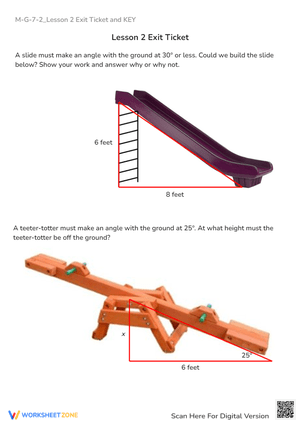
- Application problems: Elevation, ramp, ladder, and shadow problems ask students to set up a triangle before solving, which is the step most direct-computation worksheets skip entirely.
Mistakes Students Make That These Worksheets Help You Catch
The most persistent error is treating "opposite" and "adjacent" as fixed properties of a side rather than angle-dependent labels. Show a student a 3-4-5 right triangle, ask for the sine of angle A, then immediately ask for the sine of angle B—a meaningful portion of the class gives the same fraction both times. A worksheet that presents the same triangle twice with a different marked angle each time makes this misconception visible immediately rather than waiting for it to surface on a quiz.
Calculator mode errors run a close second. A student who gets sin(30°) right in one problem may work in radian mode on the next, see an output of 0.988, and continue without pausing. Worksheets that mix angle measures across a broad range—say, 18° through 73°—help here because the outputs are less familiar and students are more likely to notice when a computed side length comes back looking geometrically impossible.
A third pattern: students round intermediate values, plug that rounded number into the next step, then round again. On a multi-step problem, that compounding error shifts the final answer enough to matter on a graded assessment. The best 10th grade trigonometric ratios printable worksheets address this directly by instructing students not to round until the final step—and doing so consistently across the entire set, so the habit forms rather than having to be rediscovered each time.
Building These Worksheets Into a Trig Unit Without Overloading Any One Lesson
Start with the side-labeling worksheet as a stand-alone activity on day one or two, before any calculator work begins. Students who cannot consistently name opposite and adjacent from a given angle will make ratio errors no matter how carefully they remember SOHCAHTOA—catching that gap early prevents a week of reteaching later.
Three or four of the shorter worksheets work well as bell-ringers. A three-problem warm-up asking students to identify the correct ratio setup—without actually solving—gives real-time feedback before direct instruction begins and fits inside the eight minutes before a lesson starts. For exit checks, pull two or three items from the mixed-selection worksheets. If students choose the right ratio and set up the equation correctly in the final minutes of class, they are ready to move forward; if most of the class selects the wrong function, that information changes tomorrow's opening.
For small-group work, sort students by error type rather than score. Students who understand ratio logic but make consistent calculator errors need a different conversation than students still confusing opposite and adjacent. Because the worksheets address these as separate skill areas, teachers can assign the specific worksheet each group needs rather than re-running the full lesson for everyone.
Adjusting the Set for a Range of Learners
Students still solidifying side-labeling benefit from pairing the identification worksheets with a reference card that shows opposite, adjacent, and hypotenuse relative to a clearly marked angle. The purpose is to reduce working memory load so students can concentrate on the ratio decision rather than vocabulary recall. Once labeling becomes automatic, pull the card.
Students who move through the standard problems quickly are ready for application worksheets that require constructing a triangle setup from a written description before solving. A problem like "a 12-foot ladder leans against a wall at a 65° angle—how high does it reach?" asks students to identify the needed side, assign a ratio, and write an equation with no diagram provided. That is meaningfully harder work without requiring different content, which makes it a genuine extension rather than busywork.
Teachers using 10th grade trigonometric ratios printable worksheets in co-taught classrooms often run the application items in two versions: one where the triangle is pre-drawn and labeled, and one where students construct it from the problem description. Both versions address the same standard; the first removes one layer of complexity for students who need it without softening the ratio reasoning itself.
Standard Alignment
These worksheets align to CCSS HSG-SRT.C.6, which defines trigonometric ratios for acute angles as relationships between side lengths in similar right triangles, and HSG-SRT.C.8, which extends that understanding to applied right-triangle problem solving. In instructional terms, HSG-SRT.C.6 is the conceptual standard—students must understand why the sine of a 30° angle is always 0.5, not just know which button produces it—while HSG-SRT.C.8 is where ladder, ramp, and elevation problems live. Both standards appear in 10th grade geometry courses and resurface in Algebra 2 and Precalculus, where right-triangle ratio definitions are treated as assumed knowledge rather than new content.
Frequently Asked Questions
Do all of these worksheets require a calculator?
No. The side-labeling and ratio-naming worksheets use triangles with labeled side lengths, so students write ratios as fractions without any computation. Only the missing-side and missing-angle worksheets require a scientific or graphing calculator. That separation makes the identification and naming worksheets practical for bell-ringer use even in rooms where devices are not accessible at the start of class.
What do the answer keys show beyond the final answer?
Each answer key shows the ratio setup and the final numerical answer. On mixed-selection problems, the key identifies which function was chosen and why—not just the decimal result—so teachers can use it to guide a class discussion about ratio-choice reasoning rather than only verifying arithmetic after the fact.
What if a student already knows the ratios but stalls on word problems?
Assign only the application-focused worksheets from the set. Students who perform well on direct-computation problems often freeze on application items because they cannot identify which side of an imaginary triangle is the unknown quantity. That gap can be addressed independently of the ratio-definition content, so there is no need to restart the set from the beginning.
Can these work for Algebra 2 or Precalculus review, or are they strictly geometry?
10th grade trigonometric ratios printable worksheets built around right-triangle sine, cosine, and tangent transfer directly to Algebra 2 and Precalculus review. When students reach the unit circle, right-triangle ratio fluency—specifically, knowing which ratio pairs with which sides—is the assumed foundation. A targeted review of the mixed-selection and application worksheets at the start of a Precalculus trig unit takes less than a class period and prevents the predictable confusion that surfaces when students cannot remember which definition applies where.
Clear All