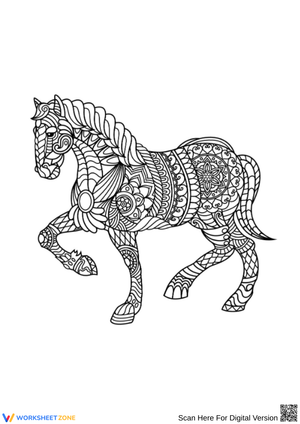
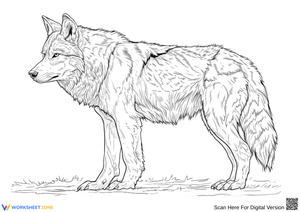
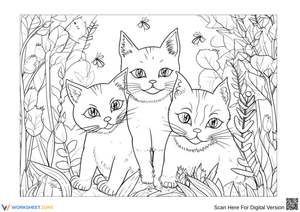
These drawing and painting worksheets pdf for 10th grade give teachers a practical toolkit for the moment when art class stops being about exploration and starts being about craft. Students at this grade level arrive with dramatically uneven preparation — some have taken private lessons for years, while others haven't drawn seriously since seventh grade. The set covers both drawing fundamentals and painting technique, so a teacher working with one mixed-ability class can pull the right worksheet for the right student rather than settling for a single-level lesson.
What the Set Covers
Each worksheet targets a discrete skill: two-point and three-point perspective, graduated value scales, cast shadow rendering, color mixing from a limited palette, glazing with acrylics, and wet-on-wet watercolor handling. The drawing worksheets provide pre-drawn horizon lines with vanishing point guides so students focus on the logic of receding planes rather than spending their time constructing the grid from scratch. Painting worksheets include pre-labeled color-mixing charts where students fill in actual pigment swatches — not just describe what they plan to mix.
The shading exercises move through five tonal zones in sequence: highlight, mid-tone, core shadow, reflected light, and cast shadow. Students work through geometric solids first — sphere, cube, cylinder — and then apply the same tonal logic to organic forms like crumpled fabric or a closed fist. That sequence matters. Geometric solids give students a reliable mental model to borrow when they encounter an unpredictable form later in a studio piece.
Student Mistakes That Surface Early and Often
Two-point perspective trips up 10th graders in a specific and consistent way: they place both vanishing points too close together on the horizon line. The result is a building that looks compressed — walls that should splay outward at dramatic angles end up nearly parallel. Most students don't catch this error until they hold the paper at arm's length. The perspective worksheets address this by using a wide-format horizon line that physically discourages cramped vanishing point placement.
Value shading produces a different but equally predictable problem. Students press too hard in the early passes, laying in a dark mid-tone before they've preserved the lightest lights. Fixing this requires heavy erasing, which damages the paper surface and discourages second attempts. Each shading worksheet includes a printed note at the top margin reminding students to begin with the lightest possible pressure and build — a small intervention that cuts re-dos noticeably.
In painting, the most common error isn't muddy color from overmixing — it's reaching for white to desaturate. The result is a chalky, flat-looking surface that more experienced painters recognize immediately. Teaching students to desaturate by mixing a color with its complement takes one well-constructed exercise; the color theory worksheets in this set are built around exactly that concept, walking students through a series of grayed neutrals without touching white paint.
Building These Worksheets Into Your Weekly Lesson Plan
The bell-ringer approach works reliably with this material. Students spend the first eight to ten minutes of class on a single focused exercise — one value step on a gradated scale, one elevation of a three-point perspective structure — then transition to their studio work. That warm-up narrows the gap between sitting down cold and producing quality marks. The shift from hallway energy to focused studio attention happens in those minutes, and it happens consistently when the task is bounded and specific.
Drawing and painting worksheets pdf for 10th grade also function well as pre-project technical clearances. Before a student starts a large-scale still life, they complete the value scale and cast shadow worksheet. Before a portrait unit, they complete the five-zone shading exercise on a sphere and an egg form. That sequence isn't gatekeeping — it's insurance. Teachers who assign the large project without the technical foundation spend the next three class periods re-teaching the same concepts to students who are now also managing a time crunch and a growing sense of failure.
For schools running block schedules, a single worksheet fits cleanly into the first segment of an 80-minute period, leaving the bulk of time for studio production without sacrificing focused skill work.
Standard Alignment
These worksheets address National Core Arts Standards for visual arts at the high school level, primarily within the Creating strand. They most directly support HS.Cr2.1.Va — "Through experimentation, practice, and persistence, demonstrate acquisition of skills and knowledge in a chosen art form" — and HS.Cr2.2.Va, which calls for students to refine their work through application of technical skill and understanding of art-making approaches. The perspective and shading exercises map to the Developing and Refining process components; the color theory and glazing work addresses the same strand's emphasis on intentional, informed material use.
Because each completed worksheet produces a datable, observable artifact, the set also supports documentation for portfolio reviews and standards-based grading systems where skill growth needs to be demonstrated rather than assumed.
Adjusting the Work for a Mixed-Ability Studio
The realistic ability spread in a 10th grade art room is wider than most planning documents account for. A student who has taken private oil painting lessons for three years sits in the same period as a student who hasn't worked in any medium since elementary school. The worksheets address both ends of that range without requiring two separate lesson preps.
For students who need more support, the perspective worksheets come with pre-drawn horizon lines, labeled vanishing points, and step-by-step prompts in the side margin. Students who are further along receive a blank-format version of the same exercise — same concept, no built-in guidance — and extend it into three-point or curvilinear perspective. Drawing and painting worksheets pdf for 10th grade that offer this kind of format variation let a teacher assign ostensibly the same task to two students while quietly matching difficulty to readiness.
For painting, students who need more support work from a limited two-color palette to keep mixing variables manageable. Advanced students use the same color theory framework but demonstrate temperature shifts — mixing a warm and a cool version of each hue — which adds genuine conceptual depth without changing the assignment structure for the rest of the class.
Frequently Asked Questions
What pencils and supplies do students need for the drawing worksheets?
Graphite across a range — 2H, HB, 2B, and 4B at minimum — a kneaded eraser, and a ruler. The ruler matters more than it initially seems: students who try to lay in perspective lines freehand spend so much attention on keeping lines straight that they lose track of vanishing point logic entirely. The ruler removes that variable and keeps cognitive focus where it belongs.
What paper weight works best for the painting exercises?
Standard copy paper warps immediately under wet paint. Print painting worksheets on 60 lb text weight or heavier — 80 lb cardstock handles acrylic exercises well. Watercolor exercises are better served by 90 lb to 140 lb watercolor paper, though that increases per-student cost. For classrooms working within a tight supply budget, 80 lb cardstock manages light watercolor washes adequately without the warping that makes value gradations difficult to read and assess.
Can students complete these exercises on a drawing tablet?
Students using a drawing tablet can open the PDF in a digital annotation app and work directly on the worksheet layer. The perspective and value scale exercises translate well to digital tools; the painting exercises are less directly transferable but serve as solid visual references for the same techniques in digital painting software. The core skill logic — how vanishing points function, how tonal zones relate to a light source — holds across both contexts.
Do these work as substitute teacher plans?
Drawing and painting worksheets pdf for 10th grade carry enough internal instruction — labeled components, sequential steps, and visible completion criteria — that a non-art substitute can manage the period without art expertise. Having a set printed and filed before any planned absence keeps students on structured skill work rather than unconnected free-draw days that don't build toward ongoing units.