


























Views
Downloads
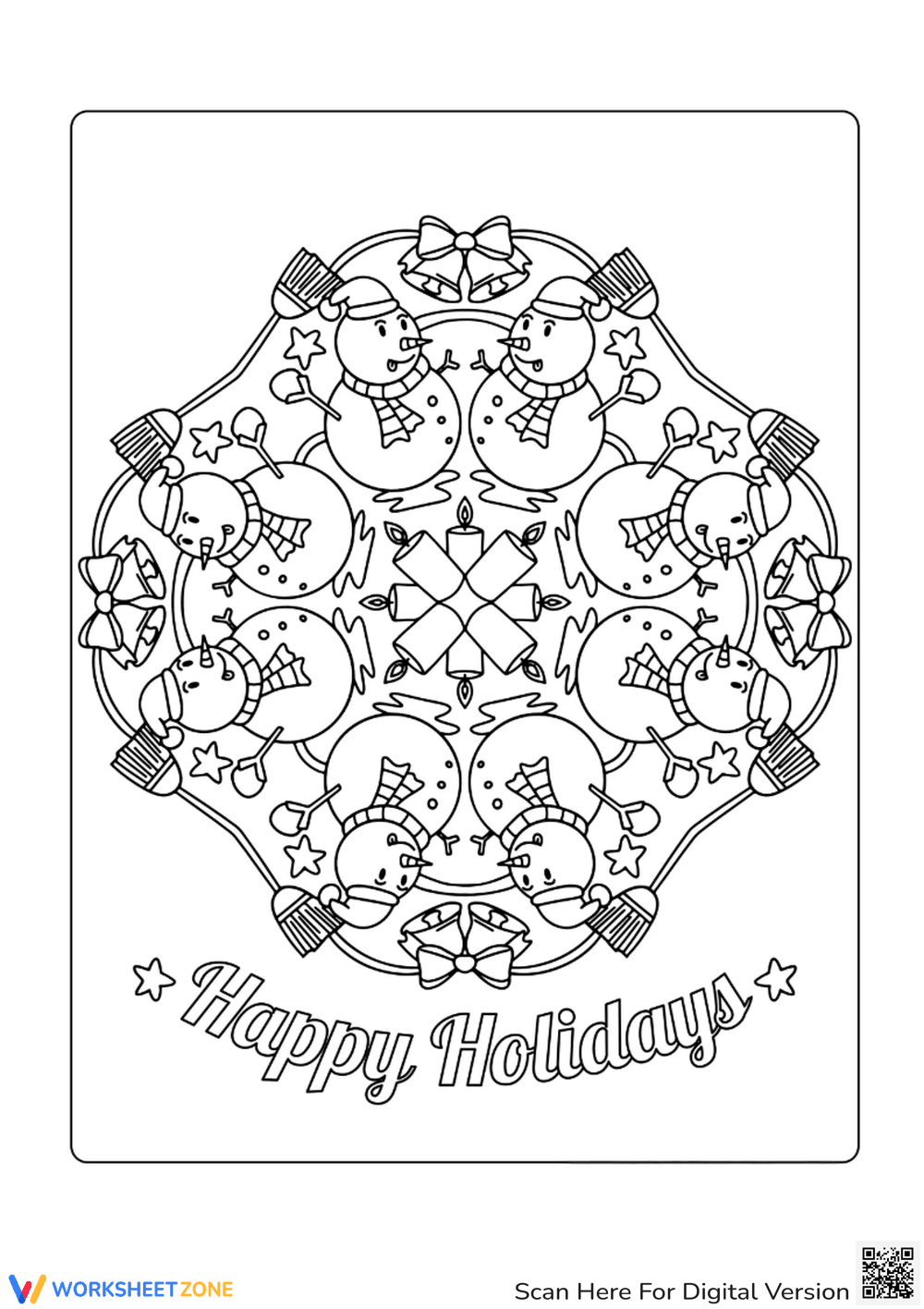

Printable Snowman Mandala Coloring Page | Grade 10
Paste this activity's link or code into your existing LMS (Google Classroom, Canvas, Teams, Schoology, Moodle, etc.).
Students can open and work on the activity right away, with no student login required.
You'll still be able to track student progress and results from your teacher account.
This Grade 10 snowman mandala coloring page provides a sophisticated creative outlet for high school students during the holiday season. By engaging with intricate geometric patterns and festive imagery, learners practice focus and fine motor precision. It serves as an ideal mindfulness activity to balance rigorous academic demands with artistic expression and seasonal joy.
At a Glance
- Grade: 10 · Subject: English & Fine Art
- Standard:
CCSS.ELA-LITERACY.L.9-10.6— Acquire and use accurately general academic and domain-specific words and phrases- Skill Focus: Fine Motor & Mindfulness
- Format: 1 page · 1 task · No answer key · PDF
- Best For: Brain breaks and holiday stress relief
- Time: 15–30 minutes
What's Inside
This resource features a single-page, high-resolution PDF containing a complex snowman mandala. The design includes symmetrical snowmen, bells, stars, and candles, centered around a "Happy Holidays" greeting. The intricate linework is specifically designed for older students and adults, offering a level of detail that encourages sustained attention and creative color choices without the need for additional instructions.
Zero-Prep Workflow
- Print: Select the single-page PDF and print enough copies for your class in less than 60 seconds.
- Distribute: Hand out the sheets along with colored pencils or fine-tip markers at the start of a transition period.
- Review: Allow students to display their finished work on a classroom gallery wall to foster a festive environment.
Total teacher preparation time is under 2 minutes, making it a perfect last-minute addition to any lesson plan or sub folder.
Standards Alignment
The primary standard addressed is `CCSS.ELA-LITERACY.L.9-10.6`, which focuses on the acquisition and use of academic and domain-specific vocabulary. While primarily an artistic task, the activity supports the expression component of the standard by allowing students to visually interpret festive themes and seasonal concepts. This standard code can be copied directly into lesson plans, IEP goals, or district curriculum mapping tools.
How to Use It
Use this worksheet as a brain break during a long block period to help students reset their focus between intensive reading and writing tasks. Alternatively, assign it as a formative assessment of student engagement during a holiday-themed literature unit. Completion typically takes 15 to 30 minutes depending on the complexity of the student's chosen color palette and artistic technique.
Who It's For
This resource is designed for Grade 9 and 10 students, though its complexity makes it suitable for adult learners as well. It is particularly effective for students who benefit from kinesthetic activities or those requiring sensory regulation during high-stress testing windows. Pair this with a holiday-themed short story or a descriptive writing prompt to create a comprehensive seasonal lesson.
Research by Fisher & Frey (2014) emphasizes the importance of productive group work and individual processing time in the gradual release of responsibility model. While often overlooked in secondary education, creative tasks like this snowman mandala provide the necessary cognitive pause required for deep information synthesis. According to the Fisher & Frey framework, integrating non-linguistic representation—such as fine art and coloring—can enhance a student's ability to engage with complex academic content by reducing cognitive load and anxiety. This printable Grade 10 worksheet aligns with these findings by offering a low-stakes, high-engagement task that supports emotional regulation in the classroom. By utilizing the CCSS.ELA-LITERACY.L.9-10.6 standard as a foundation for creative expression, educators can justify the inclusion of artistic breaks as a legitimate component of a balanced ELA curriculum. This resource ensures that students remain connected to the classroom environment while practicing the fine motor skills essential for various technical and academic disciplines.


