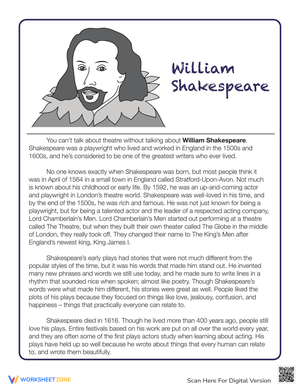
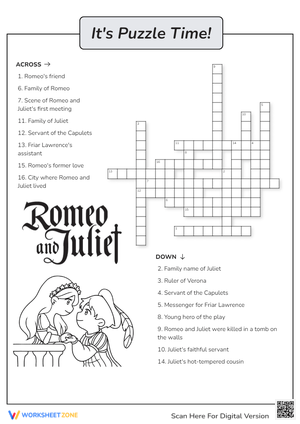
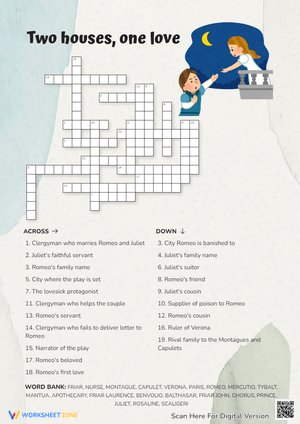
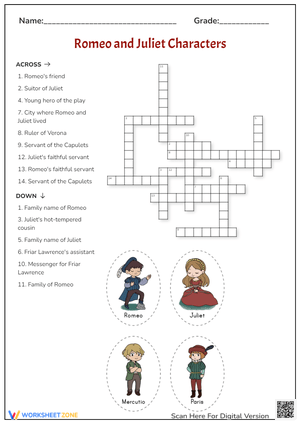
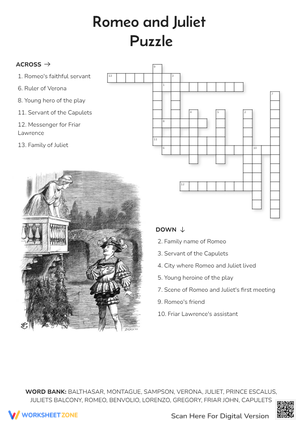
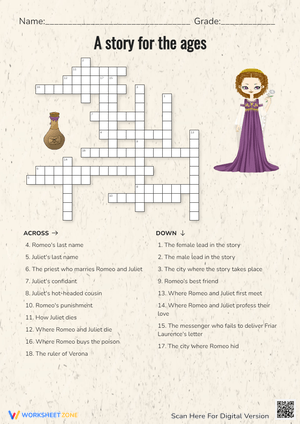
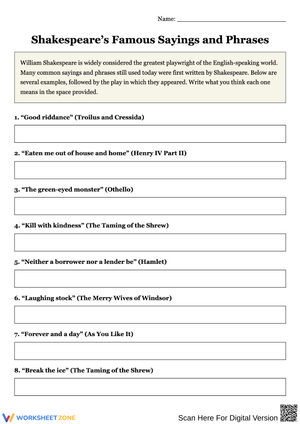
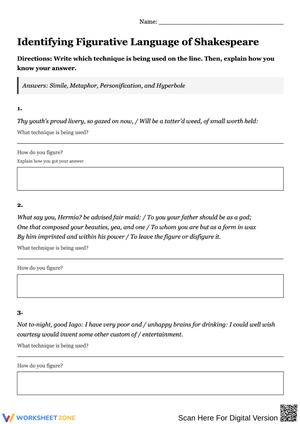
These 10th grade shakespeare printable worksheets give English teachers a concrete set of tools for the specific challenges of sophomore Shakespeare study — getting students past Early Modern English quickly enough to actually think about the plays, and building the character and rhetorical analysis that Julius Caesar and Macbeth demand at this level. Both plays are covered across the set.
The Specific Skills Covered
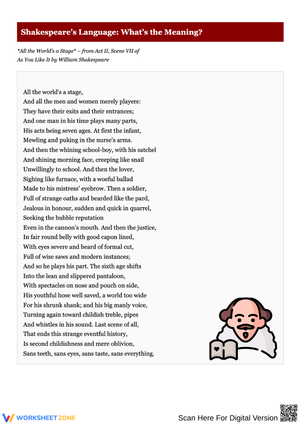
Translation exercises anchor the early portion of the set. Students encounter key passages in their original form, work through them line by line, and write modern equivalents before answering questions about word choice and tone. The aim isn't just comprehension — it's training students to read Shakespeare as a deliberate writer rather than an obstacle to decode.
Character analysis worksheets track motivation across multiple scenes, not in a single isolated moment. Each worksheet presents a sequence of quotations and asks students to mark what the character wants, what they fear, and what they're concealing. That three-part structure forces students to distinguish between what a character says and what they mean — the core analytical move for reading tragic heroes at this level.
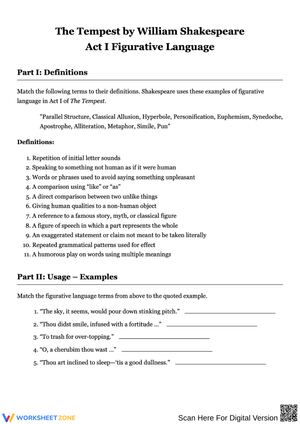
Rhetorical analysis worksheets focus on specific speeches: Antony's funeral oration in Julius Caesar, Lady Macbeth's "unsex me here" soliloquy, and Cassius's manipulation of Brutus in Act I. Students identify ethos, pathos, and logos in context, annotate each appeal in the speech's margin, and then evaluate whether the rhetoric is honest or manipulative. The set also includes iambic pentameter recognition exercises where students mark stressed and unstressed syllables in selected lines and consider where and why Shakespeare departs from the regular beat — because students who can hear the pattern can often catch the meaning more quickly than students who only decode it visually.
Student Errors Worth Watching For and Correcting Early
The most consistent misread in student work is Antony's funeral oration. Students treat "Brutus is an honorable man" as a sincere statement — they have been trained to read earnestness in declarative sentences, and it takes direct instruction for them to hear the accumulating irony. Teachers who don't address this before assigning the rhetorical analysis worksheet will find many students analyzing the speech as if Antony genuinely praises Brutus, which collapses the entire point of the assignment.
A second pattern shows up in Macbeth work: students blame the witches for everything. They write it almost formulaically — "the witches caused Macbeth to commit murder." The character analysis worksheets push back on this directly by asking students to locate evidence of Macbeth's ambition before the witches appear in Act I, scene iii. That single question usually reframes the class discussion considerably.
In translation work, students often treat paraphrase as the task. They restate the general idea of a passage rather than working through it word by word. The side-by-side format on these worksheets, which leaves narrow line-by-line space for responses, discourages that tendency — but a quick spot-check of first attempts before students advance to analysis questions is still worth the two minutes it takes.
Getting the Most From These Worksheets in Your Lesson Plans
Most teachers pull individual worksheets as they reach the relevant scene rather than working through the set from start to finish. A translation worksheet fits naturally at the opening of a new act — students complete it independently or in pairs before the class reads aloud together. The character analysis worksheets work well as the anchor for a longer discussion block, with students using their completed annotations as evidence during Socratic seminar. That sequencing — complete the worksheet, then talk — gives quieter students something concrete to reference rather than speaking from memory alone.
The rhetorical analysis worksheets earn their place as preparation for analytical writing. After students have annotated Antony's speech on the worksheet, they have the material they need to write an analytical paragraph or full essay on persuasion. Using 10th grade shakespeare printable worksheets this way — as the structured thinking work before the drafting — produces noticeably stronger first paragraphs than assigning the essay without that preparation step. The character analysis worksheets serve a similar purpose in the two or three class periods before students write their first full literary essay of the semester.
One classroom activity that consistently deepens language engagement: after students complete a translation worksheet, ask them to take a modern news headline or a song lyric and rewrite it in Shakespearean vocabulary and iambic pentameter. This reversal sends students back inside the mechanics of the language rather than just observing it from a distance, and it reveals fairly quickly which students have genuinely internalized the rhythm versus which ones memorized a definition of iambic pentameter.
Standard Alignment
The translation and vocabulary worksheets address RL.9-10.4, which asks students to determine the meaning of words and phrases as they are used in the text, including figurative and connotative meanings. In classroom terms, this standard appears every time a student has to decide whether "honorable" in Antony's speech is being used sincerely or ironically — a glossary lookup cannot answer that question, which is exactly why close translation work matters here rather than simply providing a modern-language summary.
Character analysis worksheets target RL.9-10.3, which covers how complex characters develop over the course of a text and how their choices shape the plot. At Grade 10, this standard is almost always taught through the tragic hero, which explains why Julius Caesar and Macbeth appear so consistently on sophomore reading lists. The rhetorical analysis worksheets connect to RI.9-10.6, asking students to analyze how an author's purpose shapes the content and style of a text — skills that transfer directly into the persuasive writing students are expected to produce later in the year.
Adjusting the Worksheets for a Range of Learners
For students who struggle with Early Modern English, the most effective adjustment is assigning the translation worksheet before they encounter the full text in class — not alongside it. Working through short familiar excerpts in advance reduces the cognitive strain of simultaneous decoding and analysis. Many teachers also provide a printed glossary of the most common archaic terms as a companion document, which keeps students moving through each worksheet without stopping to search elsewhere.
Students who already read fluently need a different kind of pressure. Assigning 10th grade shakespeare printable worksheets with the vocabulary cues and translation prompts removed pushes advanced students to build analysis directly from the original text — which is closer to what college-level literary work expects. Open-ended comparison prompts asking students to connect a tragic hero's choices to a character from a contemporary novel they've read recently also extend the analytical frame without requiring entirely different materials. A teacher running honors and standard-track sections of the same play can use the same worksheets in both rooms with meaningfully different levels of built-in support.
Frequently Asked Questions
Which plays do these worksheets cover?
The set addresses both Julius Caesar and Macbeth — the two plays that appear most consistently in Grade 10 English curricula across the United States. Both feature clear tragic heroes, strong rhetorical set pieces, and themes substantial enough to anchor the extended analytical writing 10th graders are expected to produce.
Can individual worksheets be used without teaching the full play?
Several can. The rhetorical analysis worksheets work as standalone exercises — Antony's funeral oration carries enough internal context that students can analyze the speech productively without having read all of Julius Caesar. Teachers who run a standalone rhetoric unit often pair that analysis work with a contemporary persuasive text to show students the same techniques operating in a modern context.
My students freeze the moment they see Early Modern English. What actually helps?
Performance before reading. Even watching a two-minute clip from a stage production before assigning a translation worksheet gives students an emotional entry point before they have to decode language on the page. The rhythm of iambic pentameter, once students can hear it in a live or recorded performance, carries meaning that silent reading alone often misses — and that rhythmic familiarity tends to make the translation work go faster when students do sit down with the worksheet.
Do these worksheets work for both honors and standard-track Grade 10 classes?
They do, with deliberate adjustments to how much support stays in place. Standard-track students benefit from the full set of vocabulary hints and structured analysis prompts. For honors sections, removing those supports and substituting open-ended comparative questions shifts the demand considerably. A teacher running two sections of the same play can use the same 10th grade shakespeare printable worksheets in both rooms with meaningfully different levels of guidance depending on the class.












 Interactive Worksheet Maker
 Quiz Maker
 Word Search Maker
 Crossword Puzzle Maker
 Word Scramble Generator
 Sentence Scramble Generator
 Handwriting Worksheet Generator
 Name Tracing Generator
 Fill In The Blank Generator