


























Views
Downloads

Picasso Word Search: Printable Grade 6 Vocabulary
Paste this activity's link or code into your existing LMS (Google Classroom, Canvas, Teams, Schoology, Moodle, etc.).
Students can open and work on the activity right away, with no student login required.
You'll still be able to track student progress and results from your teacher account.
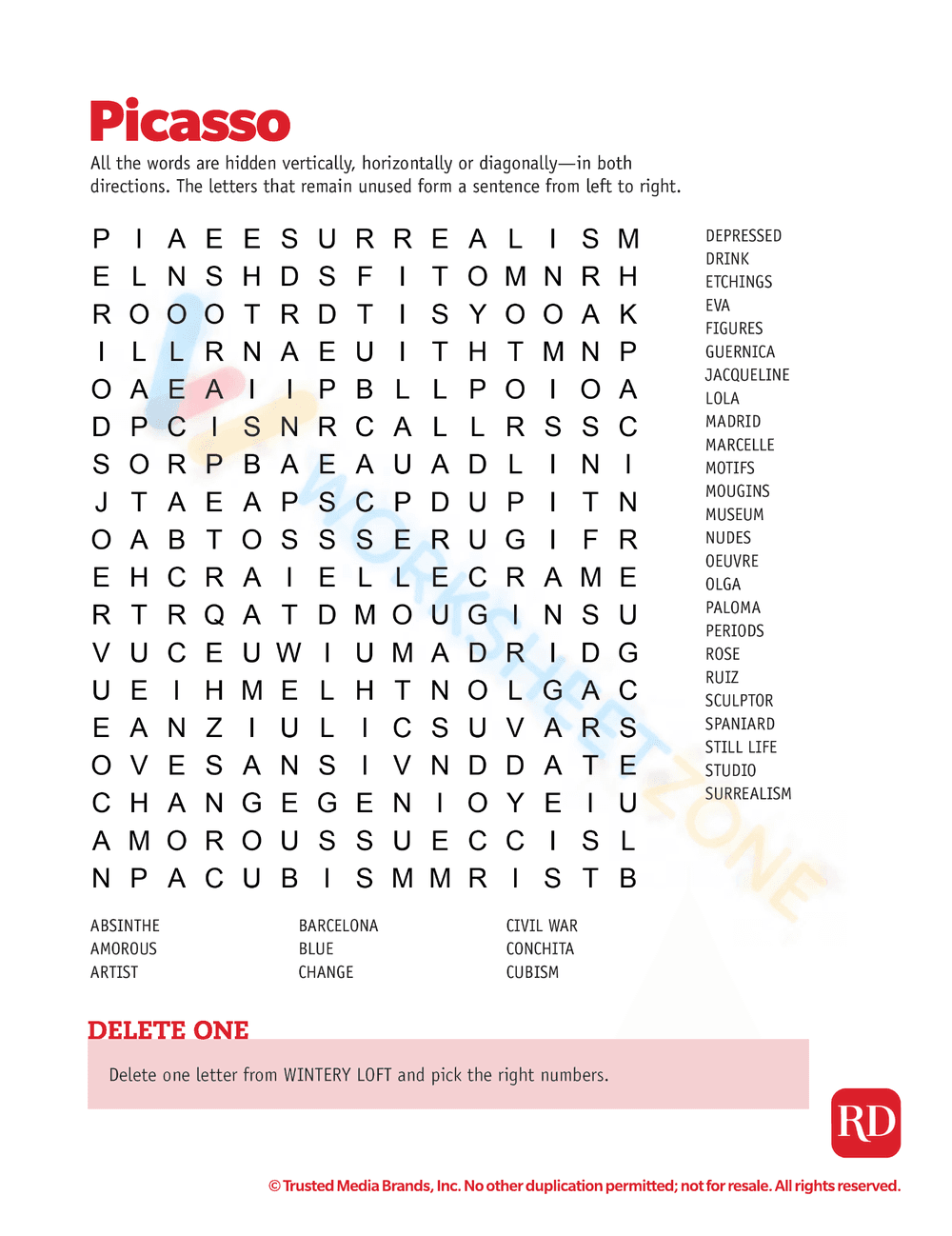
This printable Picasso word search worksheet helps Grade 6 students master domain-specific art history vocabulary through active visual scanning. Students identify key terms related to Pablo Picasso's life, artistic movements, and famous masterpieces, reinforcing spelling and word recognition. Use this engaging activity to introduce an art unit or support language arts lessons.
At a Glance
- Grade: 6 · Subject: ELA & Art History
- Standard:
CCSS.ELA-LITERACY.L.6.6— Acquire and use grade-appropriate domain-specific words- Skill Focus: Art history vocabulary and spelling
- Format: 1 page · 32 problems · Answer key not included · PDF
- Best For: Fast finishers and sub plans
- Time: 15–20 minutes
This single-page PDF features a grid containing 32 hidden vocabulary words related to Pablo Picasso, including terms like Cubism, Surrealism, Guernica, and Madrid. Words are hidden vertically, horizontally, and diagonally in both forward and reverse directions. The worksheet also includes a bonus "Delete One" word puzzle at the bottom to challenge students' critical thinking and letter-manipulation skills.
The zero-prep workflow makes this resource exceptionally easy to integrate into any classroom routine. First, print the single-page PDF document, which takes less than 1 minute. Second, distribute the sheets to your students, requiring zero setup or explanation since the instructions are self-contained. Finally, review the completed puzzles or have students self-check their work, taking under 2 minutes of teacher oversight. This makes it an ideal emergency sub plan or transition activity.
Standards Alignment
This activity aligns directly with the Common Core State Standard CCSS.ELA-LITERACY.L.6.6, which requires students to acquire and use accurately grade-appropriate general academic and domain-specific words and phrases. By identifying terms like "Cubism" and "Surrealism," students expand their academic vocabulary. Both standard codes can be copied directly into lesson plans, IEP goals, or district curriculum mapping tools.
How to Use It
Incorporate this worksheet during the introductory phase of a unit on modern art or biographical studies. Alternatively, assign it as a post-instruction review activity to reinforce spelling and term familiarity. During the activity, walk around the room to observe student scanning strategies and check if they can define key terms like "Guernica." Expect students to complete the main puzzle and bonus challenge within 15 to 20 minutes.
Who It's For
This worksheet is designed for Grade 6 students, but it is highly adaptable for middle school art classes or ELA vocabulary enrichment. It serves as an excellent resource for visual learners and students who benefit from gamified vocabulary practice. Pair this puzzle with a short biographical passage about Pablo Picasso or an introductory slide deck on 20th-century art movements.
According to research by Fisher & Frey (2014) on vocabulary acquisition, word puzzles and search activities reinforce orthographic mapping and spelling patterns by forcing students to focus on letter sequences. This worksheet targets CCSS.ELA-LITERACY.L.6.6 by introducing domain-specific vocabulary in a structured, engaging format. By scanning the grid for terms like "Cubism" and "Surrealism," students build familiarity with academic language that supports reading comprehension in both art history and language arts. The inclusion of a secondary word puzzle at the bottom further challenges cognitive flexibility and word-analysis skills. Educators can confidently integrate this tool to support vocabulary retention, knowing that active engagement with word forms aids long-term memory retrieval. This resource provides a practical, evidence-based approach to spelling practice and vocabulary reinforcement in middle school classrooms.


