


























Views
Downloads
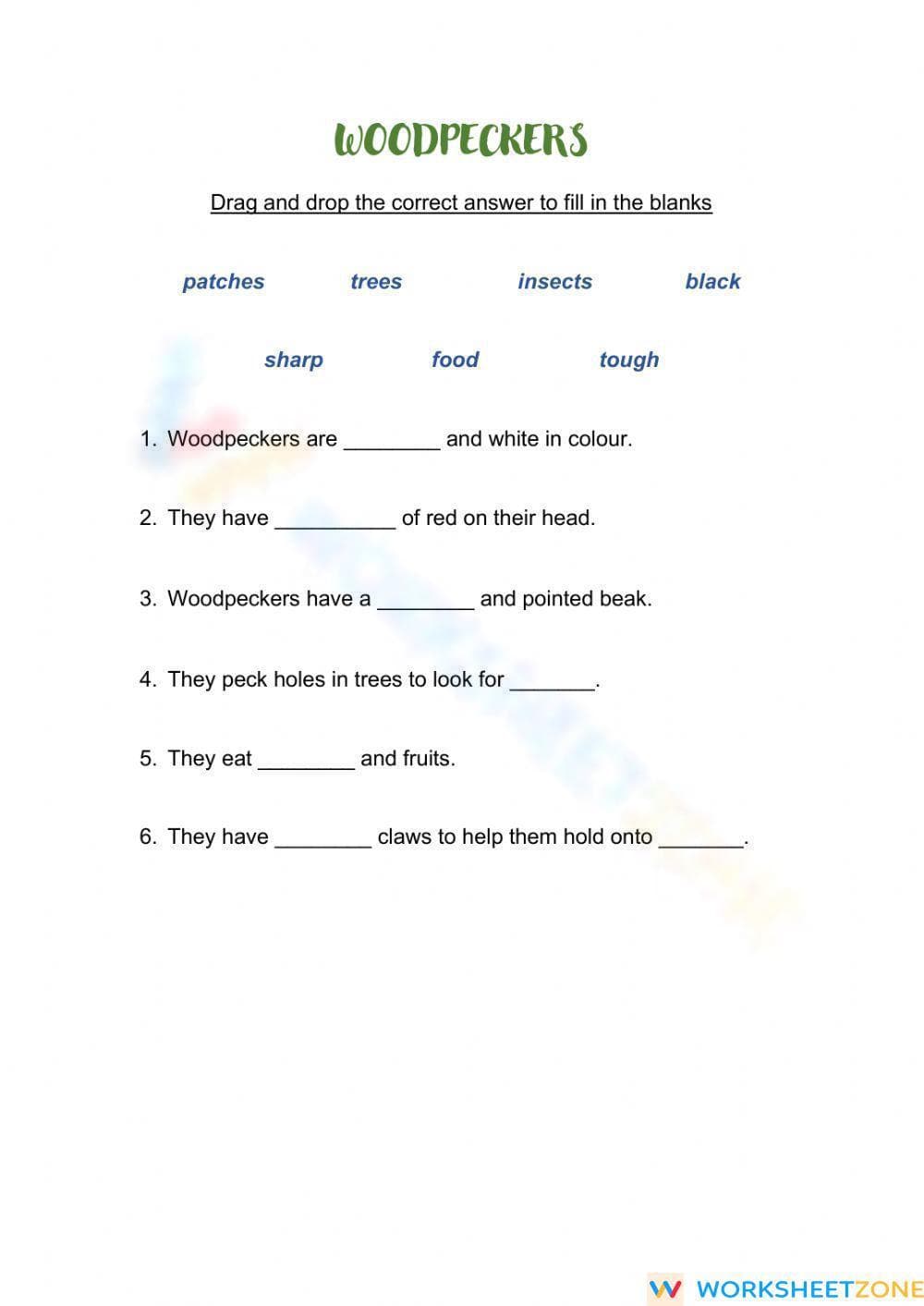

Grade 4 Woodpecker Worksheet — Printable No-Prep Worksheet
Paste this activity's link or code into your existing LMS (Google Classroom, Canvas, Teams, Schoology, Moodle, etc.).
Students can open and work on the activity right away, with no student login required.
You'll still be able to track student progress and results from your teacher account.
This Grade 4 Woodpecker informational text worksheet helps students master key reading comprehension skills through an engaging fill-in-the-blank format. By identifying physical traits, dietary habits, and habitat details of these birds, students develop a stronger grasp of how to extract specific information from a text. It is an essential tool for building foundational literacy.
At a Glance
- Grade: 4 · Subject: English Language Arts (ELA)
- Standard:
CCSS.ELA-LITERACY.RI.4.1— Refer to details in a text when explaining what the text says explicitly- Skill Focus: Informational Text Fact Retrieval · Reading Comprehension
- Format: 1 high-quality page · 6 problems · Answer key included · PDF
- Best For: Literacy centers, independent practice, and quick reading checks
- Time: 10–15 minutes of focused student work
The worksheet features a structured informational passage summarized into six critical sentences. Students are provided with a word bank containing seven vocabulary terms: patches, trees, insects, black, sharp, food, and tough. This single-page resource includes a clear title, intuitive instructions for completion, and a comprehensive answer key to facilitate immediate student feedback or easy grading.
The zero-prep design allows teachers to implement this activity in under two minutes. First, print the single-page PDF or assign the interactive version (30 seconds). Next, distribute the material to students as they arrive for a morning warm-up or transition period (30 seconds). Finally, review the completed sentences using the provided answer key for instant formative data (1 minute).
The primary focus is CCSS.ELA-LITERACY.RI.4.1: "Refer to details and examples in a text when explaining what the text says explicitly and when drawing inferences from the text." This resource also supports vocabulary acquisition. Both standard codes can be copied directly into lesson plans, IEP goals, or district curriculum mapping tools.
Use this worksheet as a post-instruction check after a lesson on informational text structures. It serves as an excellent formative assessment to observe if students can differentiate between physical descriptions and behavioral traits. For a secondary use case, include it in a "Birds and Habitats" science center to reinforce cross-curricular literacy. Expected completion time is 15 minutes.
This resource is designed for Grade 4 students but is highly effective for Grade 3 enrichment or Grade 5 review. It provides excellent support for English Language Learners (ELLs) through the included word bank and sentence frames. Pair this worksheet with a short non-fiction passage about forest ecosystems to provide students with additional context.
According to the ScienceDirect TpT Analysis, structured informational worksheets that utilize word banks significantly improve recall and retention in elementary students by reducing cognitive load during the retrieval process. This specific Woodpecker worksheet aligns with CCSS.ELA-LITERACY.RI.4.1, targeting the core skill of referring to explicit details within a text to demonstrate understanding. By focusing on observable facts such as habitat and diet, the resource mirrors the complexity levels recommended for intermediate readers. Research suggests that providing a targeted number of problems—in this case, six distinct tasks—allows for a meaningful check of comprehension without overwhelming the learner’s focus. Educators can rely on this tool to bridge the gap between initial reading and higher-order synthesis. The integration of specific scientific vocabulary like "habitats" and "physical traits" ensures that students are not only reading for meaning but also building a robust academic lexicon suitable for state testing environments.


