


























Views
Downloads

Printable Wires as Conductors Circuit Worksheet | Grade 5
Paste this activity's link or code into your existing LMS (Google Classroom, Canvas, Teams, Schoology, Moodle, etc.).
Students can open and work on the activity right away, with no student login required.
You'll still be able to track student progress and results from your teacher account.
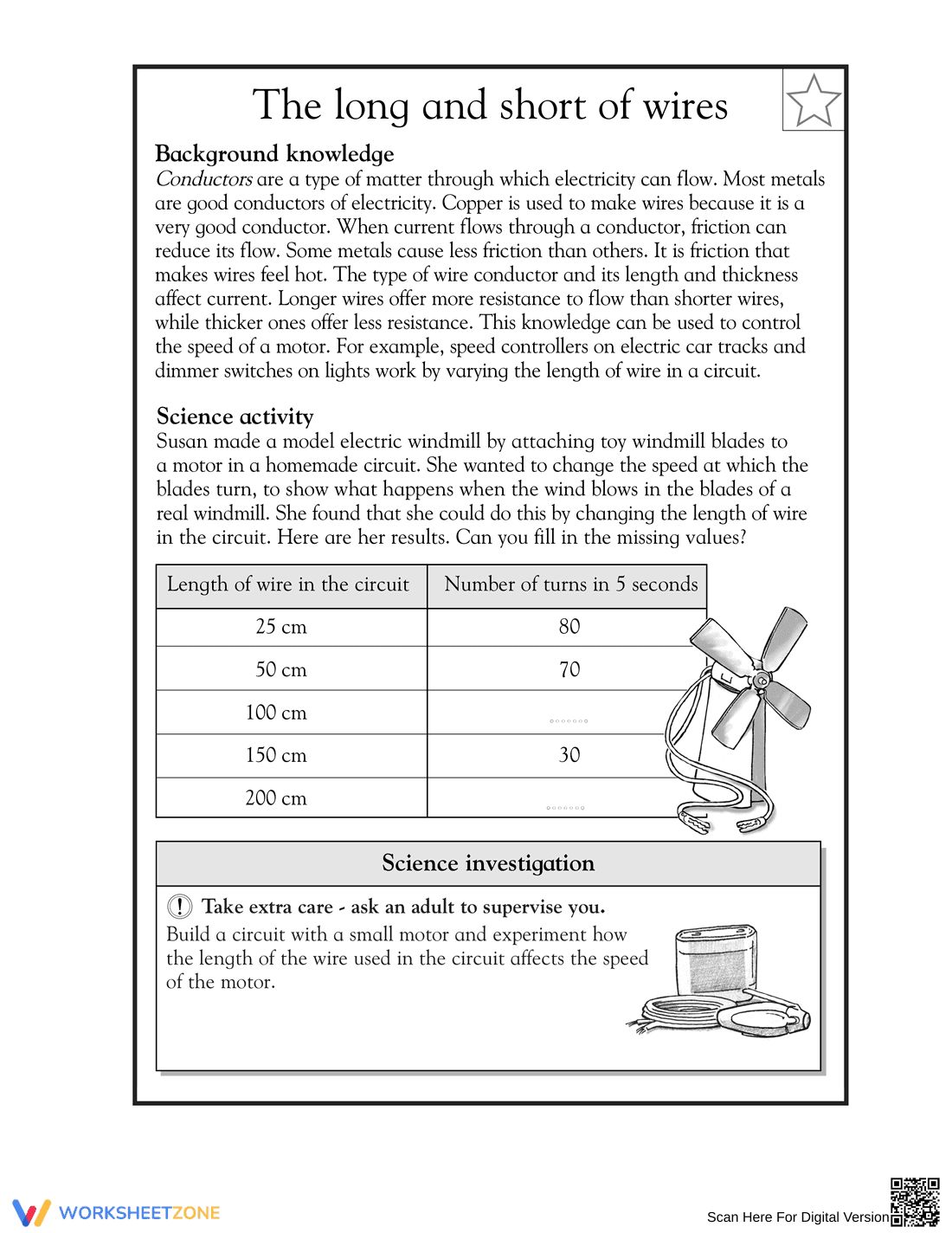
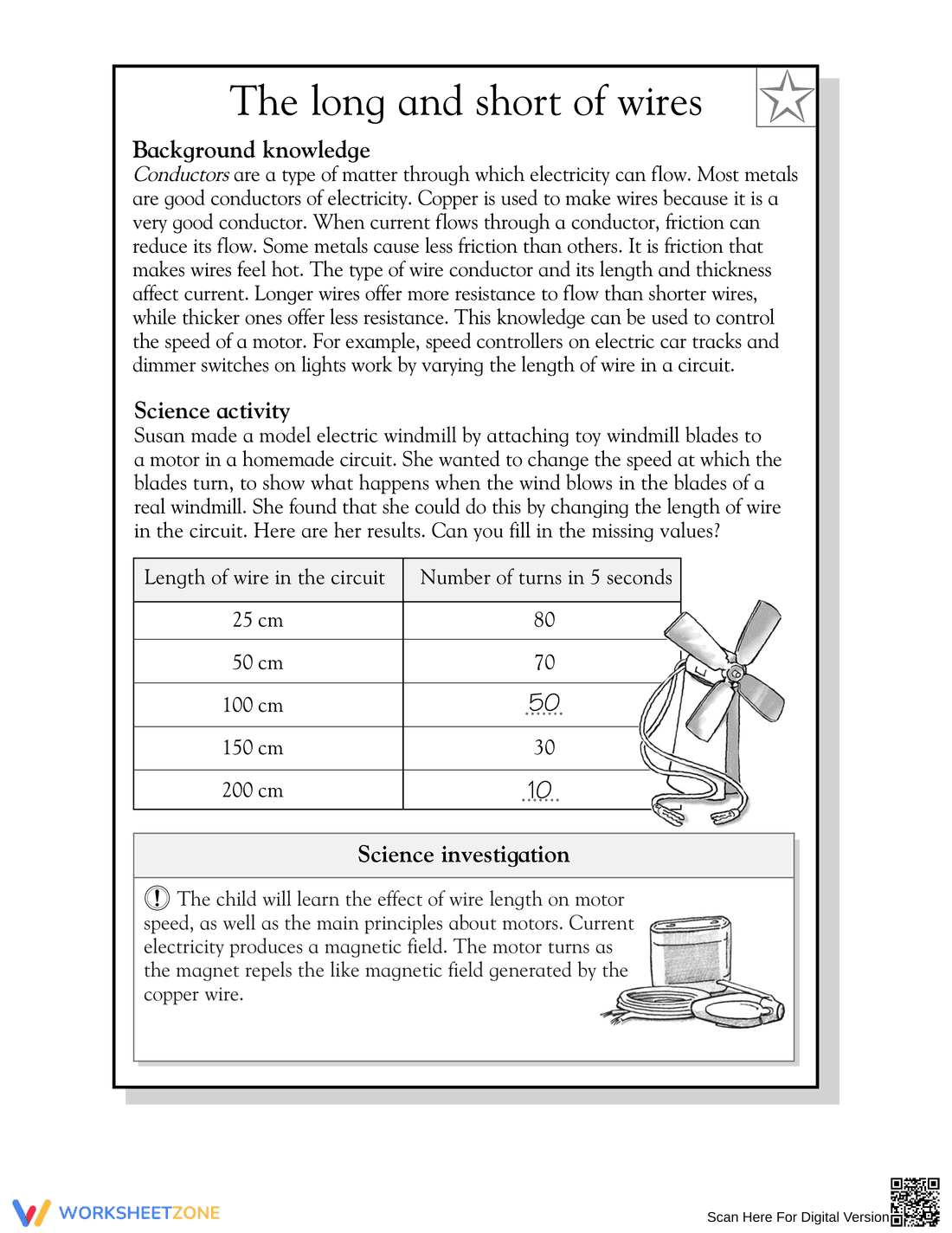
Explore how wire properties influence electrical flow with this Essential science worksheet. Students analyze a model windmill experiment to understand how wire length impacts motor speed. This activity bridges abstract electrical concepts with concrete results, helping Grade 5 learners master the fundamental principles of conductivity and resistance in closed circuits.
At a Glance
- Grade: 5 · Subject: Science
- Standard:
5-PS1-3— Make observations and measurements to identify materials based on their properties- Skill Focus: Electrical conductivity and resistance
- Format: 1 page · 4 problems · Answer key included · PDF
- Best For: Independent practice or small group science labs
- Time: 20–30 minutes
This resource features a background section defining conductors and explaining resistance. The core activity presents a data table from a windmill experiment, requiring students to fill in missing values for motor rotations based on wire length. A secondary investigation provides safety warnings and instructions for students to build their own circuits to verify findings.
Zero-Prep Workflow
Implement this lesson with minimal effort. First, print the single-page PDF (30 seconds). Second, distribute sheets for students to read the background text (5 minutes). Third, review the table results to confirm the relationship between wire length and current (10 minutes). Total teacher prep time is under 2 minutes, making this ideal for sub plans or lab enrichment.
Standards Alignment
The worksheet aligns with 5-PS1-3, which tasks students with identifying materials based on properties like electrical conductivity. By examining how wire length affects resistance, students gain a practical understanding of matter. This standard code can be copied directly into lesson plans, IEP goals, or district curriculum mapping tools for rigorous alignment.
How to Use It
Use this during the "Explain" phase of a 5E cycle. Assign the data-filling task as a formative assessment to check if students identify patterns of decreasing speed. Observe if they notice the copper conductor reference in the text to spark discussions on material properties. Expect a 25-minute completion time for the written portion.
Who It's For
This is designed for Grade 5 students but supports Grade 4 learners exploring energy transfer. The background text provides scaffolding for students with reading goals, while the hands-on extension offers a challenge for advanced learners. It pairs naturally with circuit kits containing batteries, motors, and varying lengths of copper wire.
Research from EdReports 2024 emphasizes that science instruction must integrate core ideas with cross-cutting concepts like cause and effect. This Grade 5 worksheet addresses the 5-PS1-3 standard by requiring students to analyze how the physical property of length in an electrical conductor influences system performance. By using a model windmill rotation as a metric for current flow, the activity allows students to practice the plain-English skill of identifying material properties through observation. Such structured data analysis reflects best practices in STEM education as highlighted by NAEP, which identifies interpreting scientific evidence as a critical competency for upper elementary students. This self-contained module ensures that learners not only memorize definitions of conductors but also understand the functional implications of resistance in real-world technology like speed controllers.


