


























Views
Downloads

Printable Grade 1 Science: Wind and Moving Air Worksheet
Paste this activity's link or code into your existing LMS (Google Classroom, Canvas, Teams, Schoology, Moodle, etc.).
Students can open and work on the activity right away, with no student login required.
You'll still be able to track student progress and results from your teacher account.
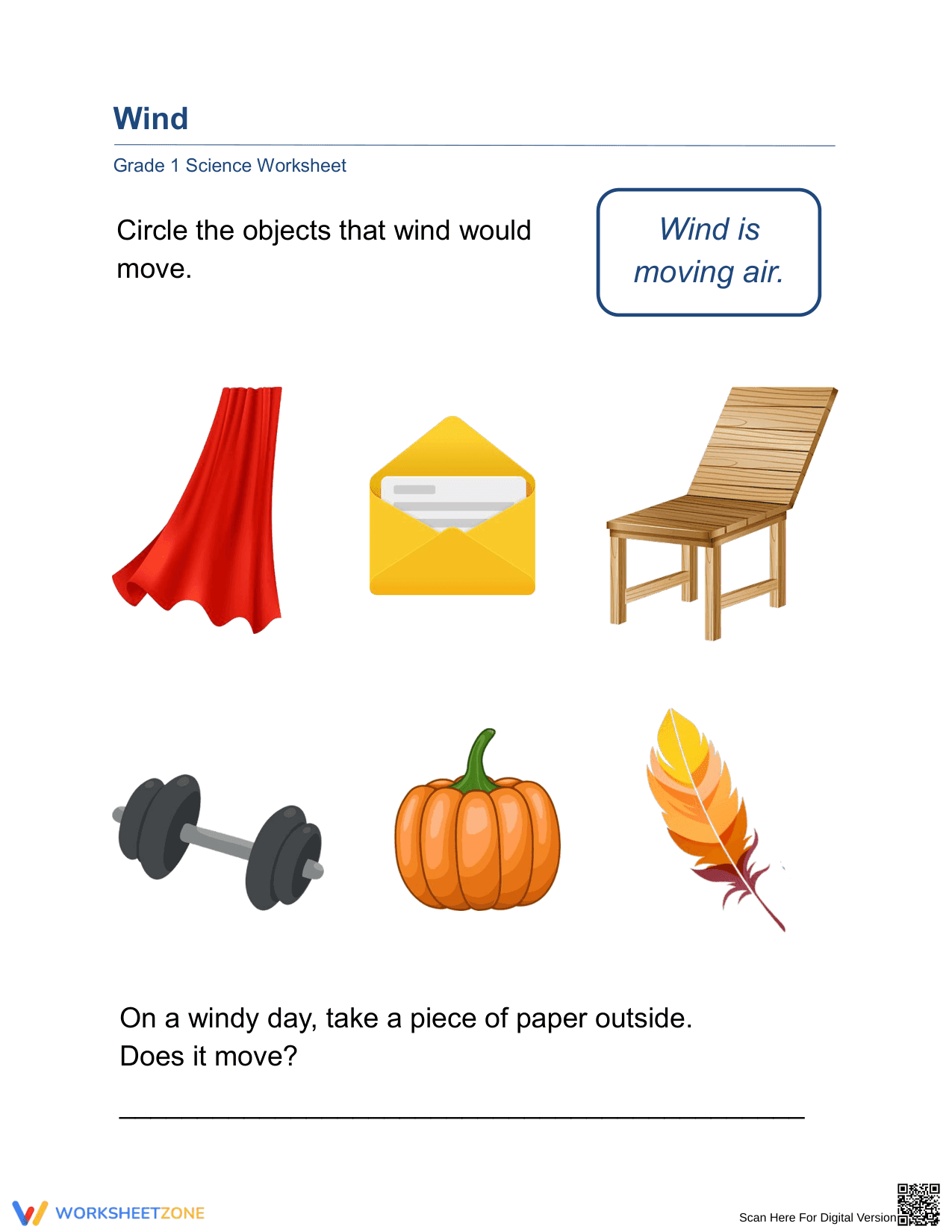
This Grade 1 science worksheet helps students understand that wind is moving air by identifying which everyday objects the wind can move. Students develop observation skills as they distinguish between light objects and heavy items that resist air current. This activity provides an immediate outcome for young learners to grasp invisible forces through visual examples.
At a Glance
- Grade: 1 · Subject: Science
- Standard:
1-ESS2-1— Use observations of weather conditions to describe patterns and physical effects- Skill Focus: Effects of wind on objects
- Format: 1 page · 7 problems · Answer key included · PDF
- Best For: Introduction to weather and forces
- Time: 10–15 minutes
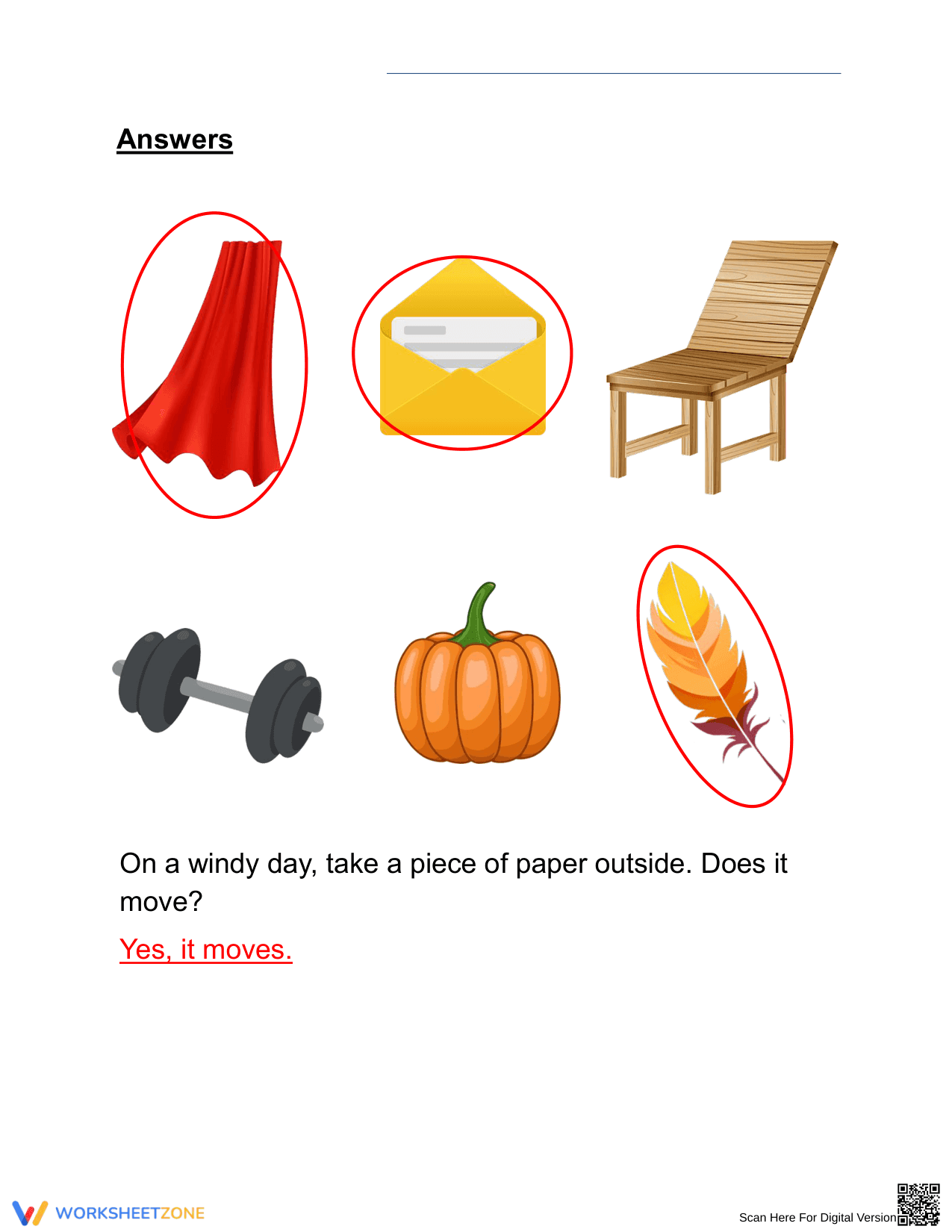
This resource contains a single-page student worksheet and a visual answer key. The main task features six illustrations of objects like feathers and dumbbells, challenging students to circle items susceptible to wind movement. It also includes an interactive observation prompt that encourages students to test wind force with a piece of paper, reinforcing classroom concepts through experience.
Zero-Prep Workflow
This worksheet is designed for a seamless three-step classroom workflow. First, print the single-page document in under 30 seconds. Second, distribute the activity during a science block or as a warm-up, requiring zero additional materials besides a pencil. Third, review the answers in less than 2 minutes using the visual answer key, making it ideal for sub plans.
Standards Alignment
Primary alignment is to `1-ESS2-1`, focusing on using observations of weather conditions to describe physical impacts. Students demonstrate understanding by predicting how moving air interacts with different masses. This standard code can be copied directly into lesson plans, IEP goals, or district curriculum mapping tools to ensure instructional compliance.
How to Use It
Use this worksheet during the "Explore" phase of a weather unit. It serves as an excellent check for understanding before moving on to wind direction. For a formative tip, observe whether students can explain why the wind moves a feather but not a pumpkin. Total completion time is 10 to 15 minutes.
Who It's For
This activity is suited for first-grade students in Earth Science. The visual nature makes it accessible for English Language Learners and students with IEPs. It pairs naturally with a read-aloud about weather patterns or a direct instruction lesson using a fan to demonstrate air movement.
The instructional design of this resource aligns with the findings in Fisher & Frey (2014) regarding the importance of scaffolding scientific observations through visual classification tasks. By requiring students to categorize objects based on their physical properties and response to external forces, the worksheet supports the development of foundational reasoning skills identified as critical for Grade 1 learners. According to ScienceDirect TpT Analysis, structured worksheets that combine identification with a hands-on extension task significantly improve retention of abstract concepts like air movement. This resource adheres to the 1-ESS2-1 framework by encouraging students to use evidence from their surroundings to explain the physical effects of weather. This approach ensures that young scientists are moving beyond simple identification toward the predictive modeling required by NGSS standards.


